
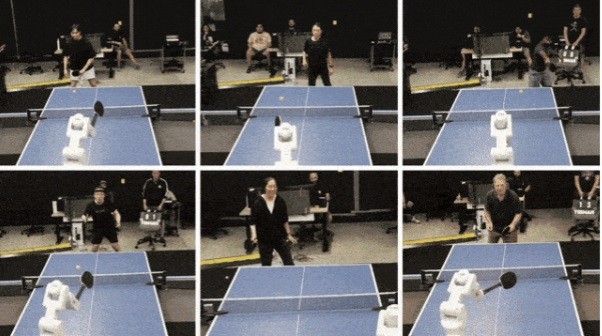
A new study suggests that Google's DeepMind software can control a robotic arm to beat a human in table tennis, but only against average table tennis players in some cases; its effectiveness against top world players is not guaranteed.
Robots can beat humans in table tennis matches.
TPO - Google's DeepMind technology has been used to train a robotic arm to play table tennis, and it has been able to beat humans.
 Báo Tiền Phong•12/08/2024
Currently, there are robots that can cook, clean, and perform acrobatics, but they still struggle with rapid response capabilities in the real world. "Achieving human-level performance in terms of accuracy, speed, and generality remains a major challenge in many fields," the researchers wrote in their study.
To overcome this limitation, researchers combined an industrial robotic arm with a customized version of DeepMind's powerful algorithm. DeepMind uses neural networks, a multi-layered architecture that mimics how information is processed in the human brain. So far, the robot has been able to beat the world's best Go player and solve problems that have stood for decades and beyond.
As the AI learns how to serve with its forehand or use left-handed targeting in complex algorithms, researchers also gather data on its strengths, weaknesses, and limitations. They then feed this information back into the AI program, providing DeepMind with a realistic assessment of the robot's capabilities. The system then selects which skills or strategies to use, much like a human table tennis player might.
They then had the AI-controlled robot compete against 29 people. DeepMind's robot defeated all the beginners and about 55% of the intermediate players, but was beaten by the advanced players. In the international ranking system, the robot is still considered an amateur player.
Across all skill sets and win rates, players agreed that playing against robots was fun and engaging, the researchers wrote in the study.
Researchers say this new method could be useful for a variety of applications requiring rapid response in dynamic physical environments.
Ha Thu
According to Live Science

![[Photo] General Secretary and President To Lam presides over a meeting on preparations for the review of one year of operation of the three-tiered government system.](https://vphoto.vietnam.vn/thumb/1200x675/vietnam/resource/IMAGE/2026/06/02/1780391821195_a1-bnd-4595-9717-jpg.webp)











![[Video] What to do when changing phones from June 15, 2026?](https://vphoto.vietnam.vn/thumb/402x226/vietnam/resource/IMAGE/2026/06/02/1780386426938_dt-jpg.webp)














































































Comment (0)