

According to Minister Nghi, the draft Housing Law (amended) only regulates housing development policies in general and the development of specific types of housing such as commercial housing, social housing, public housing, and resettlement housing. Content related to construction activities refers to the law on construction. Therefore, in practice, the application of the Housing Law and the Construction Law is not mixed.
"The drafting agency will incorporate the opinions of National Assembly deputies to further review and refine the draft, ensuring that the scope of the draft law is clear and does not overlap with other relevant laws," Mr. Nghi said.
Regarding the scope of regulation, the Minister stated that although the draft Law on Housing (amended) and the Law on Real Estate Business (amended) also address mixed-use buildings, the Law on Housing (amended) only regulates issues related to the management and use of mixed-use buildings that include residential areas.
Regarding housing ownership policy, the head of the Ministry of Construction said: “The conclusion notice of the National Assembly Standing Committee identified this as a highly sensitive issue with a significant impact on society, and there are still differing opinions. Therefore, the drafting agency has submitted a proposal to the Government to incorporate the opinion of the National Assembly Standing Committee and not include provisions on limited-term ownership of apartment buildings in the draft Housing Law (amended) submitted to the National Assembly for consideration.”
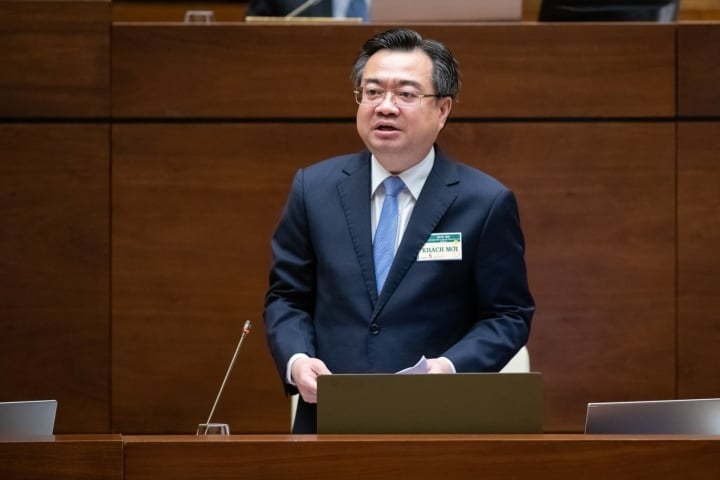
Minister Nguyen Thanh Nghi. (Photo: Quochoi.vn)
However, the draft law has been amended to clarify further details regarding the lifespan of apartment buildings, cases of apartment building demolition, the rights and obligations of owners in relocating, demolishing, and contributing funds for rebuilding apartment buildings; and to clarify the responsibilities of relevant parties when renovating and rebuilding apartment buildings, providing a basis for handling, resolving, and addressing current difficulties and obstacles.
Minister Nguyen Thanh Nghi also explained the suggestion to review regulations on the conditions, number, and types of housing that foreigners can own, to avoid affecting the housing needs of domestic citizens and to ensure national security and defense. Accordingly, the drafting agency will coordinate with the reviewing agency to conduct thorough research, clearly stating that it is consistent with the Party's policy and in line with relevant legal regulations.
Regarding housing development programs and plans, Minister Nguyen Thanh Nghi clarified that the regulations on housing development programs and plans in the draft amended Housing Law are not new but are inherited from the 2005 Housing Law and the 2014 Housing Law, and are now being included in the draft law in a restructured chapter.
This is necessary and appropriate to the practical situation in order to help overcome the imbalance between housing supply and demand. This regulation does not overlap or duplicate other plans. This is because the contents stipulated in the development plan, such as the land area for commercial housing development, social housing, housing for resettlement, public housing, etc., are not detailed in the planning system as prescribed by the Land Law and the Planning Law.
However, the drafting agency will continue to review this regulation to ensure it is clearer, avoids overlaps and duplications, ensures convenience, transparency, decentralization, and empowers localities; while also ensuring state management in accordance with the Government's directives.
Minister of Construction Nguyen Thanh Nghi also addressed the issue raised by the delegates regarding regulations on land use for commercial housing development. The lead agency plans to report to the Government to incorporate the delegates' opinions and continue researching and refining these regulations to ensure consistency with the amended Land Law.
Regarding the renovation and reconstruction of apartment buildings, the drafting agency will continue to review and clarify relevant contents, including the opinions of National Assembly deputies, to ensure feasibility and expedite the implementation of apartment building renovation and reconstruction projects.
Regarding social housing development policies, allowing provincial People's Committees to decide the percentage of revenue from land use fees and land lease fees of commercial housing projects and urban areas within their jurisdiction is consistent with reality and relevant laws. However, the drafting agency plans to report to the Government for consideration and will incorporate this into the draft law during the finalization process, stipulating only a certain percentage from the local budget; not specifying a percentage of revenue from land use fees and land lease fees of commercial housing and urban area construction projects.
PHAM DUY
Beneficial
Emotion
Creative
Unique
Source

![[Image] Hanoi Police officially crowned champions of V-League 2025/2026](https://vphoto.vietnam.vn/thumb/1200x675/vietnam/resource/IMAGE/2026/05/31/1780244769054_ndo_br_039d561b692be875b13a-jpg.webp)

![[Photo] Admire the coral "masterpiece" amidst the million-year-old heritage of Dak Lak province.](https://vphoto.vietnam.vn/thumb/1200x675/vietnam/resource/IMAGE/2026/05/31/1780221235105_anh-man-hinh-2026-05-31-luc-16-53-27.png)
![[Photo] The General Secretary, President and his wife begin their state visit to the Philippines.](https://vphoto.vietnam.vn/thumb/1200x675/vietnam/resource/IMAGE/2026/05/31/1780230559452_anh-man-hinh-2026-05-31-luc-19-28-11.png)
![[Photo] Solemn bathing ceremony and Buddha procession in Hue](https://vphoto.vietnam.vn/thumb/1200x675/vietnam/resource/IMAGE/2026/05/31/1780228263543_1-jpg.webp)

















![[Video] Sunset at Lap An Lagoon – Where the sun sets over the fishing nets](https://vphoto.vietnam.vn/thumb/340x192/vietnam/resource/IMAGE/2026/05/31/1780192137701_beach-landscape-sea-water-nature-grass-745871-pxhere-com.jpeg)








































![[Photo] Admire the coral "masterpiece" amidst the million-year-old heritage of Dak Lak province.](https://vphoto.vietnam.vn/thumb/402x226/vietnam/resource/IMAGE/2026/05/31/1780221235105_anh-man-hinh-2026-05-31-luc-16-53-27.png)






























Comment (0)