

Mr. Danh Hoai Riem, Head of Hamlet 6, was very happy to recognize us. He excitedly said: "Hamlet 6 today not only has modern infrastructure but also a much better life for the people, especially the Khmer ethnic minority..."
The man we painstakingly searched for 15 years ago, Mr. Ut Thuan, was Do Minh Thuan, born in 1961. Mr. Ut Thuan was the youngest son of Mr. Do Van Bien (Ba Bien), who donated most of his garden land to build several offices of the U Minh Base Area, including the living and working quarters of Comrade Vo Van Kiet (later Prime Minister ) during the period of 1971-1974 in the U Minh base area. Mr. Ba Bien's family had sheltered cadres over many periods, so when asked to temporarily borrow the embankment area to use as a base, he readily agreed. "Back then, there were a lot of mosquitoes, so the house where Uncle Kiet lived (Mr. Thuan only learned this later) was built on a banana grove, surrounded by mesh netting, and next to it was a fairly sturdy bomb and artillery shelter," Mr. Ut Thuan recalled.
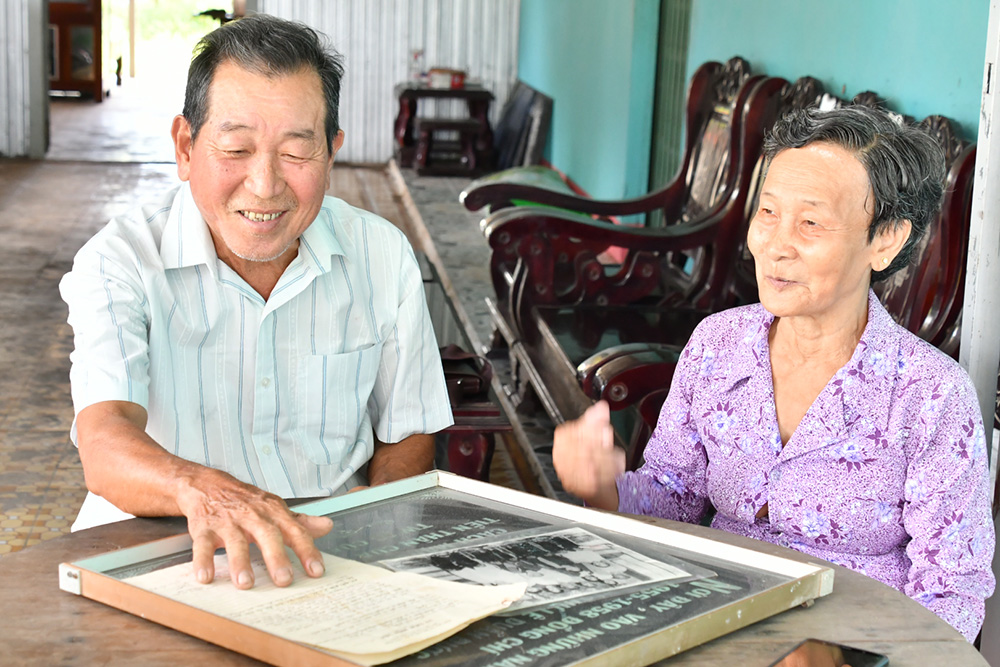 |
| Mr. and Mrs. Pham Van Nghiep review photos and mementos of the late General Secretary Le Duan. |
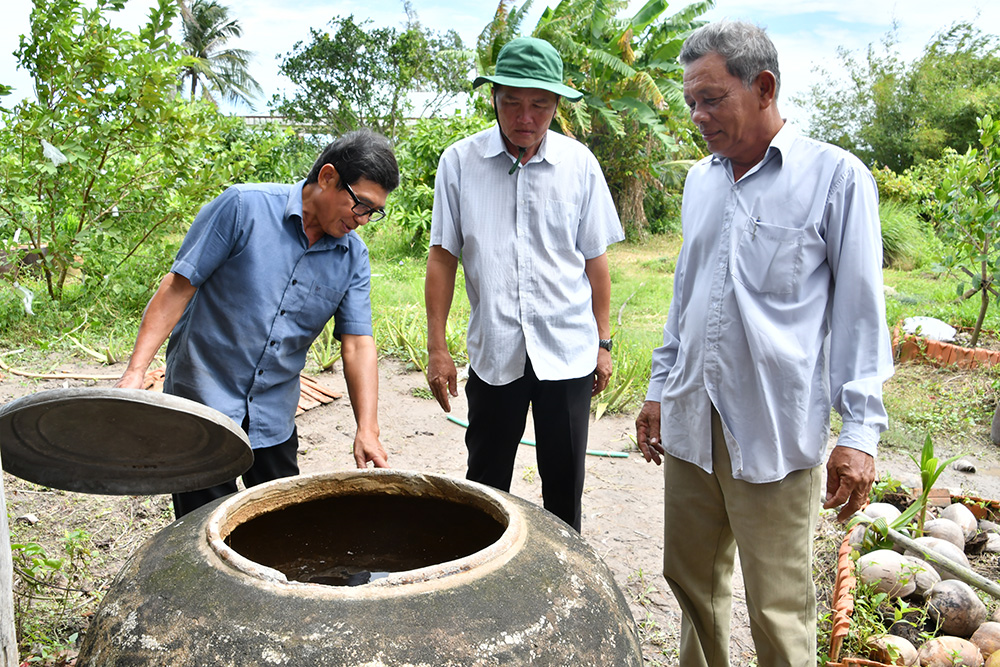 |
| Mr. Do Minh Thuan (far left) with his keepsake, a cement jar. |
Fifty years after the reunification of the country, the landscape of Khanh Hoa commune in particular, and U Minh district in general, has changed considerably, but the affection and unwavering loyalty of the people here to the Party and the revolution remain as strong as ever. Continuing the family tradition, Mr. Ut Thuan donated 2 acres of land to build the historical site where Comrade Vo Van Kiet lived and worked today. Another story is that Mr. Thuan previously kept a memento closely associated with his life: a cement container used as a bomb shelter, personally given to him by Mr. Tran Quoc Anh (Chin Anh) – a bodyguard of Comrade Vo Van Kiet. In 2023, officials from the Military Region 9 Museum came to Mr. Ut Thuan's house to collect artifacts for display. One might have thought Mr. Ut Thuan would be reluctant to accept such a valuable memento, but upon understanding that the collection was for preservation for future generations, he readily agreed.
Leaving Mr. Ut Thuan's house, following the wide, clean road along the Cai Tau River, we found our way to the house of Mr. Pham Van Nghiep in Rach Chuoi hamlet, village 2, Nguyen Phich commune, U Minh district. Mr. Pham Van Nghiep is the youngest son of Mr. Pham Van Mau. The house Mr. Nghiep inherited from his father was one of the places where Comrade Le Duan (later General Secretary) was sheltered during his revolutionary activities in Ca Mau. Behind Mr. Nghiep's house, there is still a bamboo fence, and in the middle of the fence is a mound of earth that was once a hut and secret bunker where Mr. Mau hid Comrade Le Duan. Mr. Nghiep said: “Back then, I was young, and I only remember a period when my parents and older sister brought food to the officials staying in our garden. It wasn't until after liberation, when a delegation of officials from Hanoi came to survey the area, and General Secretary Le Duan visited Minh Hai province (now Ca Mau and Bac Lieu provinces), that he sent someone to bring my father to Ca Mau town to meet with the families who had sheltered him. Only then did I fully understand. Before he passed away, my father instructed me to preserve the bamboo fence where General Secretary Le Duan's secret bunker used to be at all costs. Fulfilling my father's wish, I have kept that garden intact to this day...”
Text and photos: PHONG PHU
* Please visit the section commemorating the 50th anniversary of the great victory of Spring 1975 to view related news and articles.
Source: https://www.qdnd.vn/phong-su-dieu-tra/ky-su/son-sat-u-minh-826026

















![[Infographics] Resolution No. 79-NQ/TW of the Politburo on the development of the state-owned economy](https://vphoto.vietnam.vn/thumb/402x226/vietnam/resource/IMAGE/2026/01/10/1768038914679_chp_3-11-23.jpeg)


















Comment (0)