

At 8:07 p.m. ET, SpaceX's Falcon Heavy rocket lifted off from NASA's Kennedy Space Center, carrying the US military's X-37B spacecraft to an unprecedented altitude. However, it remains unclear exactly where the spacecraft will go in space.
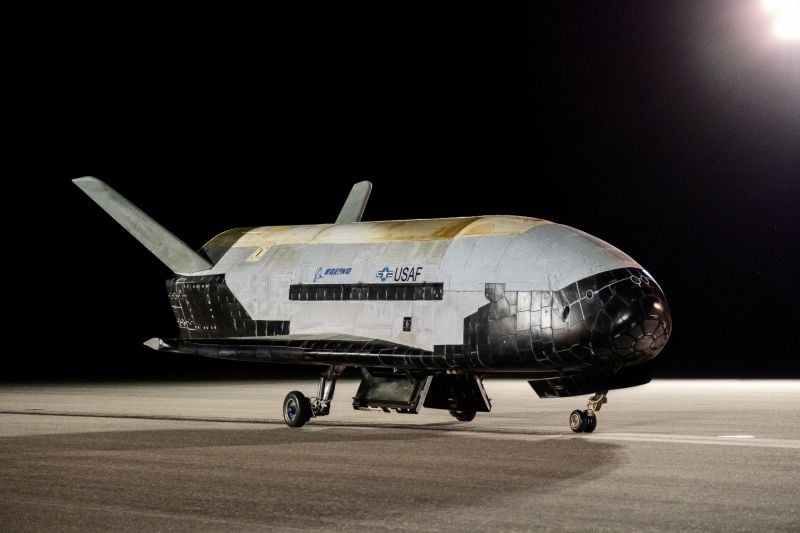
The X-37B orbital test vehicle completed its sixth successful mission in 2022. Photo: U.S. Space Force
For a long time, the activities of the X-37B in space have been a fascinating and widely discussed topic among the space research community, with amateur researchers eagerly tracking its movements and sharing hypotheses about its activities.
Like a miniature NASA space shuttle with its windows sealed, the X-37B is reusable and fully autonomous. The spacecraft is known for its purpose of researching concepts such as transmitting solar power from space to Earth, or the effects of radiation on food seeds grown outside of Earth.
This mission, also the seventh space flight for the X-37B spacecraft, promises to yield even more exciting results than previous flights.
Space flight is "further than ever before."
This marks the first time the X-37B has been launched using SpaceX's Falcon Heavy rocket, one of the world's most powerful rockets, capable of launching spacecraft into higher orbits than ever before.
Previously, the X-37B was launched on a SpaceX Falcon 9 rocket and an Atlas V rocket manufactured by United Launch Alliance – a joint venture between Lockheed Martin and Boeing. The combined thrust of these two rockets was even less than that of the Falcon Heavy rocket.
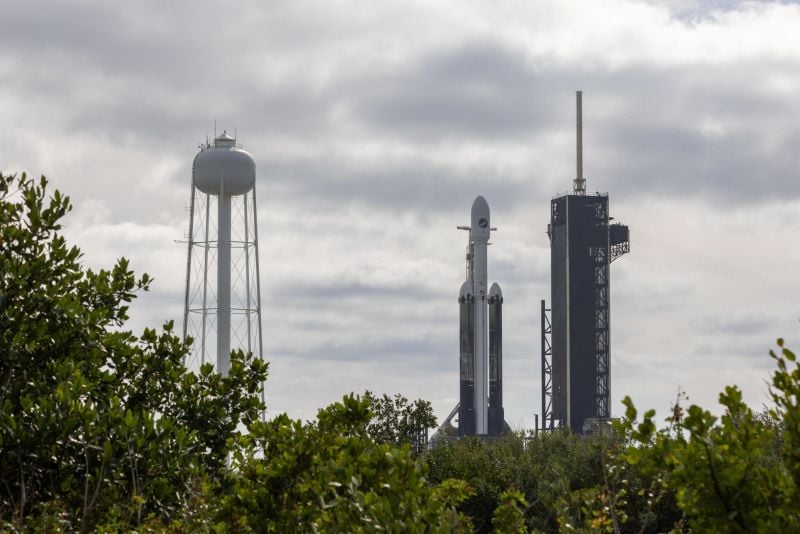
SpaceX's Falcon Heavy rocket stands on the launch pad ahead of the U.S. military's attempt to launch the X-37B spacecraft on December 11. The company later delayed the launch. Photo: Sipa
Paul Graziani, CEO of COMSPOC, a company specializing in tracking objects in space, believes that launching the X-37B with a Falcon Heavy rocket could take the spacecraft to more distant orbits, possibly even to the Moon or Mars. If the X-37B travels deeper into space than on previous flights, observers on Earth will find it difficult to pinpoint the vehicle's location.
According to Graziani, if the US military doesn't want the X-37B to be tracked, the vehicle could be hidden in the bright sunlight or in other ways, including frequently changing its location. In previous flights, the X-37B has demonstrated its ability to perform many maneuvers in space.
COMSPOC will attempt to locate the X-37B should it enter geosynchronous orbit, approximately 36,000 km from Earth where most major communications satellites are inactive. Graziani and Bob Hall, the company's Director of Operational Integration, said this is where the company focuses its sensors for tracking satellites.
Space technology innovation
General Chance Saltzman, commander of the U.S. Space Force, stated that the X-37B will help the U.S. conduct research experiments on current and upcoming space activities, as well as "cross-border" experiments.
These experiments include Seeds-2, a NASA experiment designed to help astronauts survive on larger space missions in the future. This experiment will "expose plant seeds to the harsh radiation environment of long-duration spaceflights" and builds on research conducted during previous X-37B missions.
Growing food in the harsh, soilless environment of space is crucial for astronauts undertaking long-duration missions to the Moon or beyond, for example, in places where it is difficult to obtain new food sources.
Regarding this mission, it is unclear how long the X-37B spacecraft will remain in orbit. Previously, each X-37B flight has been longer than the previous ones.
The final space flight of the X-37B rover concluded in November 2022 after nearly 909 consecutive days in space. On that sixth mission, the spacecraft carried experimental technology designed by the U.S. Navy to convert solar energy and transmit it back to Earth.
The X-37B has spent over 3,700 days in space on various unmanned missions. Upon returning to Earth, the spacecraft will land on a runway, much like an aircraft descending from the sky.
Ngoc Anh (according to NASA, CNN, Reuters)
Source



































































































Comment (0)