

With its ability to closely follow and reflect life in a timely manner, the song genre has created an inevitable rule for itself: continuous innovation. Therefore, innovation in song music erupted immediately after the liberation of Saigon and the reunification of the country. Unfortunately, we lacked sensitivity at that time, allowing this innovation to continue for too long. Besides the gains we will discuss below, we lost things that were very undeserved. The prestige of the resistance song genre was tarnished, and classical music genres, even national organizations like the Vietnam National Opera and Ballet Theatre and the Vietnam Symphony Orchestra, were shaken to their core. Fortunately, all of that is in the past. Today, in harmony with economic development and political and social stability, our music is clearly flourishing in all genres, especially song music, although some shortcomings remain.
In the period after 1975, more than 50 years ago, there was a young musician at the time—Tran Tien—who was one of the pioneers in writing about the country, the Party, and President Ho Chi Minh with a new language—the language of light music: the song "Melody of the Fatherland," with a slow rock rhythm; and the song "If You Want to Find Lenin- Ho Chi Minh ," with a soul rhythm. Both songs were enthusiastically received by young audiences. It can be said that this was a major turning point, following the resounding successes of the "Singing for My Compatriots" campaigns with works by Trinh Cong Son, Ton That Lap, Truong Quoc Khanh, Tran Long An, etc., written before 1975. From then on, light music was present in both North and South Vietnam and became the common voice of the majority of the public nationwide.
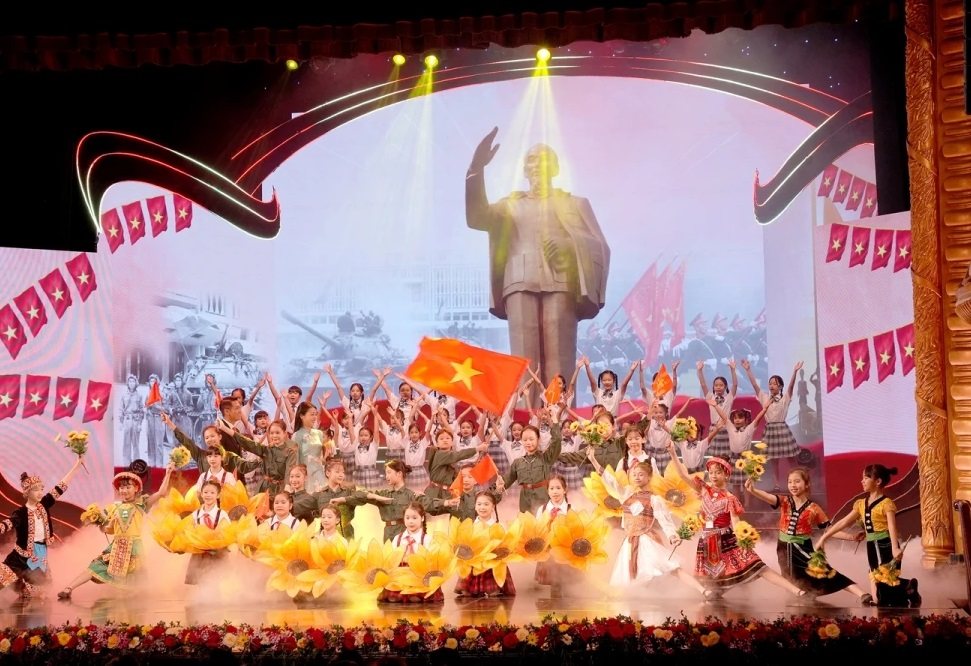
Continuing this theme are works such as "As if Uncle Ho were present on the day of the great victory" (Pham Tuyen), "The country, a lullaby" (Van Thanh Nho), "Spring melody" (Cao Viet Bach - Luu Trong Lu), "Homeland" (Giap Van Thach - Do Trung Quan); "This afternoon the sea sings" (Hong Dang), "The country on the shore of the waves" (Thai Van Hoa); "The country" (Pham Minh Tuan - Ta Huu Yen)... Many authors have successfully written about Uncle Ho, but perhaps the most successful is Thuan Yen, who managed to transform his writing style from the author of "The Southern mother who defeated the enemy with bare hands," "Every step we take" to the author of "Uncle Ho, a boundless belief," "He returns to visit his homeland," "Central Vietnam remembers Uncle Ho," and "The moon over Ba Dinh" (poem by Pham Ngoc Canh).
 |
| Illustration photo: vov.vn |
Writing about different regions is also a part of traditional themes. In this area, we have works like "Spring in Ho Chi Minh City" (Xuan Hong), "The Stance of Ben Tre" (Nguyen Van Ty), "Nha Trang in Autumn" (Van Ky), "Love for the Red Soil of the Eastern Region" (Tran Long An), "My Hometown Quan Ho Village" (Nguyen Trong Tao - poem by Nguyen Phan Hach), "Love Song of the Central Highlands" (Hoang Van), "Sa Pa, City in the Mist" (Vinh Cat), " Hue , My Love" (Truong Tuyet Mai - poem by Thanh Binh), "Oh Madrack" (Nguyen Cuong)...
There is one sacred place that almost every musician wants to write about to express their feelings: Hanoi—the heart of the nation. Not only in Vietnam, but perhaps even in the world, there are few cities with so many songs about them! To stand out alongside long-standing classics like "The People of Hanoi" (Nguyen Dinh Thi) and "Marching Towards Hanoi" (Van Cao), composers have had to find new words and unique ways of expression. This has created an extraordinary richness and diversity, even though they all focus on the same subject: the capital city of Hanoi! Nguyen Duc Toan has "Hanoi - The Pink Heart," Nguyen Thanh has "October Emotions" (poem by Ta Huu Yen), Trinh Cong Son has "Remembering Hanoi's Autumn," Phu Quang has "Oh, My Dear, Hanoi Streets" (poem by Phan Vu), Tran Hoan has "The Song of the People of Hanoi," Hoang Hiep has "Remembering Hanoi," Truong Quy Hai has "Hanoi in the Season Without Rain" (poem by Bui Thanh Tuan), Trong Dai has "Hanoi on a Windy Night" (lyrics by Chu Lai and Trong Dai), Nguyen Cuong has "Forever My Childhood in Hanoi," Vu Thanh has "Hanoi in Autumn," Le Viet Hoa has "Spring on the To River"... It's impossible not to mention a poem written in 1972 that already embodies innovative elements in its expression: "Hanoi - Faith and Hope" by Phan Nhan.
Life in peacetime has broadened the scope of reflection when writing about one's homeland. It may simply involve praising the beauty of a place or recounting folk legends. This style of writing is exemplified by the sensitive pen of Pho Duc Phuong in a series of articles: "Lake on the Mountain," "Legend of Lake Nui Coc," "A Glimpse of West Lake," and "On the Peak of Phu Van."
We cannot forget the early days of peace and national reunification. Nor can we forget the ten years of border war that followed. Songs once again marched forward with a determined will to win and with new expressions: “Farewell at the Departure Point” (Vu Trong Hoi); “Border Song” (Xuan Giao); “The Length of the Border” (Tran Chung); “Roses on the Support Point” (Ho Bac), “Singing About Him” (The Hien), “Border Sim Flowers” (Minh Quang), “Love Song of Youth” (Ton That Lap)…
Our songs remain deeply loyal to soldiers, even during silences: "Singing the Marching Song Forever" (Diep Minh Tuyen); "Bridge Connecting Happy Shores" (Van An - poem by Phan Van Tu), "In the Distant Island" (The Song), "A Little Love Poem from a Marine" (Hoang Hiep - poem by Tran Dang Khoa), "When Tanks Pass Through the Quan Ho Region" (An Thuyen - poem by Nguyen Ngoc Phu), "Spring by the Window" (Xuan Hong - poem by Song Hao). Especially when mentioning wounded soldiers and martyrs, and the image of mothers, emotions surge intensely: "Round Footprints on the Sand" (Tran Tien), "The Unforgettable Song" (Pham Minh Tuan), "The Color of Red Flowers" (Thuan Yen - poem by Nguyen Duc Mau), "Young Grass of the Ancient Citadel" (Tan Huyen), "Legend of the Mother" (Trinh Cong Son), "Heroic Vietnamese Mother" (An Thuyen)...
It has been suggested that a chronicle of the two resistance wars could be written using songs about battles and victories. Unfortunately, this has become a weakness in peacetime. We have few songs praising the successes in reconstruction since the country's reunification. Examples include "Trị An's Springtime Resounds" (Tôn Thất Lập), "Warm Sunshine of the Homeland" (Vĩnh An), "Hanoi's Constructions" (Quốc Trường), "Springtime on the Oil Wells" (Phạm Minh Tuấn)...
Despite these shortcomings, light music songs have compensated for a rare theme concerning family life. Typical examples include the artist couple Ngoc Le and Phuong Thao with songs like "Oh, Bicycle!" and "Three Candles," which evoke sacred yet warm imagery. But the most significant and substantial contribution comes from famous love songs such as: "Boat and Sea" (Phan Huynh Dieu - lyrics by Xuan Quynh), "Give Me One Day" (Duong Thu), "Secret Fragrance" (Vu Hoang - lyrics by Phan Thi Thanh Nhan), "Season of Swallows Flying" (Hoang Hiep - lyrics by Diep Minh Tuyen), "Waiting" (Huy Thuc - lyrics by Vu Quan Phuong), "Folk Song of You and Me" (An Thuyen), "Farewell at Sunset" (Thuan Yen - lyrics by Hoai Vu), "Whispering Spring" (Ngoc Chau), "The Time of Red Flowers" (Nguyen Dinh Bang - lyrics by Thanh Tung)... Three authors stand out with three distinct personalities, three different colors, and three different temperatures when speaking about love: Trinh Cong Son, Thanh Tung, and Tran Tien. Trinh Cong Son's love songs bring a cool, soothing feeling, Thanh Tung's love songs bring warmth, while Tran Tien's love songs bring the heat of fire. All three are very successful. This phenomenon could be analyzed in depth as a specialized topic, but I'll reserve that for another occasion.
It would be a disservice not to mention another group of authors who are very popular among young students: Nguyen Ngoc Thien with "Oh, Beloved Life," Tu Huy with "A Glimpse of Homeland" (co-written with Thanh Tung), and Nguyen Van Hien with "I Wouldn't Dare."
There is another vast area of themes dedicated to preschool and young children—the future citizens of the country. Songs in this area have achieved considerable success, but also present numerous challenges for improvement and greater effectiveness. However, we must consider this a separate topic and cannot address it on this occasion.
Overall, it can be affirmed that Vietnamese songs have a continuous development with rich content and diverse forms. The qualitative shift from wartime songs to peacetime songs, often referred to as light music, lies in the "individualization" of social content, resulting in a soft, youthful expression with private, delicate emotional nuances that easily resonate with people in peaceful working life. We would also like to note: alongside the mainstream of each period, other traditional genres have always existed; however, the dominant and most influential genre in Vietnamese songwriting over the past few decades has been Vietnamese light music.
In short, the innovation in our songs has given rise to a new genre: Vietnamese light music. Although new, it has achieved successes comparable to any previous genre. Its prestige extends beyond the domestic sphere to many Vietnamese communities living abroad. This is very encouraging. The immediate task is to organize and encourage its long-term penetration into the lives of workers and soldiers, especially in remote areas and key regions of industrialization, modernization, and national security. Only in this way can we produce excellent compositions, which, when compiled, will form a new chronicle of the đổi mới (renovation) period.
The second issue is the need to strengthen and build a sufficiently strong team of literary critics to contribute to the continuous improvement of the quality of works, while also promptly resolving obstacles in the development process and preventing harmful and toxic trends, manifested in both composition and performance. In my opinion, this is also a key topic, a major one, addressing the weaknesses of the Vietnam Musicians Association throughout many terms. Specifically in the field of songwriting, we lack academic synthesis. This is crucial to ensure diverse and stable development. At the same time, we lack the quick and sensitive ability to both detect deviations and consistently awaken civic consciousness in creative work, avoiding moral and aesthetic depravity, of which sexually suggestive songs are merely outward manifestations. Furthermore, in reality, there has never ceased the clandestine existence of tendencies that incite unrest and undermine our political and social security; therefore, promoting civic awareness remains a constant requirement.
Source: https://www.qdnd.vn/van-hoa/doi-song/su-doi-moi-trong-ca-khuc-nhung-thanh-tuu-va-ton-tai-1041829

![[Photo] The General Secretary, President and his wife begin their state visit to the Philippines.](https://vphoto.vietnam.vn/thumb/1200x675/vietnam/resource/IMAGE/2026/05/31/1780230559452_anh-man-hinh-2026-05-31-luc-19-28-11.png)
![[Photo] Admire the coral "masterpiece" amidst the million-year-old heritage of Dak Lak province.](https://vphoto.vietnam.vn/thumb/1200x675/vietnam/resource/IMAGE/2026/05/31/1780221235105_anh-man-hinh-2026-05-31-luc-16-53-27.png)
![[Photo] Solemn bathing ceremony and Buddha procession in Hue](https://vphoto.vietnam.vn/thumb/1200x675/vietnam/resource/IMAGE/2026/05/31/1780228263543_1-jpg.webp)















![[Video] Sunset at Lap An Lagoon – Where the sun sets over the fishing nets](https://vphoto.vietnam.vn/thumb/340x192/vietnam/resource/IMAGE/2026/05/31/1780192137701_beach-landscape-sea-water-nature-grass-745871-pxhere-com.jpeg)

































![[Photo] Admire the coral "masterpiece" amidst the million-year-old heritage of Dak Lak province.](https://vphoto.vietnam.vn/thumb/402x226/vietnam/resource/IMAGE/2026/05/31/1780221235105_anh-man-hinh-2026-05-31-luc-16-53-27.png)

























Comment (0)