

The threat of antibiotic-resistant bacteria
According to the WHO, with the world facing nearly 5 million deaths annually related to antibiotic-resistant bacteria, the need to find potential drugs to combat this situation is extremely urgent.
Recently, a research team led by biotechnology pioneer César de la Fuente has been using artificial intelligence (AI)-based computational methods to exploit genetic traits from extinct human relatives such as Neanderthals, aiming to bring back their antibiotic properties from 40,000 years ago.

Model of the extinct Neanderthal human species. Photo: Getty
Through their research, scientists have discovered certain small protein or peptide molecules that have the ability to fight bacteria, which could pave the way for new drugs to combat human infections.
Antibiotics (such as penicillin) are naturally produced (by one microorganism fighting another), while non-antibiotic antimicrobials (such as sulfonamides and antiseptics) are entirely synthetic.
However, both types share the common goal of killing or inhibiting the growth of microorganisms, and both fall under the category of antimicrobial chemotherapy. Antimicrobial agents include antiseptics, antimicrobial soaps, and chemical detergents; while antibiotics are a more specialized type of antimicrobial agent used in medicine and sometimes in animal feed.
Antibiotics are ineffective against viruses that cause illnesses such as the common cold or flu; drugs that inhibit viruses are called antivirals or antiviral drugs, not antibiotics.
“It allows us to discover new sequences, new types of molecules never before found in living organisms, opening up broader possibilities for thinking about molecular diversity,” said Dr. Cesar de la Fuente from the University of Pennsylvania (USA), who led the research team. “Current bacteria have never been exposed to these new molecules, so this could be a good opportunity to combat today’s difficult-to-treat pathogens.”
Experts believe that new findings on antibiotic-resistant bacteria are extremely necessary. “The world is facing an antibiotic resistance crisis… If we need to go back to the past to find potential solutions for the future, then I fully support it,” said Michael Mahan, professor of molecular, cell, and developmental biology at the University of California (USA).
Ideas from "Jurassic Park"
Most antibiotics are derived from microorganisms and fungi, discovered by screening microorganisms living in the soil. But in recent decades, the overuse of antibiotics has caused pathogens to develop resistance to them.
Over the past decade, De la Fuente has used computational methods to assess the potential of various peptides as alternatives to antibiotics. One day in the lab, the blockbuster film “Jurassic Park” unexpectedly came to mind, sparking the team's idea to study extinct molecules. “Why not bring molecules from the past back?” he said.
To discover previously unknown peptides, the research team trained an AI algorithm capable of identifying fragmented sites in human proteins that might have antimicrobial activity. The scientists then applied this to publicly available protein sequences from modern humans (Homo sapiens), Neanderthals (Homo neanderthalensis), and Denisovans—another ancient human species closely related to Neanderthals.
The research team then used the properties of previously studied antimicrobial peptides to predict which ancient peptide was most likely to kill bacteria.
Next, the team synthesized and tested 69 of the most promising peptides to see if they could kill bacteria. The research team selected six of the most potent, including four from modern humans, one from Neanderthals, and one from Denisovans.
The team exposed them to mice infected with Acinetobacter baumannii, a common cause of hospital-acquired infections in humans. (A hospital-acquired infection is an infection a person develops while hospitalized, which they did not have at admission.)
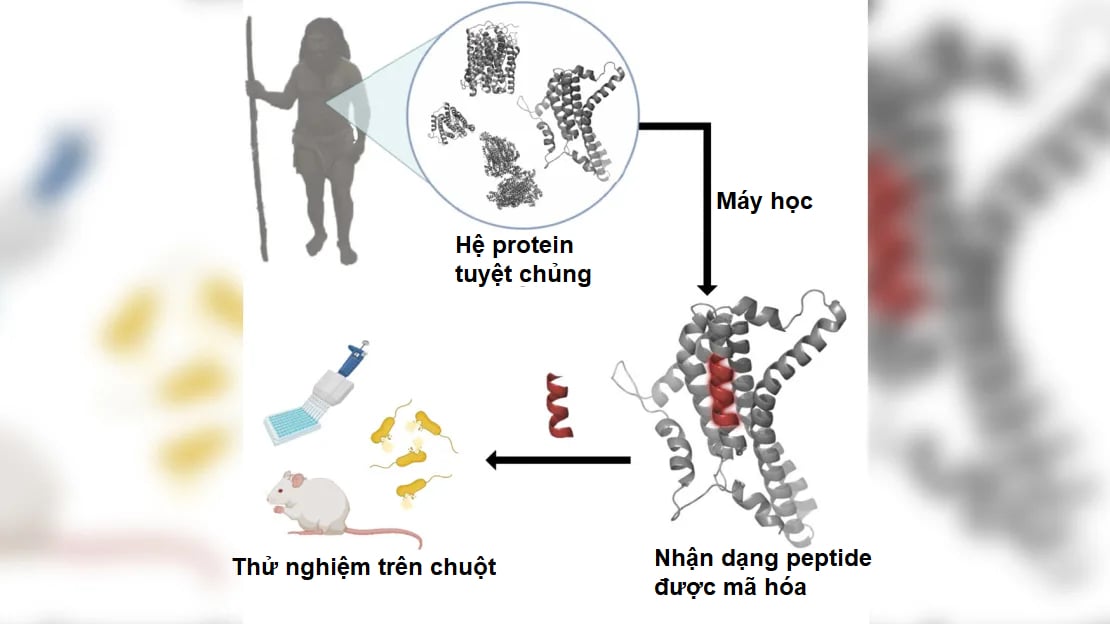
Biotechnology pioneer César de la Fuente of the University of Pennsylvania said that, of the six peptides selected by algorithm, one peptide from Neanderthals was the most effective in combating pathogens in mice infected with bacteria. (Image: University of Pennsylvania)
“I think one of the most exciting moments was when we chemically recovered molecules in the lab and then, for the first time, brought them back to life. It was amazing from a scientific perspective to witness that moment,” De la Fuente shared.
Experimental results showed that in infected mice developing skin abscesses, the peptides actively killed the bacteria; in mice with thigh infections, the peptides were less effective but still prevented bacterial growth.
"The best peptide is the one we call Neanderthalien 1, from Neanderthals, and that's the most effective one when tested on mice," said De la Fuente.
More research is needed.
However, De la Fuente stressed that none of the peptides qualify as "ready for use as antibiotics" and that they would instead require significant adjustments. In research expected to be published next year, he and colleagues have developed a new deep learning model to explore the protein sequences of 208 extinct organisms with detailed genetic information.
The research team found more than 11,000 potential antimicrobial peptides never before discovered, found only in extinct organisms, and synthesized the most promising peptides from the woolly mammoth of Siberia, the Steller's sea cow (a marine mammal that became extinct in the 18th century due to hunting in the Arctic), the giant sloth, and the giant Irish elk (Megaloceros giganteus). He said the newly discovered peptides have “excellent anti-infective activity” in mice.
Dr. Dmitry Ghilarov, lead researcher at the John Innes Centre in the UK, said the bottleneck in finding new antibiotics is that they can be unstable and difficult to synthesize. “There are many of these peptide antibiotics that are not being developed and pursued by the industry because of difficulties such as toxicity,” Ghilarov said.
According to an article published in May 2021, out of 10,000 promising compounds identified by researchers, only one or two antibiotics received approval from the U.S. Food and Drug Administration.
Dr. Monique van Hoek, professor and associate director of research at the George Mason University School of Systems Biology (USA), said it is very rare for a naturally occurring peptide to directly lead to the creation of a new drug or antibiotic.
According to Van Hoek, the discovery of a new peptide will provide a foundation for researchers to use computational techniques to explore and optimize its potential as a new antibiotic.
Currently, Dr. Van Hoek is focusing her research on a synthetic peptide derived from a naturally occurring peptide in American alligators. The peptide is currently undergoing preclinical testing.
Ms. Van Hoek said that while it might seem strange to seek new antibiotic sources from extinct crocodiles or humans, the severity of antibiotic-resistant bacteria makes these studies worthwhile.
Hoai Phuong (according to CNN)
Source

![[Image] Pleasant weather helps students enter the 10th grade entrance exam with confidence.](https://vphoto.vietnam.vn/thumb/1200x675/vietnam/resource/IMAGE/2026/05/29/1780034401612_ngay-1-thi-lop-10-minh-duy-8-5009-jpg.webp)
![[Photo] Ba Lang An Lighthouse - the "eye of the sea" amidst the "rock museum" of Quang Ngai province.](https://vphoto.vietnam.vn/thumb/1200x675/vietnam/resource/IMAGE/2026/05/29/1780038698840_anh-man-hinh-2026-05-29-luc-14-10-42.png)



























































































Comment (0)