

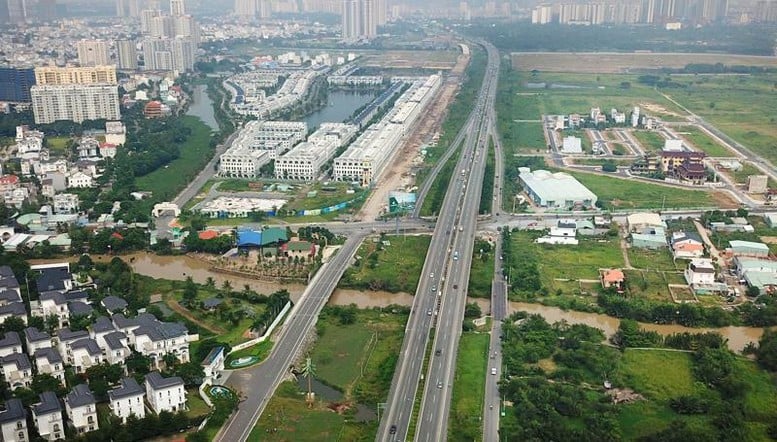
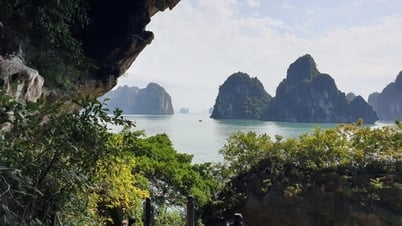
The draft abolishes annual district-level land use planning and plans; adds commune-level land use planning and plans. Illustrative photo
In which, Article 1 amends and supplements a number of articles of the Land Law, including 29 clauses, including 3 groups of contents: Group of contents on institutional viewpoints, objectives, tasks, solutions to amend and supplement Resolution No. 18-NQ/TW reported by the Government Party Committee and approved by the Central Executive Committee in Resolution No. 69-NQ/TW, expressed in the draft Law including 8 clauses in Article 1; group of contents amending and supplementing to continue to remove difficulties and obstacles in the implementation of the Law including 7 clauses in Article 1; group of contents amending to suit the 2-level local government model including 10 clauses in Article 1 and technical amendments in 4 clauses in Article 118. The Law is expected to take effect from January 1, 2026.
The draft Law amends regulations on the system of land use planning and plans in the direction of eliminating annual district-level land use planning and plans; supplementing commune-level land use planning and plans according to 2 options.
Option 1 is to replace district-level land use planning and annual district-level land use plans with commune-level land use planning and five-year commune-level land use plans.
Option 2 is not to regulate commune-level land use planning but only to regulate the establishment of commune-level land use planning based on provincial-level land use planning targets allocated to commune-level administrative units, or planning established according to the provisions of the law on urban and rural planning in order to innovate and reduce the order, procedures, and content of land use planning.
Notably, the draft Law adds 3 cases where the State reclaims land for socio-economic development for national and public interests (Article 79). Specifically, urgent public investment projects serving political and foreign affairs tasks; projects in free trade zones, in international financial centers; logistics projects; mixed residential, urban, tourism, commercial services, cultural, sports and other purposes projects; cultural industrial projects and other socio-economic development projects decided by the Provincial People's Council in accordance with local conditions.
Second, in the case of using land to implement a socio -economic development project through an agreement on receiving land use rights, when the deadline for completing the agreement expires or the extension period expires if the agreement completion period is extended and over 75% of the land area and over 75% of the number of land users have been agreed upon, the State shall recover the remaining land area to allocate or lease land to the investor.
The third case is to create a land fund to lease land for continued production and business as prescribed in Point d, Clause 3, Article 124 of the 2024 Land Law.
At the meeting of the Council for Appraisal of the Draft Law on Amendments and Supplements to a Number of Articles of the Land Law organized by the Ministry of Justice, Chairman of the Ho Chi Minh City Real Estate Association Le Hoang Chau said that the regulation "in the case of using land to implement socio-economic development projects through agreements on receiving land use rights, but the agreement must be completed by the end of the term or the extension period expires if the agreement completion time is extended and over 75% of the land area and over 75% of the number of land users have been agreed upon, the State will reclaim the remaining land area to allocate land and lease land to investors" will remove obstacles and difficulties for thousands of projects that have been "unfinished" in compensation for many years.
Mr. Le Hoang Chau said that in practice, in many cases, investors have agreed on over 75% (even over 95% of the land area) or have agreed with over 75% of the number of land users, but still cannot reach an agreement to clear the remaining area, so investors cannot carry out the project, capital is tied up, land is wasted, and cannot be put into use.
The draft Law also adds cases of implementing urgent public investment projects serving political and foreign affairs tasks; projects in free trade zones, in international financial centers; logistics projects; mixed residential, urban, tourism, commercial services, cultural, sports and other purposes projects; cultural industry projects and other socio-economic development projects decided by the Provincial People's Council in accordance with local conditions...
According to Deputy Minister of Justice Nguyen Thanh Tu, Chairman of the Appraisal Council, it is necessary to continue reviewing and supplementing to ensure consistency with the Party's policies and guidelines to perfect the draft Law.
Regarding the scope of the draft law, the drafting committee needs to continue reviewing and trying to "scan" all the difficulties and inadequacies of current regulations and urgent contents for socio-economic development to supplement the draft law, while ensuring that no new difficulties or problems arise.
Regarding contents such as adding 3 cases of land recovery; compensation, support, resettlement; auction and bidding, it is necessary to review, assess the impact carefully and have a solution. In particular, it is necessary to focus on policy communication to clarify the provisions of the draft Law.
Deputy Minister of Justice Nguyen Thanh Tu emphasized the provisions on control and post-control mechanisms to limit abuse while ensuring consistency between this Law and related laws, especially the Law on Urban and Rural Planning, the Investment Law as well as internal consistency of the draft law itself with the remaining provisions of the current Land Law...
Bich Phuong
Source: https://baochinhphu.vn/sua-doi-luat-dat-dai-kip-thoi-go-nhung-diem-nghen-phat-sinh-tu-thuc-tien-10225081914574013.htm
















![[Photo] Politburo works with the Standing Committee of Da Nang City Party Committee and Quang Ninh Provincial Party Committee](https://vphoto.vietnam.vn/thumb/1200x675/vietnam/resource/IMAGE/2025/8/19/b1678391898c4d32a05132bec02dd6e1)

![[Photo] President Luong Cuong's wife and Queen of Bhutan visit Tran Quoc Pagoda](https://vphoto.vietnam.vn/thumb/1200x675/vietnam/resource/IMAGE/2025/8/19/62696af3852a44c8823ec52b03c3beb0)
![[Photo] General Secretary To Lam attends the inauguration and groundbreaking ceremony of 250 projects to celebrate National Day](https://vphoto.vietnam.vn/thumb/1200x675/vietnam/resource/IMAGE/2025/8/19/3aa7478438a8470e9c63f4951a16248b)
![[Photo] General Secretary and Prime Minister visit the National Exhibition and Fair Center](https://vphoto.vietnam.vn/thumb/1200x675/vietnam/resource/IMAGE/2025/8/19/f4503ad032d24a90beb39eb71c2a583f)
![[Photo] Close-up of the first International Financial Center building in Ho Chi Minh City](https://vphoto.vietnam.vn/thumb/1200x675/vietnam/resource/IMAGE/2025/8/19/3f06082e1b534742a13b7029b76c69b6)






































Comment (0)