

Speaking at the meeting, Deputy Minister Bui Hoang Phuong stated that the semiconductor industry is a field of particular interest to both Vietnam and Japan. It is not only a technological pillar of the future but also a foundation for the sustainable development of the digital economy . Vietnam hopes to promote cooperation with Japan through specific activities in training, research, technology development, and attracting foreign investment.
The Deputy Minister stated that during his trip to Japan two weeks ago, he met with numerous organizations, training institutions, and businesses related to the semiconductor industry. He expressed his hope to welcome seasoned experts from Japan to Vietnam to directly support training, technology transfer, and the strong development of the semiconductor ecosystem.
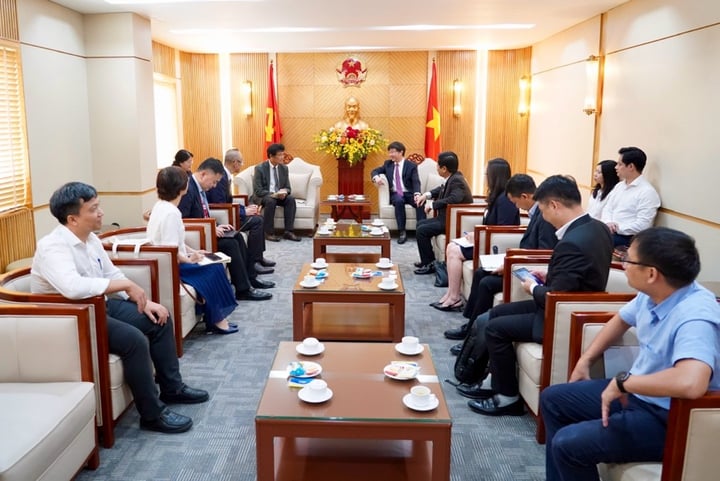
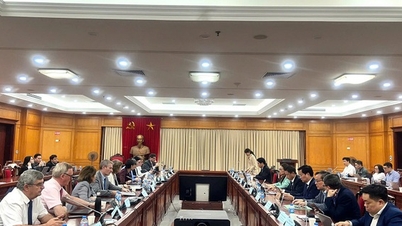
Overview of the working session
On the Japanese side, Professor Tsuyoshi Usagawa shared that this trip to Vietnam will last about 10 weeks, during which he will spend most of his time working at the Vietnam-Japan University with the goal of coordinating the development of a bachelor's degree program in semiconductors, a program that is expected to begin enrolling students from September onwards.
Professor Usagawa affirmed that he and his Japanese colleagues are very interested in Vietnam's policies and strategic direction regarding human resource development in this key industry.
Professor Tsuyoshi Usagawa also expressed his hope that the Vietnam-Japan University would become an important bridge, helping to expand educational and research cooperation between the two countries. Kumamoto University in Japan is ready to share its experience, send experts to teach, and support the development of a training foundation for future generations of semiconductor engineers in Vietnam.
Professor Usagawa also highly appreciated the potential for developing young human resources in Vietnam. Vietnam not only has friendly people and beautiful scenery but also possesses a generation of ambitious young people, which will be an important foundation for the sustainable development of the semiconductor industry in the future.
During the meeting, the two sides exchanged views on many important issues, most notably the cooperation proposals from the Vietnamese Ministry of Science and Technology , including: establishing research and development (R&D) centers for semiconductors at several universities in Vietnam, providing support in terms of equipment, research tools, and training; supporting curriculum development, increasing scholarships, and facilitating student and faculty exchanges, especially short-term training courses in Japan; providing in-depth training in materials engineering, semiconductor manufacturing, automation, and quality control to meet the requirements of the modern industry; and sending Japanese experts to work in Vietnam to advise on the implementation of national semiconductor industry development programs.
Earlier, at the meeting, Mr. Nguyen Khac Lich, Director of the Information Technology Industry Department (Ministry of Science and Technology), stated that Vietnam has issued the National Semiconductor Industry Development Strategy to 2030, with a vision to 2050, demonstrating the government's strong commitment to shaping Vietnam's position in the global supply chain.
Accordingly, Vietnam's semiconductor industry development strategy is built on the formula C = SET + 1, where: C stands for Chip; S stands for Specialized, developing specialized chips; E stands for Electronics, developing the electronics industry; T stands for Talent, developing human resources; and +1 stands for attracting foreign investment to create a "plus-country" position in the "X+1" model of the global semiconductor industry.
Japan is currently one of the world's leading countries in the semiconductor and electronics industry. With a comprehensive strategic relationship maintained and developed over many years, Vietnam views Japan as a key partner in building its national semiconductor industry.
The meeting concluded in an open, trusting, and highly constructive atmosphere, raising many expectations for the strategic cooperation between Vietnam and Japan in the field of science and technology in general and semiconductors in particular.
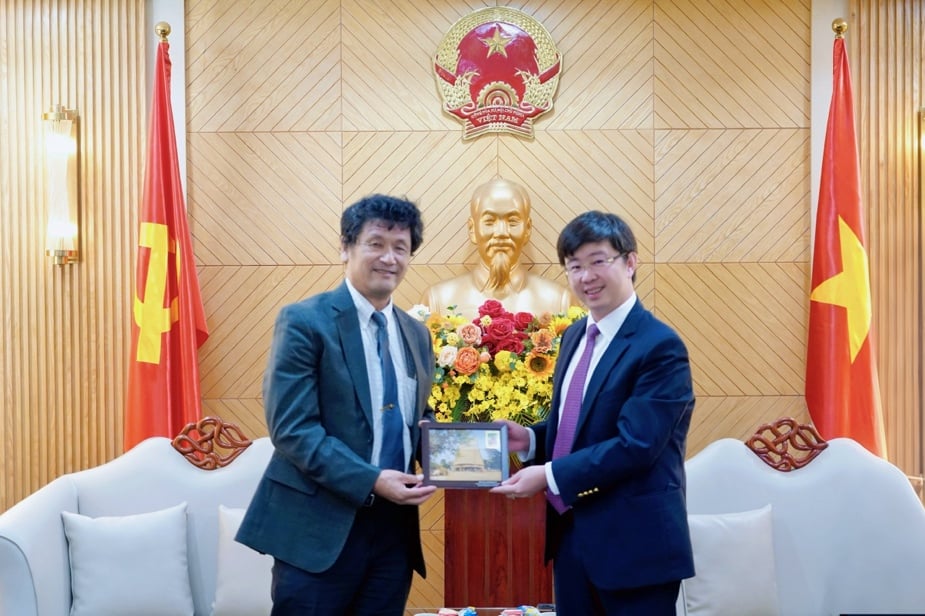
Deputy Minister Bui Hoang Phuong presents a commemorative gift to Professor Tsuyoshi Usagawa.
Source: https://mst.gov.vn/tang-cuong-hop-tac-viet-nhat-trong-linh-vuc-ban-dan-dat-nen-mong-cho-dao-tao-va-phat-trien-nhan-luc-chat-luong-cao-197250725081804149.htm

![[Photo] Prime Minister Pham Minh Chinh holds a phone call with the CEO of Russia's Rosatom Corporation.](/_next/image?url=https%3A%2F%2Fvphoto.vietnam.vn%2Fthumb%2F1200x675%2Fvietnam%2Fresource%2FIMAGE%2F2025%2F12%2F11%2F1765464552365_dsc-5295-jpg.webp&w=3840&q=75)


![[Photo] Closing Ceremony of the 10th Session of the 15th National Assembly](/_next/image?url=https%3A%2F%2Fvphoto.vietnam.vn%2Fthumb%2F1200x675%2Fvietnam%2Fresource%2FIMAGE%2F2025%2F12%2F11%2F1765448959967_image-1437-jpg.webp&w=3840&q=75)









































![[OFFICIAL] MISA GROUP ANNOUNCES ITS PIONEERING BRAND POSITIONING IN BUILDING AGENTIC AI FOR BUSINESSES, HOUSEHOLDS, AND THE GOVERNMENT](https://vphoto.vietnam.vn/thumb/402x226/vietnam/resource/IMAGE/2025/12/11/1765444754256_agentic-ai_postfb-scaled.png)









































Comment (0)