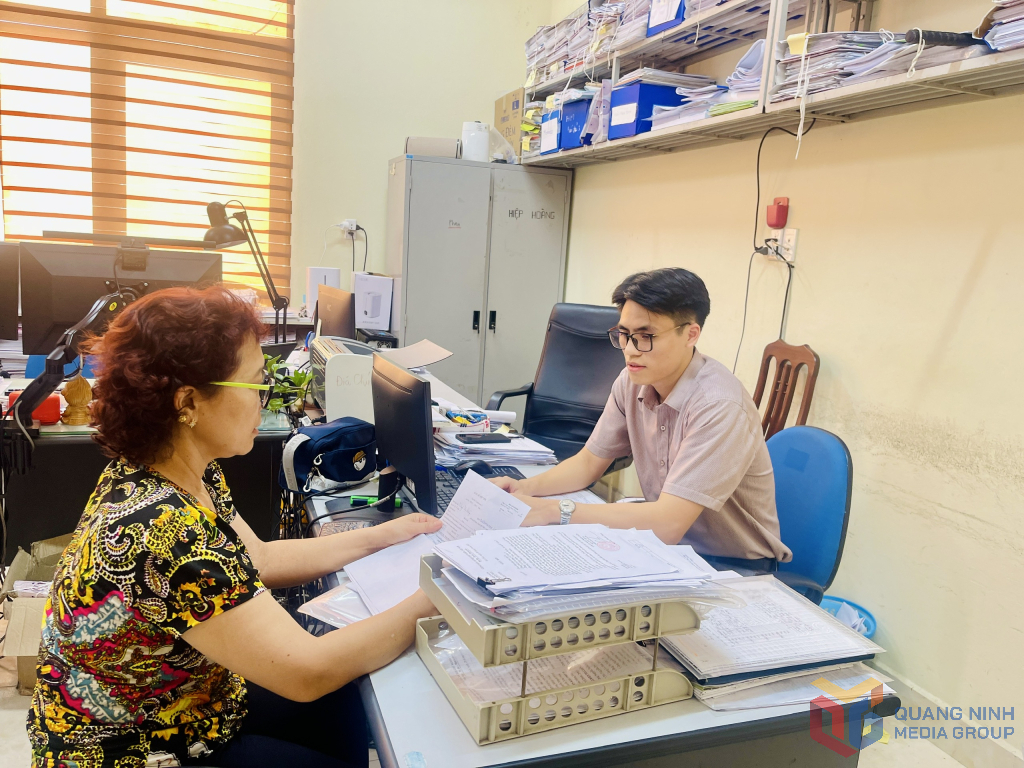
Officials from the Economic , Infrastructure and Urban Planning Department of Bai Chay ward guide residents through the process of digitizing land documents. Photo: Hoang Nga
The campaign to review and clean up the entire land database built over time in all 54/54 communes, wards, and special zones; collecting, digitizing, and creating data for land use right certificates that have been issued but not yet included in the database. Immediately after the data was collected, the province's specialized units implemented the process of cross-checking and verifying land parcel information with the National Population Database; simultaneously reviewing, adjusting, and supplementing information related to land users to ensure the data is always "accurate - complete - clean - and active". As of November 26th, the campaign has basically completed its important objectives. Quang Ninh has collected a total of 454,827 records, reaching 98.62% of the projected target. Specifically, the collection of land use right certificates and housing certificates at the commune and ward level has reached over 98% of the required number of land parcels. Notably, the digitization and data creation process has been accelerated. 448,914 records have been digitized (scanned/captured), reaching 97.34% of the total records requiring database creation for the entire province. Simultaneously, information has been entered into Form No. 01 for 451,452 records, reaching 97.89%. Currently, 4 out of 11 tasks in Plan 230/KH-UBND have been completed, and 3 tasks are being carried out regularly and meet the requirements.
One of the key tasks is reviewing, classifying data, and cross-referencing land user information with the national population database. The Quang Ninh Department of Agriculture and Environment has transferred 457,321 land user records that have been issued land use certificates to the Police Department for Administrative Management of Social Order (PC06) of the Provincial Police for verification. Through cross-referencing, 398,532 data points were found in the population database, equivalent to 87.14% of the received land user data; of which, 370,593 land user data points matched the national population database, accounting for 81.4%, and can be synchronized with the central national database. However, 27,939 data points (6.11%) still contain inaccurate information and require local authorities to supplement and complete them. Currently, the task force has reviewed and classified 254,293 land parcel data records. 2,048 land parcels belong to Group I (correct, complete, clean, and viable) and 252,245 land parcels belong to Group II (requiring correction and supplementation). This is an important step towards establishing a synchronized, transparent electronic data system that meets the requirements of digital government development, efficient land management, and convenience for citizens and businesses.
In addition, the province has restructured the administrative procedures for land management. The Provincial People's Committee has approved the reduction of paper-based documents for 14 administrative procedures, replacing them with digitized electronic data. This is considered a breakthrough in reducing administrative procedures and saving time and costs for organizations and individuals when conducting land transactions.
The involvement of the political system from the provincial to the grassroots level has created a strong ripple effect. Many localities have excellently completed their assigned tasks. For example, Mao Khe ward has reached over 420,981 people, collected 15,179 records (100%), digitized 7,150 records, and entered 9,164 records into Form 01. Mong Cai 3 ward, after launching the "90 Days to Enrich and Clean Land Data" campaign, from September 26th to November 15th, collected 7,582 out of 7,582 records, completed 100% of land use right certificates and citizen identification cards, and processed data at 92.5%. Despite difficulties such as households frequently absent from fishing activities, unused urban land, bank mortgage records, lost documents, or records lacking information on origin and area, localities have proactively established working groups to collect, input, cross-check, and complete records.
As of November 26th, 36 out of 54 communes, wards, and special zones in the province have completed 100% of their document collection; 33 out of 54 localities have completed 100% of their document digitization. Among these, 9 localities, including Van Don Special Zone, Mao Khe Ward, Quang Hanh Ward, An Sinh Ward, Mong Duong Ward, Dong Ngu Commune, Quang Duc Commune, Hai Hoa Commune, and Cai Chien Commune, have completed all campaign criteria ahead of schedule: document collection, digitization, data entry, verification, and are ready to synchronize data to the national system.
Despite achieving high results, the campaign still has urgent work to do to meet the deadline. Approximately 6,300 records remain uncollected, mostly related to mortgaged land, land where the owner is frequently absent, or where the information is unclear. Data synchronization to the National Database has only reached 23.22%. Therefore, the province has requested daily reporting, clearly assigned responsibilities to each locality, and established a 24/7 online technical support team to promptly address any issues. The Department of Agriculture and Environment, the Provincial Police, the Land Registration Office, and technology units such as VNPT, FPT, and the Department of Science and Technology are working closely together to complete the data verification, standardization, quality control of data entry, and ensure data security and safety before synchronization.
With nearly 100% of data collected and digitized, a high verification rate, and many localities achieving their goals ahead of schedule, Quang Ninh is nearing its objective of building an accurate, complete, clean, and active land data system – a foundation for digital government, administrative procedure reform, transparent land management, and better service to citizens and businesses. This is not just the result of a campaign, but a major step forward in realizing the commitment to building a modern, efficient, and transparent administration.
Minh Thu
Source: https://baoquangninh.vn/quyet-liet-ve-dich-chien-dich-lam-giau-lam-sach-dat-dai-3386347.html































![[Photo] Reception to welcome General Secretary and President To Lam and his wife on their State visit to the Philippines](https://vphoto.vietnam.vn/thumb/1200x675/vietnam/resource/IMAGE/2026/06/01/1780295488620_vna-potal-chieu-dai-chao-mung-tong-bi-thu-chu-tich-nuoc-to-lam-va-phu-nhan-tham-cap-nha-nuoc-toi-philippines-8798060-7855-jpg.webp)


































































Comment (0)