

The Japan Aerospace Exploration Agency (JAXA) announced today that the SLIM spacecraft has awakened after a lunar night (equivalent to two Earth weeks).
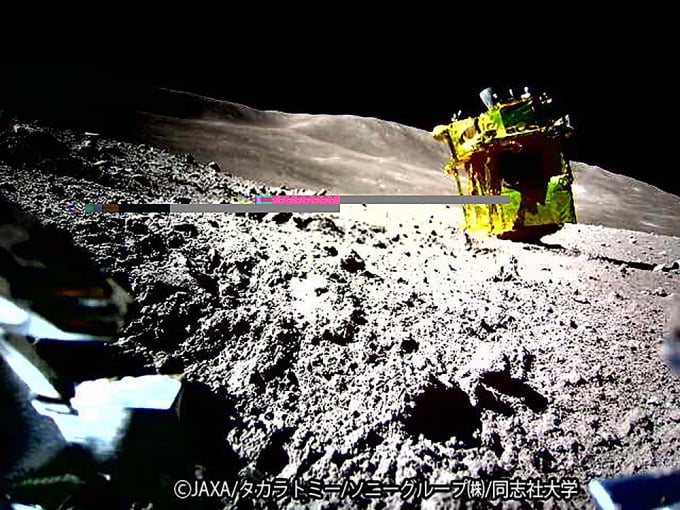
The yellow SLIM lander on the surface of the Moon. Photo: JAXA/Takara Tomy/Sony Group/Doshisha University/AFP
The Lunar Intelligent Surveyor (SLIM), or Moon Sniper, landed on the lunar surface on January 19th but upside down, causing its solar panels to orient themselves incorrectly. By the end of January, the Japan Aerospace Exploration Agency (JAXA) reported that the angle of the sun changed and SLIM "came back to life" for about two days, conducting scientific observations with its high-resolution cameras. Afterward, the spacecraft went back to sleep as the lunar night fell. Because SLIM was not designed to withstand the harsh conditions of a lunar night, JAXA is unsure whether it will ever wake up again.
"Yesterday, we sent a command and SLIM responded. It successfully survived a night on the lunar surface (approximately two Earth weeks long) while maintaining communication capabilities," JAXA said on social media platform X on February 26.
According to the agency, the communication ended after a short time because it was still midday on the Moon and the temperature of the communication device was very high. Experts are preparing for SLIM to resume operation once the device's temperature has cooled down sufficiently.
The SLIM lunar landing in January garnered attention due to its precise landing technology; the actual landing site was confirmed to be only 55 meters from the target, much smaller than the usual range of several kilometers. This was an impressive victory for Japan's space program, making it the fifth nation to have a soft-landing spacecraft on the Moon after the United States, the Soviet Union, China, and India. Several other countries, including Russia, South Korea, and the UAE, are also aiming to reach the Moon.
Meanwhile, on February 23, the Odysseus spacecraft became the first American spacecraft to land on the Moon since the Apollo program more than 50 years ago. This unmanned lander, built by a private company and funded by NASA, landed near the south pole, an area believed to contain significant water ice. The Japanese private company ispace also attempted a lunar landing last year, but the spacecraft crashed and lost contact.
Thu Thao (According to AFP )
Source link



















































































Comment (0)