

A Beijing research team says it has found a way to build a hypersonic missile with a steel nose cone, marking a significant advance in heat shield technology.
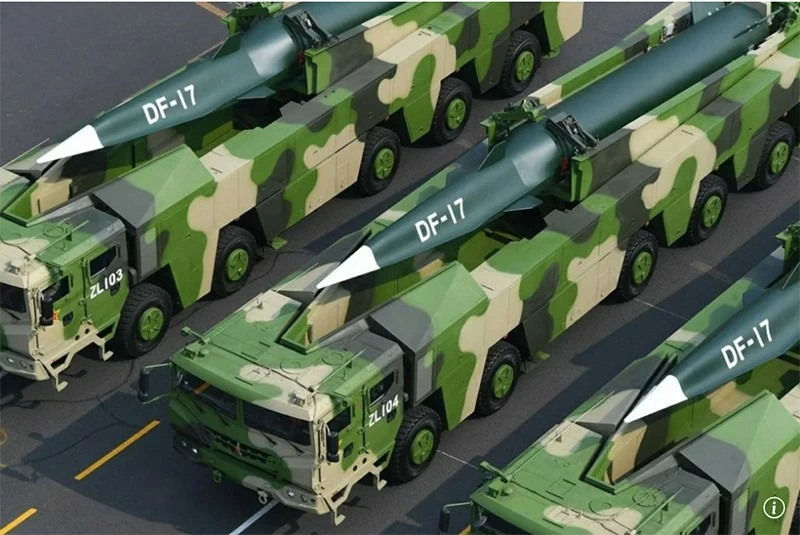 |
Researchers, led by Huang Fenglei, a professor at the Beijing Institute of Technology, published the design of a hypersonic anti-ship missile in the Chinese journal Acta Armamentarii last month.
Partial design reveals that the warhead casing – located at the front of the missile – is made from a widely available, high-strength stainless steel.
Steel begins to melt at temperatures around 1,200 degrees Celsius (2,190 degrees Fahrenheit), but the nose cone of a hypersonic weapon can reach temperatures as high as 3,000 degrees during flight due to atmospheric heating.
The research team said their missile is designed to reach Mach 8 – or eight times the speed of sound – and this is a significant step forward in heat shield technology.
The use of inexpensive materials also aligns with the Chinese military's strategy to reduce costs in the hypersonic arms race with the United States and Russia.
The article did not specify what stage the missile was in or whether it had undergone testing.
In the United States, tungsten alloys are commonly used for parts of supersonic vehicles that generate the most heat because tungsten has a melting point above 3,400 degrees. For example, Boeing's X-51 Waverider aircraft has a tungsten nose cone to withstand temperatures of Mach 5.
Tungsten alloys also accumulate a great deal of thermal energy, and a U.S. congressional investigation last year determined that inadequate thermal protection was the primary reason for the failure of U.S. hypersonic weapons tests.
According to the Beijing research team, a steel hypersonic missile would not be able to survive more than 20 seconds at maximum speed without advanced thermal protection technology.
Their missiles are designed to shoot up into the atmosphere after launch, then descend to an altitude of 30km to 20km as they glide towards the target ship.
After traveling at Mach 8 for 18 seconds, the temperature inside the warhead can reach 300 degrees – not enough to melt steel, but enough to ignite the explosives.
According to the research team, adding a thermal shield layer on top of the steel shell could solve the problem. They propose using ultra-high temperature ceramics capable of withstanding temperatures of 3,000 degrees or higher. This would create a 4mm thick top layer of the protective barrier. Beneath and adhering to the steel shell would be a 5mm thick layer of gel gas – an insulator to keep the explosive's temperature at around 40 degrees while flying at high speed.
Project leader Huang is one of the most influential scientists working in China's defense industry. He is the Deputy Director of Research for a military program, a technical advisor to the powerful Central Military Commission, and the Deputy Director of a technical unit within China's Equipment Development Bureau.
China does not disclose the cost of producing hypersonic weapons, but according to public reports, several types of these weapons are being mass-produced and deployed for use on mobile missile launchers, warships, and bombers.
As part of its ongoing reform and modernization program, the Chinese military has recently sought to reduce the cost of military products by requiring suppliers to leverage the country's manufacturing technology and economies of scale.
One example is a new method for producing silicon carbide gel gas developed by Chinese scientists, which costs only 1/100th the price and is ten times faster.
Source: https://baoquocte.vn/ten-lua-sieu-thanh-cua-trung-quoc-co-the-duoc-che-tao-tu-thep-285069.html


![[Image] Central Party Office summarizes work in 2025](/_next/image?url=https%3A%2F%2Fvphoto.vietnam.vn%2Fthumb%2F1200x675%2Fvietnam%2Fresource%2FIMAGE%2F2025%2F12%2F18%2F1766065572073_vptw-hoi-nghi-tong-ket-89-1204-jpg.webp&w=3840&q=75)




















































































Comment (0)