

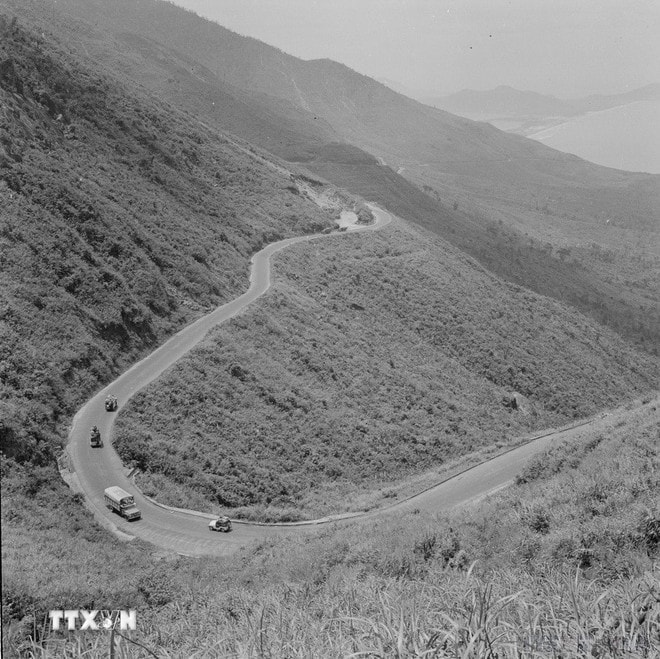
In his book "General Headquarters in the Spring of Victory," General Vo Nguyen Giap wrote: "On April 6, 1975, the telegram from the Central Military Commission to the Command of Group 559 clearly stated: ... It is necessary to prioritize the work of ensuring support and mobility of our forces into B2 as the number one central task."
Therefore, it is necessary to have a well-organized plan for this work, especially ensuring the movement of units, military equipment, and ammunition needs are met according to the planned schedule.
I instructed Comrade Dong Si Nguyen to set up a command post in Quy Nhon and Comrade Hoang Minh Thao in Nha Trang, to organize and supervise the units marching along Highway 1, ensuring that there was absolutely no disruption to the logistical support for the advancing units…
The demands of the front were extremely urgent, day by day, hour by hour. Time was of the essence, of strength. Comrades used every means to organize and urge units to march as quickly as possible, provide support as urgently as possible, and brilliantly complete this lightning-fast support operation.
Along the two main axes, Highway 1 and the Truong Son Road, with the urgent organization of Group 559, the active support of Military Region V, and with their tireless efforts and all available means, the units overcame difficulties, fought the enemy, and advanced, opening roads.
When roads collapsed, the local people came out to help repair them. When bridges were destroyed by the enemy, in addition to the bridges and self-propelled ferries of the engineering corps, there were also boats of all sizes belonging to the people. When vehicles broke down, they found every way to repair and tow them away..."
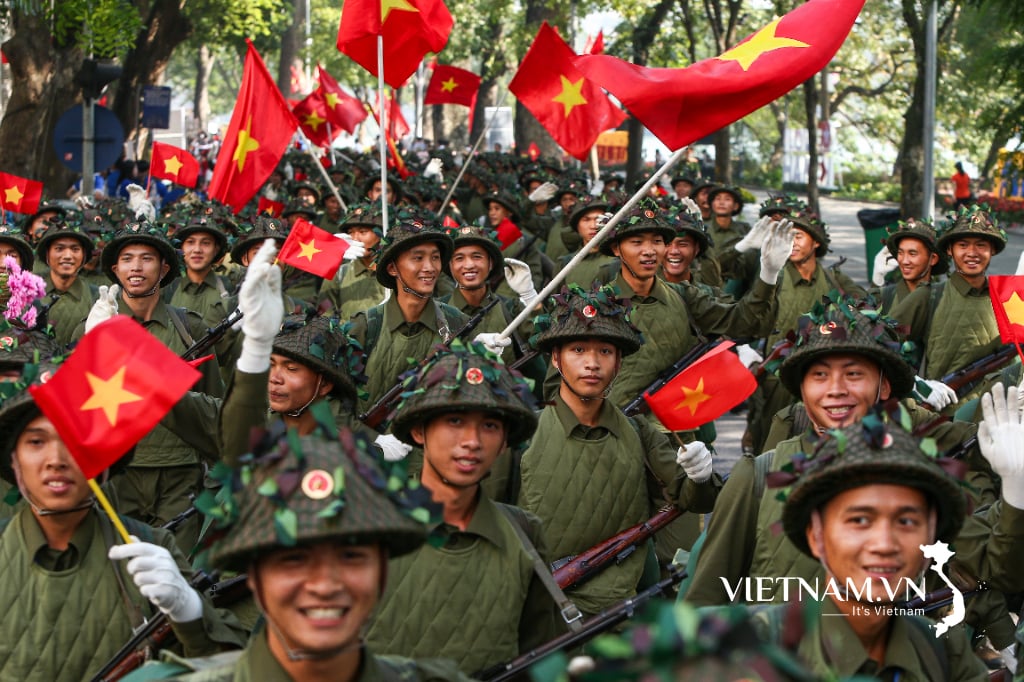
In the East, the Coastal Army, comprising the majority of the Huong Giang Corps, reinforced by the 3rd Infantry Division and the 3rd Armored Battalion of Military Region 5, advanced south along Route 1.
With the help of local Party committees and people, our troops repaired eight bridges damaged by enemy attacks, opened dozens of kilometers of military roads, and increased the highest daily marching speed to 185 km/h. While marching, the units also learned from combat experiences and studied how to use weapons and equipment captured from the enemy.
The Central Highlands Army Corps was ordered to march into the southeastern region of Vietnam. The 316th Infantry Division and its light command post advanced south from Buon Ma Thuot along Highway 14.
The 10th Division, while sweeping for enemy forces in Nha Trang and Cam Ranh, quickly withdrew its troops and proceeded along inter-provincial road 2 to road 20. More than 3,000 vehicles from the 471st Automobile Division (559th Regiment) and other brigades were mobilized for transportation.
The 7th and 575th Engineering Regiments received assistance from thousands of people of various ethnic groups in the Bac Ai base and newly liberated areas in repairing roads and building bridges.
On April 6, 1975, the 8th Main Force Division of Military Region 8, the 241st Engineering Battalion of Military Region 8, and local armed forces cut off several sections of Highway 4; the 4th Main Force Division of Military Region 9, along with local armed forces, destroyed the Ba Cang sub-district and controlled Tra Noc airport ( Can Tho ).
On the same day, April 6, 1975, Mai Năng, the commander of the 126th Naval Special Forces Regiment, was summoned by Lieutenant Colonel Hoàng Hữu Thái, Deputy Commander of the Navy, and given the following mission: “The time is ripe for liberating the South. The Central Military Commission and the Commander-in-Chief, General Võ Nguyên Giáp, have assigned the Navy, in coordination with Military Region 5, the task of urgently mobilizing forces for combat, seizing islands occupied by the puppet army, and liberating the Spratly Islands.”
This is a highly important, top-secret mission. The Naval Command and Military Region 5 have agreed to establish a unit to carry out this mission, codenamed C75, with you as its commander. The unit comprises officers and soldiers selected from the 126th Special Forces Regiment, ships and sailors from the 125th Brigade (the "No Number" Fleet), and special forces from Military Region 5, reinforced with army weapons and equipment such as recoilless rifles, 82mm mortars, and B41 rocket launchers..."
Also on April 6, 1975, the Standing Committee of the Central Committee of the Southern Region issued a directive to intensify the general offensive and general uprising to liberate the cities. The directive clearly stated: "The direct revolutionary situation in the cities has arrived; the immediate urgent task has become intertwined with the fundamental task of the national democratic revolution in the South."
Following the directives of the Central Committee, the Saigon - Gia Dinh City Party Committee issued the document "Things to be done immediately in the stages before, during and after the city's liberation".
The directive of April 6, 1975, from the Central Committee of the Southern Region accelerated the process of liberating provincial and district capitals in the Southern and southernmost parts of Central Vietnam, including Saigon - Gia Dinh city.
TH (according to VNA)Source: https://baohaiduong.vn/ngay-6-4-1975-than-toc-tien-ve-phia-nam-408814.html

![[Photo] National Assembly Chairman Tran Thanh Man working with the Standing Committee of the Economic and Financial Committee](https://vphoto.vietnam.vn/thumb/1200x675/vietnam/resource/IMAGE/2026/05/20/1779249584387_ndo_br_1-jpg.webp)



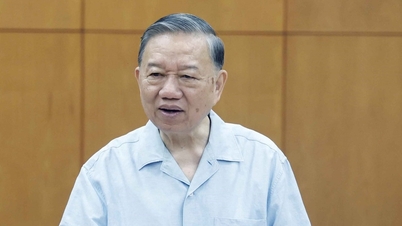
![[Photo] General Secretary and President To Lam presides over a meeting on assessing national development resources.](https://vphoto.vietnam.vn/thumb/1200x675/vietnam/resource/IMAGE/2026/05/20/1779253785852_a1-bnd-2943-8519-jpg.webp)
































































Comment (0)