

 |
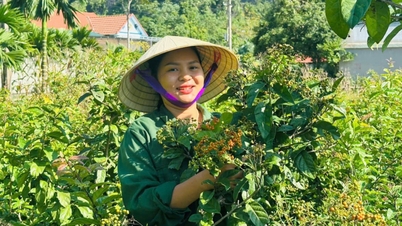
| Tea harvesting in exchange for labor is a beautiful cultural aspect of the working life of farmers in the tea-growing region of Van Han commune. |
Extracting the essence of earth and sky.
The best and most famous tea in the country is still Thai Nguyen tea. This tea-growing region holds a legendary story of the faithful love between Coc and Cong, and a tale of a kind and loyal woman who devoted herself to her husband and raised her children. Thanks to her "Bodhisattva" heart, she saved her villagers during a great flood. The remnants of this story, preserved in the vast forests of Northern Vietnam, are the Ba Be Lake of today.
The natural and artificial lakes on the mountain slopes of Thai Nguyen province are a vibrant emerald green. Their deep, yet expansive, waters, along with the winding Cau and Cong rivers flowing through the mountains and towns, nourish the banks, giving rise to tea plants. These resilient plants silently extract the essence from the earth and air, creating a refined aroma and flavor to offer to humanity.
The beautiful natural landscapes, the warm hearts of the people, and the fragrant tea have captivated hearts. What's special is that while tea plants grow lushly in many different regions across the country, the heart of Viet Bac, the gateway from Hanoi to the northeastern provinces, boasts the finest tea in Vietnam.
The harmonious climate, fertile soil, and warm-hearted people have given this tea a unique and superior aroma and flavor compared to other tea-growing regions in the country. When brewed, it reveals the fragrant aroma of glutinous rice from upland rice. Poured into a cup, it has a shimmering turquoise color. Upon touching the lips, one feels the astringent and bitter taste spreading along the tongue and into the bloodstream, followed by a lingering sweetness.
 |
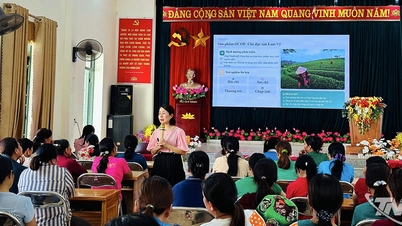
| Artisan Nguyen Thi Hai, President of the La Bang Commune Tea Association (far left), tells visitors the story of how farmers in the region built their tea brand. |
For hundreds of years, tea plants have been closely intertwined with human life. This connection is evidenced by the fact that people in the region used the leaves to brew tea, and then explored and created processing methods ranging from simple to modern technology. From a common beverage to a regional specialty. In the past, people in the region would pick tea leaves, dry them, store them, and brew them for drinking. When people learned to harvest young buds and dry them in cast-iron pans, it was a major invention that changed the production and processing mindset of the tea industry.
Tea farmers in various regions have continuously improved their processing methods, such as replacing cast iron pans with flat sheet metal, then manual rotating machines, and later, motor-driven machines. Electric tea rolling machines have replaced manual methods. Machinery and technology have helped tea growers reduce their labor. But perhaps for true tea connoisseurs, the best cup of tea, one that carries the most life-changing flavors, is still the one prepared in a traditional cast iron pan, from wilting and drying to infusing the tea with its aroma.
Unique flavor
Because of its delicious tea, considered among the best in the country, few people from Thai Nguyen are not proud of their homeland's tea. No matter where they go, people from Thai Nguyen often bring a pot of tea to offer to friends from all over. While leisurely sipping tea at a festival, friends from other provinces might suddenly sing a song about the love story of Princess Cong and Prince Coc...
The love people have for each other and for nature, more specifically, the love the people of Thai Nguyen have for tea plants. This love has been proven over hundreds of years, through countless changes and transformations. The people of Thai Nguyen have remained deeply connected to tea plants, like close friends, with their very blood, flesh, and soul. Even during periods of river closures and restricted trade, when farmers in Thai Nguyen couldn't make a living from tea cultivation, they never gave up. Instead, they silently and diligently nurtured the plants, carefully selecting the land and hills to cultivate the green shoots, creating vibrant tea-growing regions.
With Vietnam's integration into the global economy, tea, like a long-dormant plant, has suddenly awakened, rapidly becoming a commodity that generates high income for workers. Therefore, since the 1990s, tea cultivation has received significant investment from all levels of government and relevant sectors. Farmers, in particular, have dedicated most of their barren hillsides or converted low -value orchards to tea cultivation. To date, farmers throughout the province have planted over 24,000 hectares of tea, of which 23,000 hectares are for commercial production.
 |
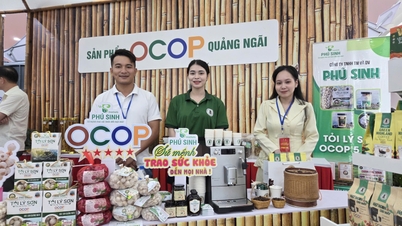
| Currently, the entire province has 207 processed tea products certified under the OCOP program with 3-5 stars. (Photo taken at Phu Luong Agricultural Products Cooperative, Hop Thanh commune). |
Currently, Thai Nguyen tea is processed in three ways: manual processing; industrial processing; and high-tech processing, but semi-industrial processing is more common. This is because tea is considered a special commodity, requiring the skillful hands of artisans to create a refined product.
Before the year 2000, tea farmers in Thai Nguyen province primarily produced hook-shaped tea leaves packaged in plastic bags. Today, they have created over 1,000 different tea products. The tea is packaged using vacuum-sealed machines, ensuring food safety and hygiene. Among these, 207 processed tea products have received OCOP certification ranging from 3 to 5 stars.
Prioritizing tea quality is the pinnacle of Thai Nguyen's brand building. That's why domestic and international tourists visiting Thai Nguyen, while enjoying tea, also hear stories about "lakes on the mountain, tea in the clouds." All these elements blend together, shimmering and encapsulated in the teapot, representing the fragrant essence of this land.
Source: https://baothainguyen.vn/van-hoa/202605/thao-thom-tra-thai-6db2da6/












































































Comment (0)