

With local health systems overwhelmed, international support resources dwindling, and thousands of people at high risk of exposure yet to be located, the Ebola outbreak in the Democratic Republic of Congo is spreading at an alarming rate. Documents from an emergency coordination meeting between the World Health Organization (WHO) and the Africa Centres for Disease Control and Prevention (Africa CDC) reveal a worrying reality: the global response is lagging weeks, even months, behind the actual speed at which the virus is spreading.
Dangerous virus strains and gaps in the healthcare shield.
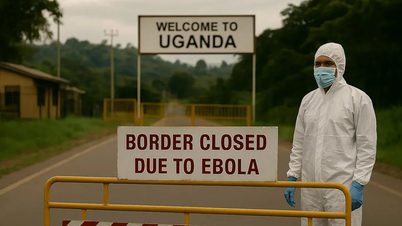
According to WHO reports, the current outbreak has recorded approximately 900 cases in Congo, claiming the lives of around 220 suspected cases. Notably, the disease has officially spread to neighboring Uganda with 7 confirmed cases.
The danger of this outbreak lies in the fact that the causative agent has been identified as the Bundibugyo virus strain, a variant for which there is currently no vaccine or specific treatment. This forces healthcare forces to revert to the most basic defensive measures.
"We are having to go back to the most basic Ebola response methods of the past, a time when we didn't have the tools to control the epidemic as effectively as we do now with vaccines and specific treatments," said Dr. Alan Gonzalez, Deputy Director of Operations at Doctors Without Borders (MSF).
In the fight against Ebola, time is always measured in hours. Finding and isolating contacts within 21 days, the incubation period of the virus, is crucial. However, in Congo, the epicenter of the outbreak, this race is lagging far behind.
As of last week, health authorities had only located and tracked a mere 7% of the more than 1,200 people identified as having had close contact with suspected cases. By the middle of this week, the contact tracing list had rapidly surpassed 2,000 cases, putting immense pressure on an already strained healthcare system.

Medical personnel wearing sterilized protective gear bury an Ebola victim in Mongbwalu, Ituri province, eastern Democratic Republic of Congo, on May 24. Photo: Xinhua.
Although Congo has considerable experience dealing with Ebola, with this being the 17th outbreak since 1976, the current resource shortages have put health workers in a dire position. Health facilities lack the appropriate testing kits specifically for the Bundibugyo strain, leading to delayed diagnoses and allowing the virus to silently spread through the community for the first six weeks.
Professor Salim Abdool Karim, a key consultant for the Africa CDC, stated that the outbreak is moving at a "terrifying speed." Regarding the disease's spread, he frankly said: "If I had to choose the worst place for this to happen, it would be Ituri. There are so few people on the ground, and that creates countless other problems, such as finding fuel for transport vehicles. Everything just piles up."
A wall of skepticism and violence from the community.
Besides medical challenges, the biggest obstacle preventing aid workers from reaching the sick comes from the fear and distrust of the local population. In Ituri province (eastern Congo) - the epicenter of the outbreak - years of ongoing armed conflict have stifled healthcare infrastructure.
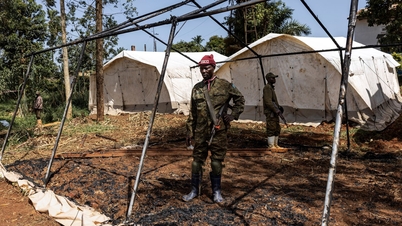
When the epidemic struck, panic escalated the conflict to its peak. Many hospitals and isolation tents were attacked and burned by angry mobs trying to reclaim the bodies of their deceased relatives for burial according to custom. They were unaware that the Ebola-infected corpses carried extremely high viral loads and were a terrifying source of infection.
WHO Director-General Tedros Adhanom Ghebreyesus issued an urgent warning: "This outbreak is overwhelming our capacity to respond. Attacks on healthcare facilities are making it nearly impossible to track cases and close contacts."

A healthcare worker wearing protective gear prepares to bury an Ebola victim in Mongbwalu, Ituri province, eastern Democratic Republic of Congo, on May 24. Photo: Xinhua.
Explaining this sentiment, Mamadou Kaba Barry, head of the Coalition for International Health Action (ALIMA) mission in Congo, said that many suspected cases are quietly disappearing from the reporting system because people fear isolation. "Everyone is afraid. Some cases are disappearing and many other suspected cases are not being reported due to a lack of trust among the population. They fear that if they go into isolation and die, their families will never be able to retrieve their loved one's body," Barry said.
A pivotal factor exacerbating the health crisis in Congo is the lack of international resources. Many sources acknowledge that in the past, outbreaks were often contained more quickly thanks to close coordination and ample funding from the United States, which co-led response campaigns.
However, the US withdrawal from the WHO in January, along with widespread funding cuts from other wealthy nations, has left a huge void. With finances dwindling, organizations have been forced to scale back operations. Amadou Bocoum, Country Director of CARE, shared that his emergency response team has been forced to cut by a third. In this context, Marion Koopmans, a member of the WHO Emergency Committee, acknowledged that determining the true scale and tracing all exposures at this time is "an extremely difficult task."
What is happening in Congo right now is reviving the specter of the historic Ebola disaster in West Africa from 2014–2016, an outbreak that infected more than 28,000 people and claimed the lives of over 11,000.

The Democratic Republic of Congo has stepped up surveillance in its response to the Ebola outbreak, having so far identified more than 900 suspected cases, including 101 confirmed cases. (Photo: Xinhua)
In the coordination meeting document, the WHO Africa team sent out a warning message: "There is no vaccine. There is no cure. The virus has been silently spreading for six weeks undetected. Cross-border spread has been confirmed. Healthcare workers are dying. Every day that passes without a fully resourced response is another day the epidemic is expanding."
A decade after the West African tragedy, the world still seems to have not learned its lesson. Global disease surveillance systems are fractured, while this dangerous virus continues to creep across borders.
As Mamadou Kaba Barry put it: "In West Africa before, people fled because they were afraid. Now, some of the lessons haven't been fully learned. We can never get used to Ebola. It will always be something incredibly terrifying." The fight against the Bundibugyo variant in Congo is no longer just an African story, but a breathtaking test of global health security.
Source: https://phunuvietnam.vn/the-gioi-bao-dong-truc-dot-bung-phat-ebola-moi-238260528123358496.htm
![[Photo] Life on both banks of the river returns to its bustling pace on the day the Long Bien Bridge opens to traffic.](https://vphoto.vietnam.vn/thumb/1200x675/vietnam/resource/IMAGE/2026/05/28/1779949763708_cau-long-bien-minh-duy-7-3610-jpg.webp)

![[Photo] The heat at the fireworks display site on the opening night of the Da Nang International Fireworks Festival 2026](https://vphoto.vietnam.vn/thumb/1200x675/vietnam/resource/IMAGE/2026/05/27/1779889741485_ndo_br_z7872039145157-fecaba5112f39e8352544099d7ef4738-5140-jpg.webp)
















































































Comment (0)