

Slow recovery
According to Mr. Hoang Hai, Director of the Department of Housing and Real Estate Market Management, Ministry of Construction , the real estate sector in Vietnam has faced many difficulties from mid-2022 until the present time.
Specifically, the decrease in supply caused real estate prices, including houses and land plots, to start increasing from the beginning of 2021. By the end of the year, apartment prices had increased by an average of about 5-7%; prices of individual houses in projects increased by 15-20%; and land plot prices increased by 20-30% compared to the end of 2020.
Most notably, apartment prices are continuously reaching new highs due to a decrease in the number of apartments entering the market. Apartments in affordable housing are priced at 25-30 million VND/m2 - 30 million VND/m2, mid-range apartments at 30-50 million VND/m2, and luxury apartments at over 50 million VND/m2, exceeding the investment capacity of their respective income levels.
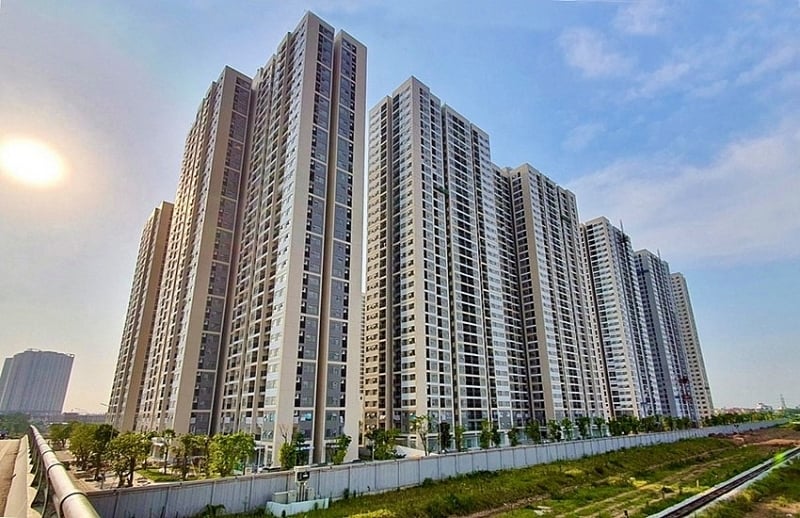
According to Mr. Hai, in recent times, the Prime Minister has taken many decisive actions to remove difficulties for the real estate sector. Most notably, Resolution 33 has yielded initial results, resolving many legal and institutional issues.
However, through working with localities and businesses, Mr. Hai assessed that many housing and urban development projects currently underway are facing difficulties, obstacles, or have been halted due to various reasons, typically those related to land law.
Currently, many projects are facing difficulties and obstacles, and are experiencing delays in implementation due to regulations on land valuation methods. The reasons relate to laws on planning, the authority to make localized adjustments to general planning; the conditions and timing for reviewing, updating, and adjusting planning to ensure the synchronization of construction planning, including general planning and zoning plans; and issues related to investment laws.
Agreeing with this view, Mr. Nguyen Van Dinh - Chairman of the Real Estate Brokers Association - observed that the real estate market is currently facing a shortage of social housing and affordable commercial housing.
Despite strong market demand, there has been a decline in trading volume as investors face the problem of capital being tied up and have to address financial challenges.
During the period of 2022-2023, real estate transactions decreased by 90%, indicating weak market demand. Besides the scarcity of affordable housing, several other issues exist, such as a lack of mechanisms and determination from many localities, leading to many projects remaining unresolved and real estate businesses facing numerous challenges.
Mr. Dinh stated that the efforts of the Government and relevant ministries in issuing various policies to address difficulties in the real estate market have had a positive impact on the market.
According to Mr. Dinh, in the first quarter of 2023, nearly 3,000 products were transacted, and in the second quarter, this number increased by 30%. To date, investor confidence has gradually recovered, and many new projects have started selling on the market, leading to an increase in the number of real estate transactions.
However, improvements in the supply of new housing and the stabilization of buyer sentiment are still progressing slowly, and it will take time to complete new projects.
At the same time, investor sentiment, while gradually stabilizing, remains quite cautious, especially among those facing financial pressure from previous investments.
According to the survey, 70% of businesses stated that policies regarding capital sources have not been truly effective. Of these, two-thirds indicated that local authorities where they have business contracts have begun disseminating information and providing policy support, but only 15% rated policies supporting land use, including land clearance and land use rights, as effective; and 28% rated the implementation of programs for accessing preferential loans as effective.
Dr. Nguyen Van Dinh expects that in the period from the end of 2023 to the beginning of 2024, the real estate market will record more positive signs compared to the end of the second quarter and the beginning of the third quarter of 2024.
Many difficulties in the recovery process.
Dr. Le Xuan Nghia, a member of the National Financial and Monetary Policy Advisory Council, believes that real estate is an essential long-term product, and therefore, an imbalance between supply and demand will lead to a crisis.
According to Mr. Nghia, the Vietnamese real estate market has experienced crises many times. Previous crises were due to oversupply, while this time it's a supply shortage. In this context, businesses lack capital and cannot launch new projects, thus causing the market to "freeze."
“ We are monitoring whether market confidence recovers as real estate corporations and businesses issue bonds. Most recently, one of the largest real estate corporations in the country issued bonds despite having no outstanding bank debt. We are watching with bated breath, but the results show that the market is only cautiously recovering about 30% of what we expected,” commented Dr. Le Xuan Nghia.
According to Mr. Nghia, the real estate market may face difficulties extending into the second and third quarters of next year. To revive the real estate market, the government is aggressively working with task forces to address market difficulties, with the participation of businesses themselves. This is an unprecedented effort, but the results have not been significant.
Meanwhile, Associate Professor Tran Dinh Thien, a member of the Prime Minister's Economic Advisory Group, proposed a key solution. Specifically, the next phase should focus on restoring the confidence of investors, businesses, and consumers.
The recovery process of the Vietnamese economy is showing positive signs; however, the private sector in general, and businesses operating in the real estate sector in particular, still face many difficulties.
To address current challenges, Associate Professor Tran Dinh Thien suggests that the government needs to provide stronger support to revive the real estate market. In addition, to promote the development of this market, both on the supply and demand sides, loan guarantee funds should be established. The Ministry of Finance needs to implement measures to ensure safety and alleviate the burden on the banking system.
Currently, the government has issued a series of solutions to alleviate difficulties for businesses and is focusing wholeheartedly on supporting them. However, the confidence of businesses and investors has not yet fully recovered, and it is necessary to continue identifying difficult situations and unusual circumstances in order to have unconventional approaches and solutions.
In addition, business associations need to continue to raise their voice to help state agencies quickly identify difficulties, thereby enabling timely policies and measures to address them.
Dinh Tran
Source


![[Photo] The General Secretary, President and his wife begin their state visit to the Philippines.](https://vphoto.vietnam.vn/thumb/1200x675/vietnam/resource/IMAGE/2026/05/31/1780230559452_anh-man-hinh-2026-05-31-luc-19-28-11.png)
![[Photo] Admire the coral "masterpiece" amidst the million-year-old heritage of Dak Lak province.](https://vphoto.vietnam.vn/thumb/1200x675/vietnam/resource/IMAGE/2026/05/31/1780221235105_anh-man-hinh-2026-05-31-luc-16-53-27.png)
![[Photo] Solemn bathing ceremony and Buddha procession in Hue](https://vphoto.vietnam.vn/thumb/1200x675/vietnam/resource/IMAGE/2026/05/31/1780228263543_1-jpg.webp)

















![[Video] Sunset at Lap An Lagoon – Where the sun sets over the fishing nets](https://vphoto.vietnam.vn/thumb/340x192/vietnam/resource/IMAGE/2026/05/31/1780192137701_beach-landscape-sea-water-nature-grass-745871-pxhere-com.jpeg)








































![[Photo] Admire the coral "masterpiece" amidst the million-year-old heritage of Dak Lak province.](https://vphoto.vietnam.vn/thumb/402x226/vietnam/resource/IMAGE/2026/05/31/1780221235105_anh-man-hinh-2026-05-31-luc-16-53-27.png)































Comment (0)