

Identifying the "essence" of Hanoi in public spaces.
- Dr. Architect Nguyen Thai Huyen, how do you assess the current system of parks, gardens, and green spaces in Hanoi?

Hanoi has identified the development of parks and green spaces as one of the key tasks in its urban planning. The city is implementing many comprehensive solutions, from reviewing and adjusting plans to ensure feasibility to prioritizing investment in new construction and renovation of existing spaces. In addition, tree planting activities at schools, hospitals, offices, and residential areas have been strongly promoted recently. However, reality shows that the system of parks, gardens, and green spaces in the inner city still falls short of expectations. Many residential areas, especially in the old inner city, suffer from a serious lack of green space. Not only is there a shortage of area, but Hanoi's public space system also reveals many limitations in terms of structure and accessibility. Many areas are difficult to access, lack community activities, shade, basic amenities, or have become commercialized. This not only affects the quality of urban life but also diminishes community life and the spatial identity of Hanoi.
- In your opinion, when discussing Hanoi's identity in public spaces, where should we begin?
- If I had to choose a starting point, I would say it's not design, but identity. That means understanding: What defines "Hanoi" in the perception of its people when they enter a public space? First, it's necessary to understand that identity is not a collection of formal elements like curved roofs, traditional motifs, or cultural symbols. Identity – viewed from the perspective of architect Christian Norberg-Schulz's "soul of the place" theory – is the ability of a space to allow people to recognize where they are and feel a sense of belonging.
For Hanoi, identifying identity in public spaces must begin with three layers: The physical layer – the characteristic urban structure with narrow alleys, communal courtyards, lakes, and greenery; the social layer – daily routines such as morning exercise, conversation, and community activities; and finally, the urban memory layer – the history through different periods. Our research shows that the system of flower gardens in the historical inner city area is highly valuable not only for its form, but also because it is connected to community life and a specific historical context. For example, Thong Nhat Park preserves historical landmarks, stories of special people and events, connected to the people's aspirations for national reunification, or the Ly Thai To flower garden on the shores of Hoan Kiem Lake in Hanoi, which has had many different names in the past, each name associated with a historical story of Thang Long... Thus, identifying identity is not about "finding differences," but about deeply understanding what already exists.
- In fact, many new public spaces today are criticized for "lacking identity." In your opinion, where does the problem lie?
- I think there's a common misconception: We tend to equate identity with form. Some places try to create identity for public buildings by incorporating traditional details like patterns, monuments, curved roofs... But if they stop there, it's easy to fall into the trap of "faking antiquity," or in other words, recreating the past superficially.
A closer observation reveals the flexibility in the use of space by Hanoi's urban residents. A sidewalk in the morning can be a place for exercise, a resting place at noon, and a playground for children in the afternoon. This clearly demonstrates a sense of community and connection among people. People don't just pass through the space; they stop, chat, and naturally form social relationships. Furthermore, there's a close connection with nature – trees, water, shade. These elements are not only ecological but also emotionally connected, and without them, even the most beautiful space will lack a distinct identity.
The reality is that while we are investing heavily in large parks, their utilization is not yet efficient. Public spaces only truly have value when they become places to live – that is, places with activities, memories, and a sense of belonging. Many parks today fail to attract large crowds because their designs prioritize form over substance, lack behavioral research, do not offer activities relevant to residents' lives, and lack effective governance and operational mechanisms. Meanwhile, traditional gardens, though small, possess immense vitality because they are easily accessible, suit people's habits, and are deeply connected to the local community.
Our research also indicates that public spaces only truly fulfill their value when they become places for interaction, recreation, and social activities. Therefore, the deciding factor is not the scale of investment, but the ability to integrate the space with daily life.
To make public spaces truly "alive"
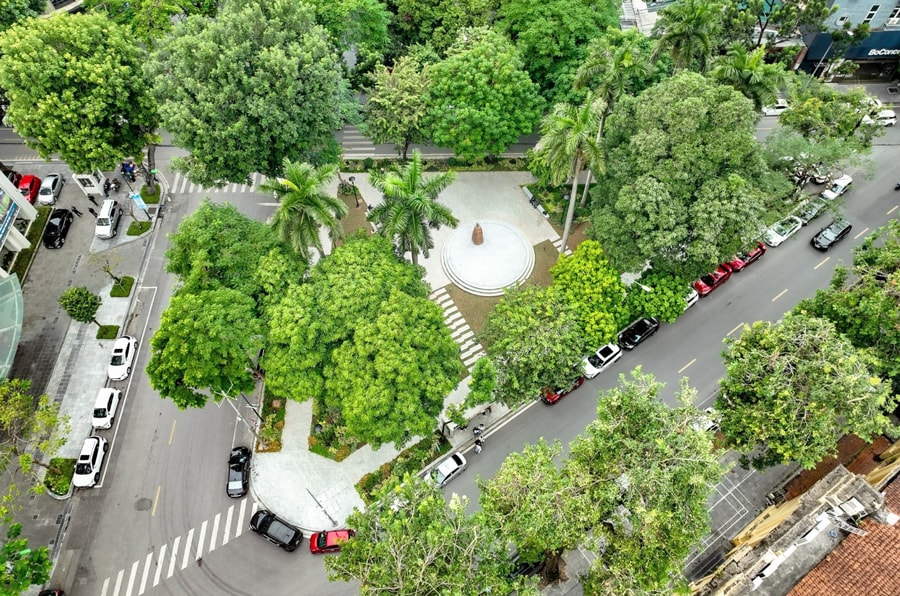
- So, starting from identifying the characteristics of public spaces, how do we then move towards creating a unique Hanoi identity in those places, Madam?
In my opinion, there are three key shifts. First, we need to move from formal design to experiential design. Instead of asking what the space looks like, let's ask: What will people do there? Will they stay? Will they return? A public space with a distinct identity must create multiple usage scenarios, be flexible, and allow people to use it naturally.
Secondly, it is necessary to respect Hanoi's distinctive spatial structure – a multi-layered structure where public, semi-public, and private spaces are intertwined. New public spaces cannot be isolated but must connect with the existing urban network, creating transitional layers and integrating with surrounding life.
Third, and most importantly, is the principle of co-creation: Identity cannot be designed from the top down, but must be formed through community participation from consultation and flexible use to the maintenance of spontaneous activities. It is this process that ensures public spaces not only "exist," but truly "live."
- In your opinion, how can we leverage the institutional breakthroughs from the 2026 Capital City Law and the Hanoi Capital City Planning with a 100-year vision to develop public spaces that reflect Hanoi's unique identity?
- A favorable institutional framework is necessary, but only a prerequisite. Real effectiveness depends on synchronized design and operation. First, planning needs to clearly establish minimum thresholds for public space, minimizing the possibility of arbitrary adjustments; organizing the spatial system according to a logical network rather than fragmented points. Next is management, which clearly defines operational responsibilities, ensures genuine public nature (wide accessibility, no commercialization), and tightly controls functional changes during use. Finally, social tools will play a key role in maintaining long-term quality through community participation, transparency of planning and management information, and the establishment of independent oversight mechanisms.
Hanoi possesses a significant advantage: its cultural depth and an urban society that still retains strong community interactions. If properly exploited, this will provide an excellent foundation for building a unique identity. However, if it merely continues to chase after superficial forms or copy external models, the risk of losing its identity is very real.
Thank you very much, ma'am!
Source: https://hanoimoi.vn/thiet-design-nhung-noi-chon-mang-ban-sac-ha-noi-884357.html
![[Image] Pleasant weather helps students enter the 10th grade entrance exam with confidence.](https://vphoto.vietnam.vn/thumb/1200x675/vietnam/resource/IMAGE/2026/05/29/1780034401612_ngay-1-thi-lop-10-minh-duy-8-5009-jpg.webp)


![[Photo] Ba Lang An Lighthouse - the "eye of the sea" amidst the "rock museum" of Quang Ngai province.](https://vphoto.vietnam.vn/thumb/1200x675/vietnam/resource/IMAGE/2026/05/29/1780038698840_anh-man-hinh-2026-05-29-luc-14-10-42.png)




































































Comment (0)