

The former Dị Nậu commune, now merged into Thọ Văn commune, is an ancient land rich in cultural heritage. The ancients called this place Kẻ Núc – an ancient Vietnamese village belonging to the center of the Văn Lang tribe during the Hùng Vương era.
Over generations, this land has been home to a system of communal houses, temples, pagodas, and shrines, along with unique folk customs and festivals. And amidst this ancient setting, heritage trees stand as an integral part of the homeland's soul.
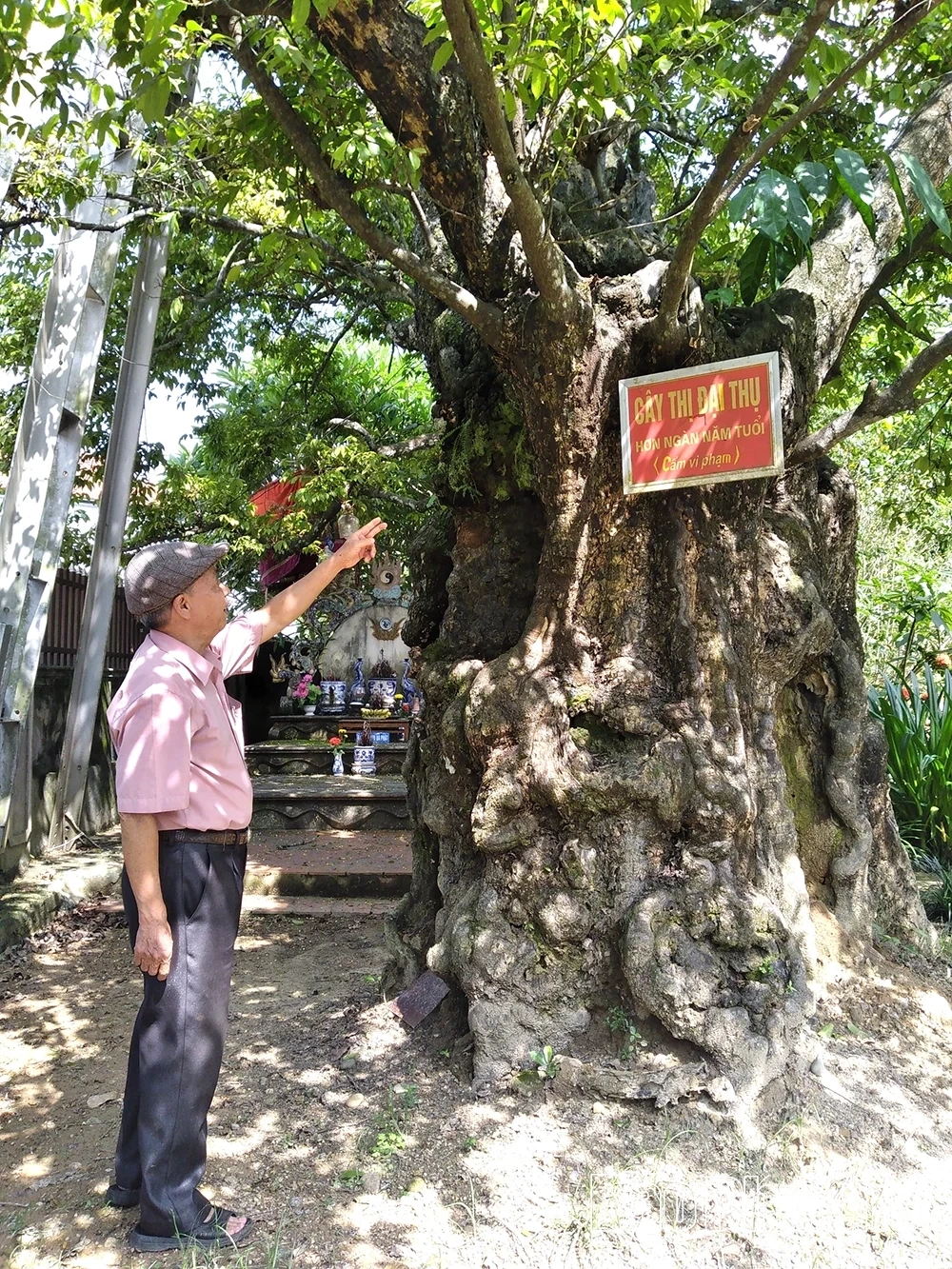
The thousand-year-old persimmon tree remains lush and green, casting its shade over the shrine dedicated to Saint Tan Vien.
The path leading to the shrine of Saint Tan Vien in the early summer days is shaded by an ancient persimmon tree. From afar, the tree appears majestic, its gnarled trunk covered in the patina of time. According to local records, the tree was planted during the reign of Dinh Bo Linh, more than a thousand years ago.
The tree's base has a circumference of up to 7.6 meters, and its trunk is so large that it would take six people to encircle it. What surprises many people is that despite its great age, the tree remains lush and green, with abundant branches and leaves, and continues to bloom and bear fruit every year.
Under the shade of the persimmon tree, the elderly and children of the village often sit and chat and play together every evening. For many locals, the persimmon tree is not simply a rare ancient tree, but also a part of their childhood memories. The gentle fragrance of ripe persimmons at the end of summer has accompanied generations growing up in this peaceful village.
Not far away, within the grounds of Dam Nhan Pagoda, seven ancient frangipani trees remain evergreen, blooming with pristine white flowers in the summer, filling the entire temple courtyard with their fragrant scent. Their gnarled, weathered trunks further enhance the tranquil and sacred atmosphere of the ancient pagoda.
Locals still tell stories that, having survived wars and natural disasters, these ancient trees have persevered, serving as a testament to the resilience of the village. During difficult times, when the trees were afflicted with disease or rotten branches threatened to fall, the villagers would work together to care for, support, and protect each tree.
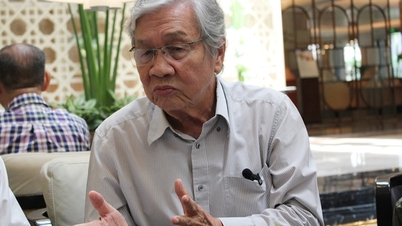
Mr. Ta Dinh Hap, nearly 90 years old, is one of the dedicated individuals committed to preserving the local heritage tree. He said: “The ancient tree has survived to this day thanks to the care of countless generations of villagers. We always consider the tree a treasure of the village. Every time I see the tree thriving, I feel as if our ancestors are still present, still watching over their descendants today.”

A corner of Dam Nhan Pagoda is shaded by a centuries-old frangipani tree.
According to Mr. Hap, the most valuable thing is that the local people are always consciously protecting the trees. No one arbitrarily cuts branches, digs around the base, or encroaches on the growing space of the ancient trees. On every festival or on the 15th and 1st day of the lunar month, many people who come to offer incense at the shrine or temple still take the time to clean and take care of the landscape around the heritage trees.
In 2012, the thousand-year-old persimmon tree and seven frangipani trees in Di Nau were recognized as Vietnamese heritage trees. For the local people, this was not only a source of joy but also immense pride. The title served as an affirmation of the cultural and historical value of this ancient land along the Red River.
In recent years, many tourists from within and outside the province have come to Tho Van to admire the ancient persimmon tree and learn about the cultural life of an old Vietnamese village. Many people, standing under the canopy of the ancient persimmon tree, feel a unique sense of peace and tranquility typical of this midland countryside.
Amidst the hustle and bustle of modern life and its many changes, the heritage trees in Tho Van silently stand as a thread connecting the past with the present. The people here understand that preserving these ancient trees is not only about protecting the landscape and the environment, but also about preserving the memories of their village, the values that their ancestors have painstakingly cultivated for generations. For them, heritage trees represent history, culture, and a part of the soul of their homeland.
Hong Nhung
Source: https://baophutho.vn/tho-van-gin-giu-cay-di-san-255369.htm
![[Photo] First session of the 14th Congress of the Vietnam Trade Union](https://vphoto.vietnam.vn/thumb/1200x675/vietnam/resource/IMAGE/2026/06/03/1780465947883_ndo_br_img-3852-jpg.webp)

![[Photo] Secretary of the National Assembly Party Committee, Chairman of the National Assembly presides over the meeting of the Standing Committee and Executive Committee of the National Assembly Party Committee.](https://vphoto.vietnam.vn/thumb/1200x675/vietnam/resource/IMAGE/2026/06/03/1780480353201_ndo_br_bnd-2585-jpg.webp)
![[Photo] General Secretary and President To Lam presides over a meeting with the Central Organizing Committee.](https://vphoto.vietnam.vn/thumb/1200x675/vietnam/resource/IMAGE/2026/06/03/1780482764658_a1-bnd-4741-3342-jpg.webp)





































![[Video] Sunset at Lap An Lagoon – Where the sun sets over the fishing nets](https://vphoto.vietnam.vn/thumb/1200x675/vietnam/resource/IMAGE/2026/05/31/1780192137701_beach-landscape-sea-water-nature-grass-745871-pxhere-com.jpeg)































Comment (0)