

Large timber production
This is the middle of the dry season, and taking advantage of the favorable weather, thousands of households in the province are actively harvesting timber to prepare for the new reforestation season. Ms. Nguyen Thi Huong's family in Cai Vang village, Dong Phu commune, owns 160 hectares of economic forest. Since the beginning of the dry season, the family has harvested 20 hectares of 7-year-old eucalyptus forest and a portion of pine forest over 20 years old (after the resin harvesting period has ended), earning a profit of over 3 billion VND.
|
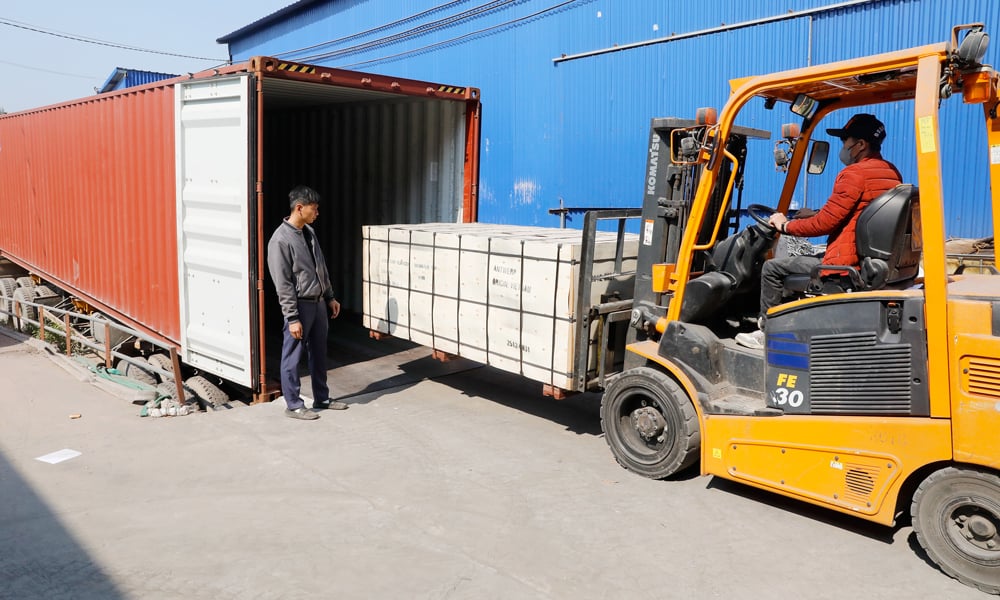
Workers at Bao Minh Production and Trading Company Limited in Tam Tien commune are loading processed wood products onto containers for export to the European market. |
Mr. Tran Dinh Men, from Quynh Nau village, Tam Tien commune, owns nearly 45 hectares of planted forest. In 2025, Mr. Men plans to harvest 11 hectares of mature timber forest (mainly eucalyptus) that is over 10 years old. Because he has mastered intensive cultivation techniques and has access to capital, Mr. Men chose to plant mature timber forests (harvesting only after 8-13 years, instead of the 4-5 year harvesting cycle used by many other forest owners), earning an additional profit of 100-200 million VND per hectare (depending on the age of the trees).
In 2025, Bac Ninh province will harvest over 12,180 hectares of concentrated planted forests, with a total timber output of over 1.52 million cubic meters. 3 The province currently has 727 businesses involved in processing forest products, mainly processing timber from planted forests. The value of forestry production in 2025 (at current prices) is expected to reach over 2.36 trillion VND, an increase of 5.3% compared to 2024. |
According to Mr. Men, planting large timber forests has many benefits. Besides saving on initial costs for seedlings, fertilizers, and labor, the quality of the timber is higher, not only for wood chips to make pulp but also for veneer or sawn timber, increasing economic value. “Currently, along with harvesting timber, my family is hiring workers to prune dead or stunted trees, helping the remaining trees grow well and achieve higher yields. At the same time, we are preparing materials, seedlings, and improving the soil in preparation for the new planting season when the rain comes,” Mr. Men said. To increase the value of the planted forest, Mr. Men invested in three wood peeling machines, both to peel veneer from the timber harvested by his family and to purchase timber from other households in the area for processing.
According to the head of the Forest Protection Department (Department of Agriculture and Environment), in 2025, the entire province will harvest more than 12,180 hectares of concentrated planted forests, with a total timber output of over 1.52 million m³ ( the highest ever, ranking second among northern provinces and seventh nationwide). The average timber output will reach 125 m³ / ha/5 years of planting. Of this, large timber accounts for 46%, reaching 152% of the plan; more than 37,780 m³ will be harvested from scattered trees .
Output advantages
Large timber production has spurred the development of the province's plantation timber processing industry. The province has 727 forest product processing businesses (including 149 organizations and 578 households and individuals). The main raw material used in production is plantation timber, with the primary products being veneer, wood chips, plywood, formwork, and household furniture.
According to surveys, most timber processing facilities in the province are operating quite efficiently. Mr. Dinh Manh Huy, owner of a timber processing workshop in Thong Nhat village, Tay Yen Tu commune, reported that his facility currently purchases over 40 cubic meters of acacia and eucalyptus wood daily to be peeled into raw wood planks, nearly doubling production compared to August 2025.
|
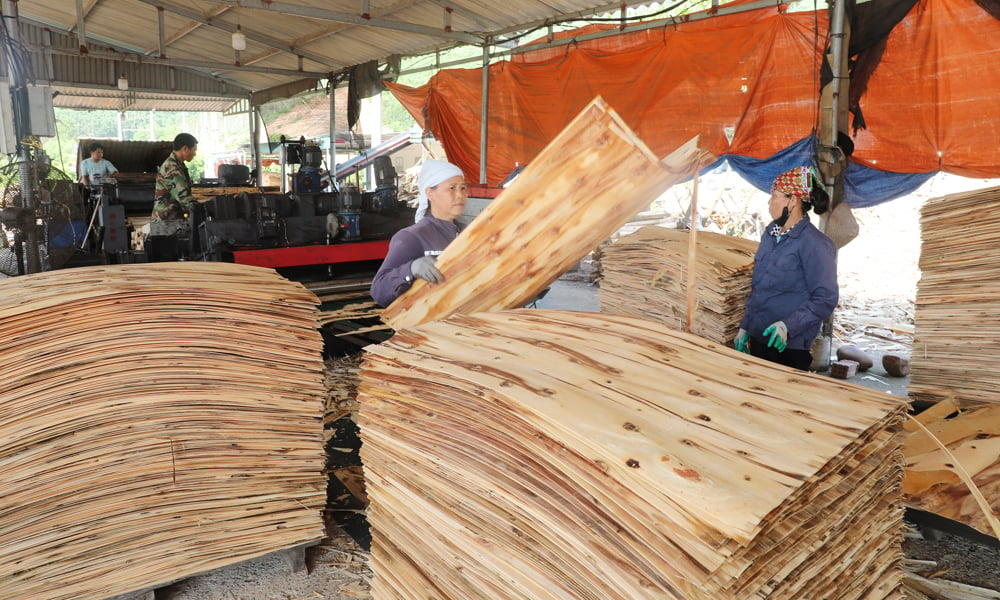
Sorting peeled wood veneer at the wood processing workshop of Mr. Dinh Manh Huy, Thong Nhat village, Tay Yen Tu commune. |
Along with plywood peeling and wood chip production for pulp, many businesses in the province have invested in modern production lines to process finished wood products for export. At Bao Minh Production and Trading Co., Ltd. in Tam Tien commune, Mr. Tran Van Luan, the company's director, stated that the business invested 25 billion VND to build a factory and purchase two plywood processing lines; the production is a closed loop from plywood peeling to pressing and packaging. Currently, the company produces approximately 40 m³ of plywood and film-faced plywood per day . All products are exported to the European market. The company provides stable employment and income for 50 workers, with salaries ranging from 10 to over 13 million VND per person per month.
According to the Department of Industry and Trade's assessment, the market for veneer and processed wood products in the province, and in Vietnam in general, is currently very favorable. Besides serving domestic construction and household goods production needs, some wood processing enterprises in the province have exported plywood/film-faced plywood products to countries such as the United States, Japan, South Korea, India, and especially the European market (because Europe is restricting wood imports from the Russian Federation – the world's largest wood exporter) due to sanctions.
Favorable conditions for timber production, processing, and export are expected to help the province's forestry export value reach approximately US$115 million in 2025; the value of forestry production in 2025 (at current prices) is projected to exceed VND 2.36 trillion, a 5.3% increase compared to 2024, creating jobs and income for thousands of workers. Besides domestic raw materials, timber processing facilities in Bac Ninh also purchase timber from plantations in other provinces and cities nationwide for processing.
To facilitate the exploitation, processing, and especially the export of plantation timber products, in 2025, the Bac Ninh Forest Protection Department, in coordination with the Center for Forestry Economics (under the Vietnam Forestry Science Institute), the People's Committees of communes, and forest owners, will pilot the issuance of planting area codes for raw material forests to forest owners in the province. As a result, over 4,200 hectares of production forests have been granted planting area codes, corresponding to over 3,800 codes. The Department will receive the Itwood software application from the Center for Forestry Economics for use in the issuance and management of planting area codes for the areas that have already been assigned codes. This is one of the necessary solutions to prove the origin and provenance of plantation timber products from the province. This will enhance the reputation, position, and value of exported forest products.
Text and photos: The Dai
Source: https://baobacninhtv.vn/thu-hoach-rung-kinh-te-san-luong-lon-gia-tri-cao-postid437272.bbg
![[Photo] Solemn bathing ceremony and Buddha procession in Hue](https://vphoto.vietnam.vn/thumb/1200x675/vietnam/resource/IMAGE/2026/05/31/1780228263543_1-jpg.webp)


![[Photo] Admire the coral "masterpiece" amidst the million-year-old heritage of Dak Lak province.](https://vphoto.vietnam.vn/thumb/1200x675/vietnam/resource/IMAGE/2026/05/31/1780221235105_anh-man-hinh-2026-05-31-luc-16-53-27.png)
![[Photo] The General Secretary, President and his wife begin their state visit to the Philippines.](https://vphoto.vietnam.vn/thumb/1200x675/vietnam/resource/IMAGE/2026/05/31/1780230559452_anh-man-hinh-2026-05-31-luc-19-28-11.png)


















![[Video] Sunset at Lap An Lagoon – Where the sun sets over the fishing nets](https://vphoto.vietnam.vn/thumb/340x192/vietnam/resource/IMAGE/2026/05/31/1780192137701_beach-landscape-sea-water-nature-grass-745871-pxhere-com.jpeg)





































![[Photo] Admire the coral "masterpiece" amidst the million-year-old heritage of Dak Lak province.](https://vphoto.vietnam.vn/thumb/402x226/vietnam/resource/IMAGE/2026/05/31/1780221235105_anh-man-hinh-2026-05-31-luc-16-53-27.png)































Comment (0)