

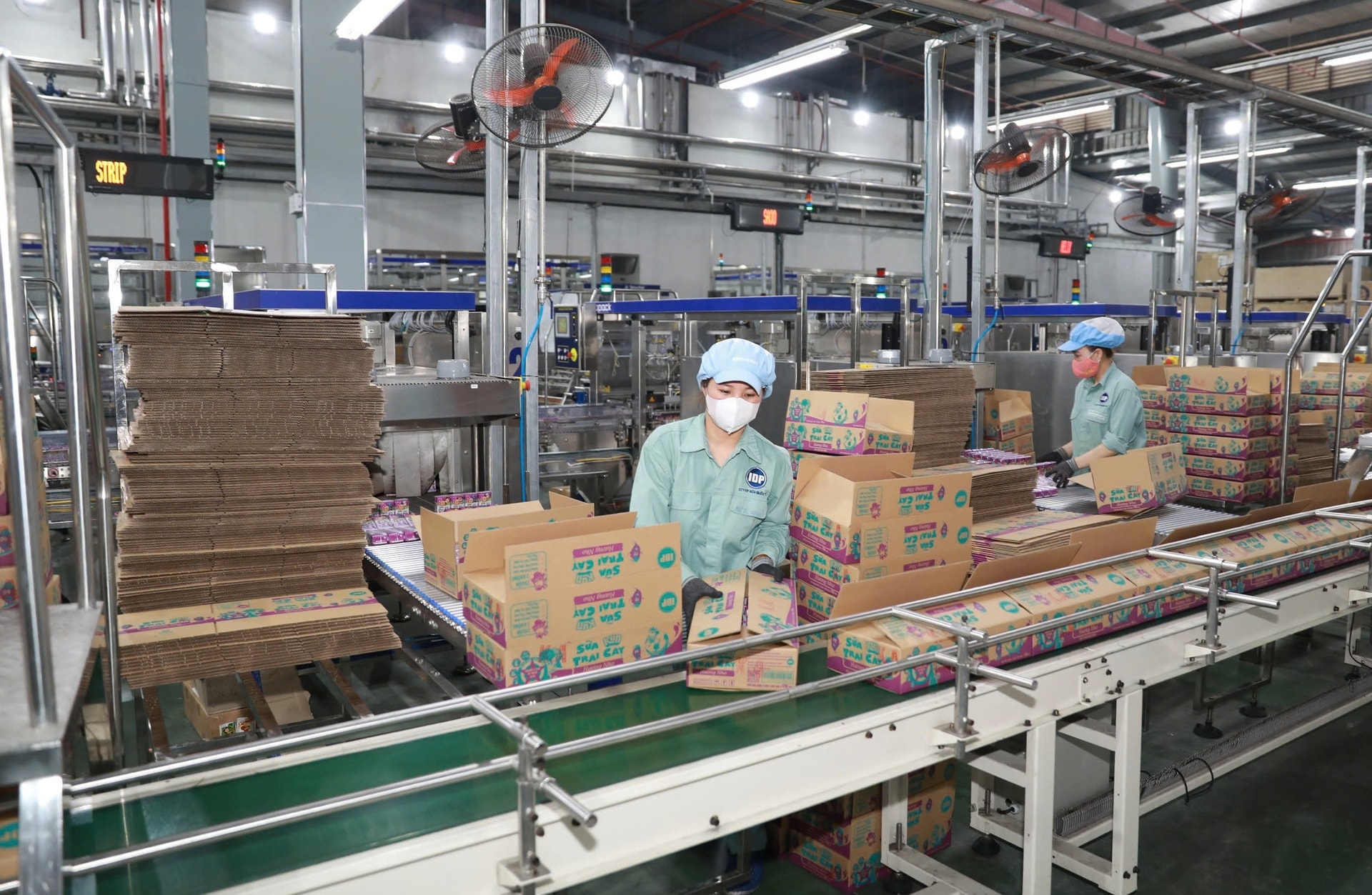
According to the General Statistics Office, Vietnam is still in a period of demographic dividend, with a large and growing working-age population, and a labor force participation rate of approximately 69% for those aged 15 and over; about 500,000 people are added to the labor force annually.
The labor force aged 15 and over in the first quarter of 2025 was 52.9 million people, a decrease of 230,700 people compared to the previous quarter and an increase of 532,000 people compared to the same period last year.
The proportion of trained workers with degrees or certificates is 28.8%, an increase of 0.2 percentage points compared to the previous quarter and an increase of 1 percentage point compared to the same period last year.
The labor structure continues to shift positively towards a decrease in the proportion of labor in the agriculture, forestry, and fisheries sectors, and an increase in the proportion in the industrial, construction, and service sectors.
The number of employed people in the first quarter reached 51.9 million, a decrease of 234,000 people, or 0.45%, compared to the previous quarter, and an increase of 532,100 people, or 1.04%, compared to the same period last year.
The workforce in agriculture, forestry, and fisheries reached 13.5 million people, a decrease of 305,000 compared to the same period last year; the industrial and construction sector reached 17.3 million people, an increase of 262,700; and the service sector reached 21.1 million people, an increase of 574,400.
The socio -economic situation in Vietnam during the first quarter of 2025 achieved many positive results, contributing to a reduction in the underemployment and unemployment rates. Overall, in the first quarter, the unemployment rate among the working-age population was 2.20%, a decrease of 0.02 percentage points compared to the previous quarter and a decrease of 0.04 percentage points compared to the same period last year.
The number of underemployed people of working age in the first quarter was approximately 797,000, an increase of 32,400 compared to the previous quarter and a decrease of 136,000 compared to the same period last year.
The limitations of the labor market were also pointed out, such as the limited quality of labor supply, which does not yet meet the demands of a modern, flexible, sustainable, and integrated market.
Nationwide, only 28.8% of the workforce has received training with degrees or certificates, lacking both in quantity and technical expertise, especially in high-quality human resources. Many new jobs are still unskilled, seasonal, and unstable.
While employment is trending upwards, the labor market is not yet developing sustainably. Specifically, the informal employment rate remains high at 64.3%, an increase of 0.7 percentage points compared to the previous quarter. Those employed in the informal sector work in precarious, unstable jobs with low incomes.
Businesses withdrawing from the market remain at a high level, directly impacting job opportunities, especially in labor-intensive industries such as textiles, construction, and manufacturing.
Due to the shift in the labor structure from agriculture, forestry, and fisheries to industry, construction, and services, Vietnam's labor productivity has remained very low compared to other countries in the region, although it has improved significantly with a steady increase over the years.
Source: https://hanoimoi.vn/thu-nhap-cua-nguoi-lao-dong-tang-720-000-dong-so-voi-quy-i-2024-699098.html
![[Image] Central Party Office summarizes work in 2025](/_next/image?url=https%3A%2F%2Fvphoto.vietnam.vn%2Fthumb%2F1200x675%2Fvietnam%2Fresource%2FIMAGE%2F2025%2F12%2F18%2F1766065572073_vptw-hoi-nghi-tong-ket-89-1204-jpg.webp&w=3840&q=75)















































































Comment (0)