

On the morning of February 12th, the National Assembly held group discussions on the draft Law on the Promulgation of Legal Normative Documents (amended). The draft law proposes adding the authority to the Government to issue normative resolutions, alongside the current decree format. 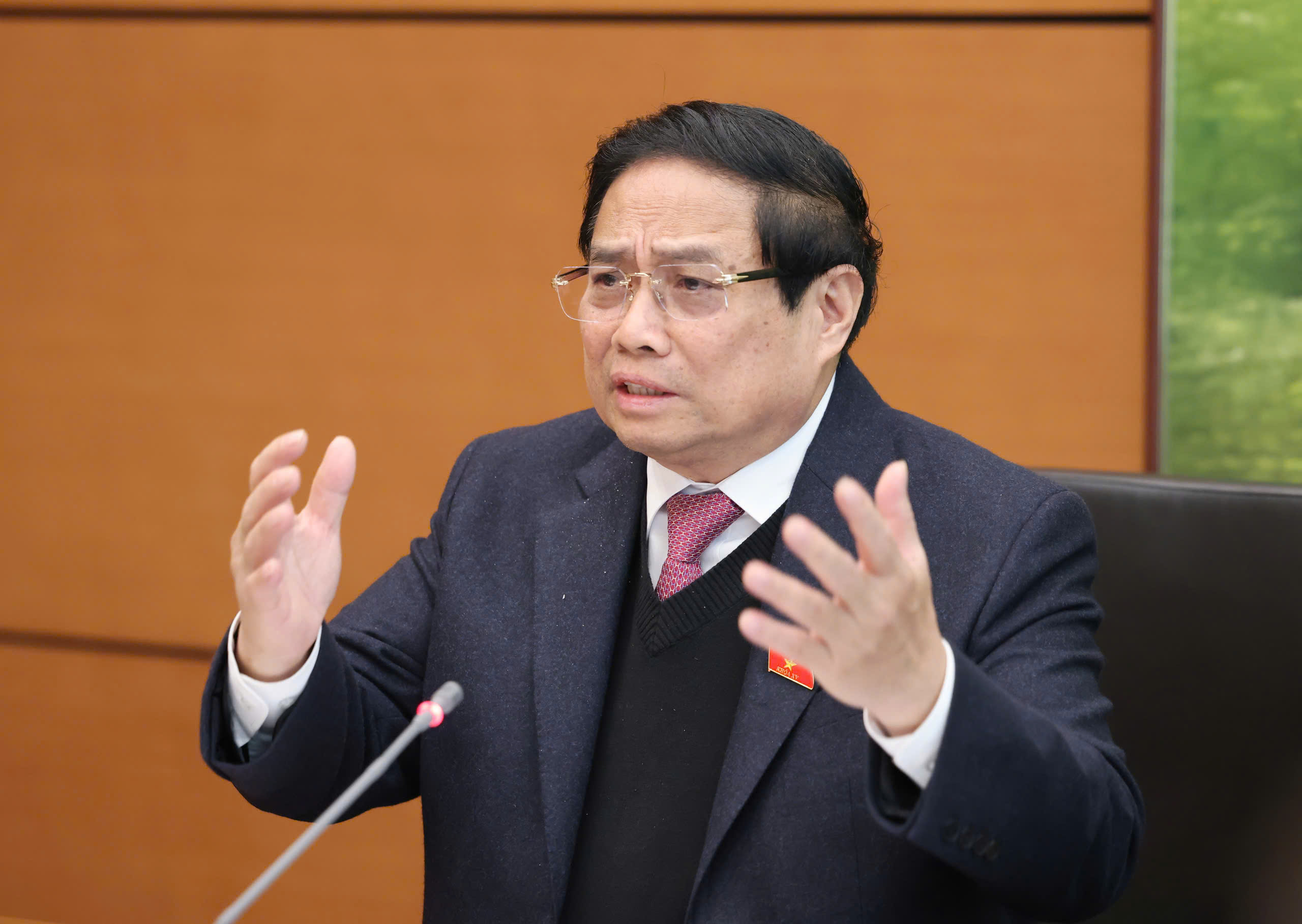
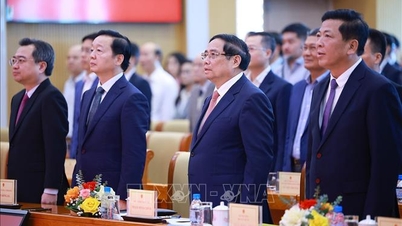
The Prime Minister delivered a speech at the group meeting on the morning of February 12.
PHOTO: GIA HAN
A decree alone will be slow.
In his remarks during the discussion, Prime Minister Pham Minh Chinh affirmed that the provision allowing the Government to issue normative legal resolutions is essential.
Experience shows that life is constantly changing very quickly. For example, less than a month after President Donald Trump took office, "the world situation has been turned upside down, and countries have to focus on finding solutions to counter the United States."
Similar to the Covid-19 pandemic a few years ago, the National Assembly could not convene, so the Government had to issue resolutions to implement measures such as social distancing, quarantine, and restrictions on movement.
Based on the examples just mentioned, the Prime Minister emphasized the principle that what is clear, mature, proven correct and effective in practice, and supported by the majority should be legalized. Conversely, anything that is subject to change should be entrusted to the executive branch for timely handling.
The head of government also stated that there are specific issues that need immediate attention, and the government can hold a meeting for an hour to make a decision. Without a legally binding resolution, things become very difficult. "If a document lacks legal force, who would dare to issue it? Who would dare to act?" the Prime Minister said.
Recalling the case of the 12 earthen mounds at Tan Son Nhat Airport, the Prime Minister stated that these mounds were built 60-70 years ago, the records were lost, and their depreciation value had expired. However, according to the law, they still needed to be assessed and valued, so no one did it. As a result, the runway was completed, but because of the mounds, planes could not take off or land. Ultimately, the Government had to issue a resolution to address the issue.
The above case is another example demonstrating the necessity of government resolutions to address urgent issues at a specific time. Currently, only decrees exist, and even if drafted using a simplified process, they still require consultation with all relevant agencies, leading to delays.
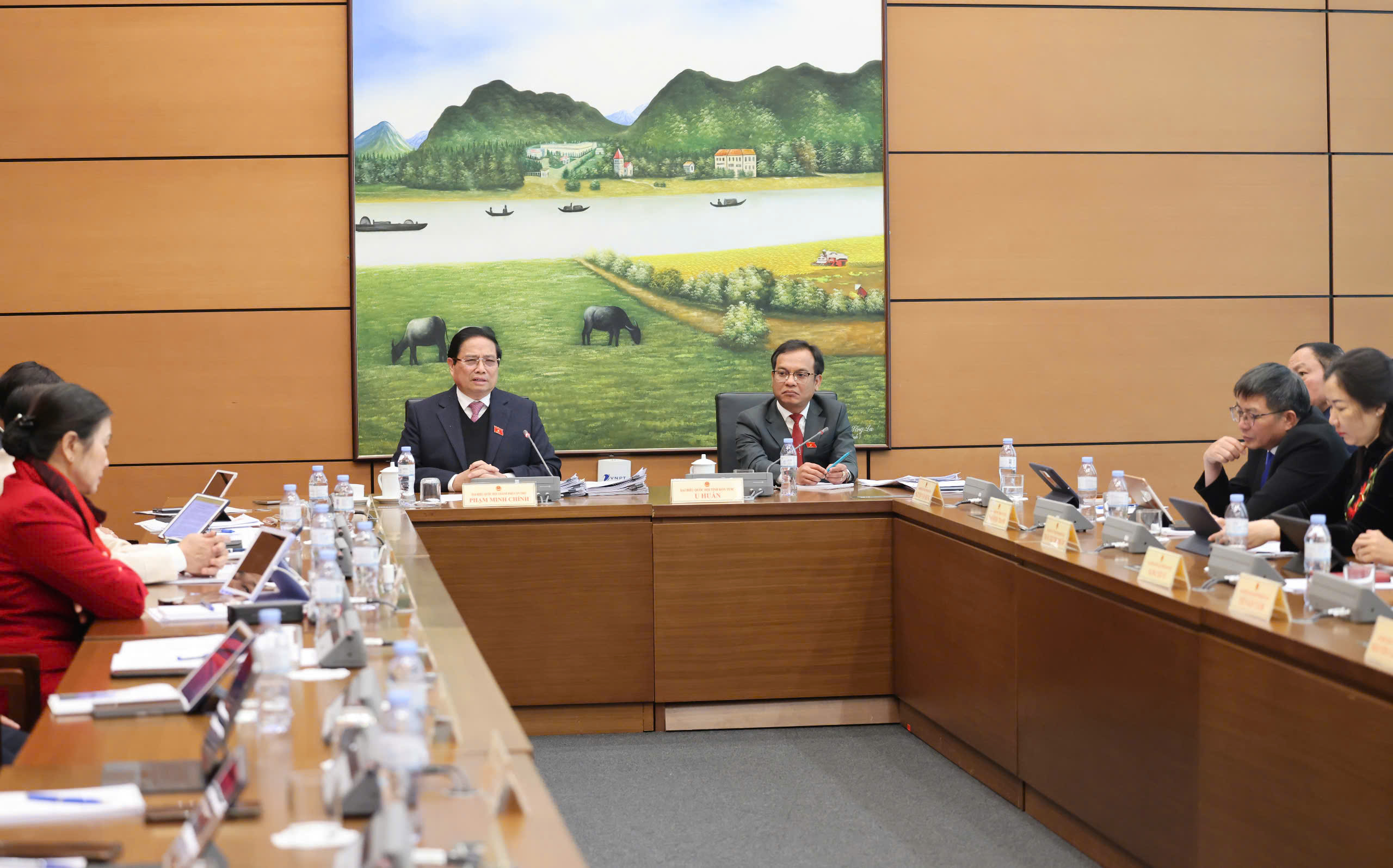
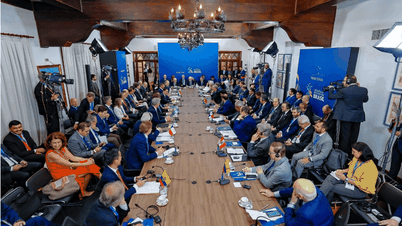
Delegates discussed the draft law on the promulgation of legal normative documents (amended).
PHOTO: GIA HAN
"It seems like a lot of power, but in practice it's not suitable."
Continuing the discussion, Prime Minister Pham Minh Chinh mentioned the constantly changing reality, "there are many things to deal with," which the law cannot always foresee.
This requires that the regulations in the law be designed in a way that provides a framework and principles, creating room for executive agencies, businesses, and citizens to be flexible and creative, "as long as there is no embezzlement, corruption, or vested interests."
For example, during the recent Covid-19 pandemic, Vietnam had experience dealing with cholera, fever, measles, etc., but no one anticipated the negative impact of Covid-19. There were immediate challenges regarding test kits, medicines, vaccines, etc., but the existing laws did not cover everything.
Alongside creating a creative space, the Prime Minister also suggested that there should be mechanisms to protect creators who accept the risks involved in applying their creativity.
Referring to the story of the village headman who promptly led villagers to the mountains and saved them from a flash flood in Lao Cai, the Prime Minister said that if everyone escaped harm, the village headman would be a hero, but if something happened along the way, he could become a villain. Clearly, the village headman's actions were creative and stemmed from pure motives, and therefore should be considered if any risks occurred.
Another story is that during Typhoon Yagi, when water levels rose, the question arose as to whether or not to demolish the Thac Ba dam to ensure safety. Current regulations grant the Prime Minister the authority to make this decision, but the Prime Minister considered it inappropriate.
Ideally, the decision on whether or not to demolish the dam should have been made by the Minister of Agriculture and Rural Development, as the minister was directly present and in charge of the dike system. However, instead of direct intervention, the decision went through an intermediary: the minister had to report to the Prime Minister, "but the Prime Minister wasn't even there," while the decision had to be made in a split second.
Because of such regulations, the Minister of Agriculture and Rural Development "has to wait for me, while constantly traveling, sometimes with signal, sometimes without." "One might think that having such great power is appropriate, but in practice it's not," the Prime Minister said.
To overcome these limitations, the Prime Minister suggested that when designing the revised Law on the Promulgation of Legal Normative Documents, it is necessary to strengthen decentralization and delegation of power, reduce administrative procedures, and individualize related responsibilities.
Thanhnien.vn


![[Photo] Prime Minister Pham Minh Chinh presides over a meeting on private sector economic development.](/_next/image?url=https%3A%2F%2Fvphoto.vietnam.vn%2Fthumb%2F1200x675%2Fvietnam%2Fresource%2FIMAGE%2F2025%2F12%2F20%2F1766237501876_thiet-ke-chua-co-ten-40-png.webp&w=3840&q=75)

























































Comment (0)