


New drivers of double-digit growth
According to Mr. Nguyen Xuan Minh, Director of International E-commerce at Sunhouse, sales on Amazon tripled compared to the same period last year, largely due to the steamer. "It's not a familiar product of Sunhouse, nor is it very popular with Vietnamese consumers. None of us expected it, but the steamer, priced at $30, is our most popular product," Mr. Minh said.
Sunhouse's story is a vivid example of the rapidly emerging wave of e-commerce exports by Vietnamese businesses. E-commerce is becoming a new "export gateway," helping businesses directly reach global consumers, reduce reliance on intermediaries, and gradually build national brands in the digital space. This trend is reinforced by the impressive growth of the domestic e-commerce market.
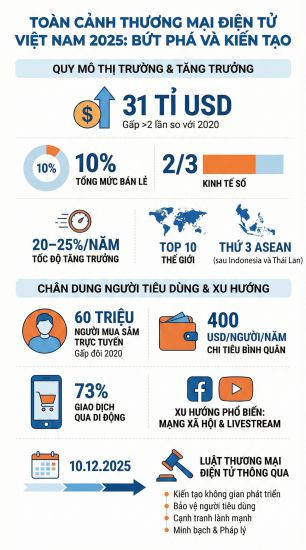
According to data from the Ministry of Industry and Trade , by 2025, the size of Vietnam's e-commerce market will reach 31 billion USD, more than double the 2020 figure; accounting for approximately 10% of the total retail sales of goods and consumer services nationwide, and two-thirds of the digital economy.
With these results, Ms. Le Hoang Oanh - Director of the Department of E-commerce and Digital Economy (Ministry of Industry and Trade) - stated that Vietnam continues to be among the top 10 fastest-growing e-commerce countries in the world, with an average growth rate of 20-25% per year and ranks third in market size in ASEAN (after Indonesia and Thailand). From a legal perspective, Ms. Le Hoang Oanh said that the Law on E-commerce, passed by the National Assembly on December 10, 2025, is expected to contribute to creating a new development space, ensuring transparency, accountability, and clear legal framework; while protecting consumer rights, ensuring healthy competition, and promoting sustainable and safe digital transformation.
E-commerce has been and continues to assert its position as a crucial pillar of Vietnam's digital economy. One of the greatest values that e-commerce brings is the ability to expand markets for businesses, especially small and medium-sized enterprises (SMEs) and individual business owners. Through digital platforms, businesses can reach millions of customers nationwide, and even expand into international markets, without needing to invest heavily in traditional distribution systems.
Trade fraud and logistics remain bottlenecks.
Besides the impressive achievements, Associate Professor Dr. Nguyen Thuong Lang believes that the development of e-commerce in Vietnam is also facing many obstacles. Logistics infrastructure in some localities is still limited, and transportation costs are high, especially for small orders and in rural and mountainous areas. This affects consumers' access to e-commerce services and the business efficiency of enterprises.
Issues such as trade fraud, counterfeit goods, substandard products, and disputes in online transactions remain complex, eroding consumer confidence. The digital capabilities of many small businesses and household enterprises are still limited, failing to effectively utilize digital tools, resulting in e-commerce business performance not matching its potential.
“For e-commerce to continue playing its role as a new growth driver, Vietnam needs to implement many solutions simultaneously. Among them, investing in upgrading logistics infrastructure, smart warehousing, and inter-regional transportation connectivity should be prioritized to reduce costs and improve the quality of delivery services. Promoting digital skills training for businesses, households, and workers will help them participate more effectively in the online business environment. Supporting businesses in building brands, improving product quality, and meeting international market standards is also a key factor in promoting cross-border e-commerce. Completing the legal framework, strengthening inspection and supervision, and strictly handling fraudulent commercial practices in the digital environment will contribute to consolidating consumer confidence and creating a healthy and transparent business environment,” recommended Associate Professor Dr. Nguyen Thuong Lang.
According to Deputy Minister of Industry and Trade Nguyen Sinh Nhat Tan, 2026 is the first year of implementing the Resolution of the 14th National Congress of the Communist Party of Vietnam, a year of significant importance, laying the foundation for a new phase of national development. In this context, e-commerce and the digital economy continue to be identified as pioneering sectors and key drivers of national digital transformation, green transformation, and sustainable growth.
“The Ministry of Industry and Trade will urgently organize the effective implementation of the Law on E-commerce; develop and submit to competent authorities for promulgation a Decree guiding the law, ensuring that the law is put into practice soon. At the same time, it will effectively implement the National E-commerce Development Master Plan for the period 2026 - 2030, with a green, sustainable, balanced and inclusive orientation,” Deputy Minister Nguyen Sinh Nhat Tan emphasized.
Source: https://baoquangninh.vn/thuong-mai-dien-tu-dat-31-ti-usd-3390717.html

![[Photo] General Secretary and President To Lam presides over a meeting with the Central Organizing Committee.](https://vphoto.vietnam.vn/thumb/1200x675/vietnam/resource/IMAGE/2026/06/03/1780482764658_a1-bnd-4741-3342-jpg.webp)

![[Photo] First session of the 14th Congress of the Vietnam Trade Union](https://vphoto.vietnam.vn/thumb/1200x675/vietnam/resource/IMAGE/2026/06/03/1780465947883_ndo_br_img-3852-jpg.webp)
![[Photo] Secretary of the National Assembly Party Committee, Chairman of the National Assembly presides over the meeting of the Standing Committee and Executive Committee of the National Assembly Party Committee.](https://vphoto.vietnam.vn/thumb/1200x675/vietnam/resource/IMAGE/2026/06/03/1780480353201_ndo_br_bnd-2585-jpg.webp)


























































![[Video] Sunset at Lap An Lagoon – Where the sun sets over the fishing nets](https://vphoto.vietnam.vn/thumb/1200x675/vietnam/resource/IMAGE/2026/05/31/1780192137701_beach-landscape-sea-water-nature-grass-745871-pxhere-com.jpeg)






































Comment (0)