

Targeting businesses and household businesses.
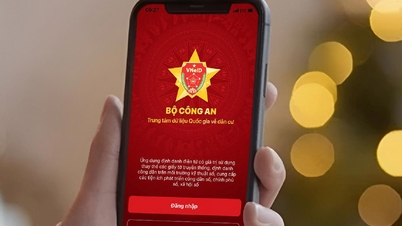
Before July 1st, many people received calls from unknown numbers requesting them to update their personal information through a fake VNeID application. After that date, scammers have adapted their tactics, targeting other administrative procedures.
Mr. NQB, the owner of a restaurant in Tay Ninh , recounted: "I received a call from an unknown number, requesting that I integrate my business license into the VNeID application and suggesting I add them on Zalo for assistance. My family only runs a small, informal restaurant without a registered business license, yet the scammers told me to go to the district tax office to register and reduce business tax from 10% to 8%. Now that there's no longer a district level, I immediately suspected this was a scam."
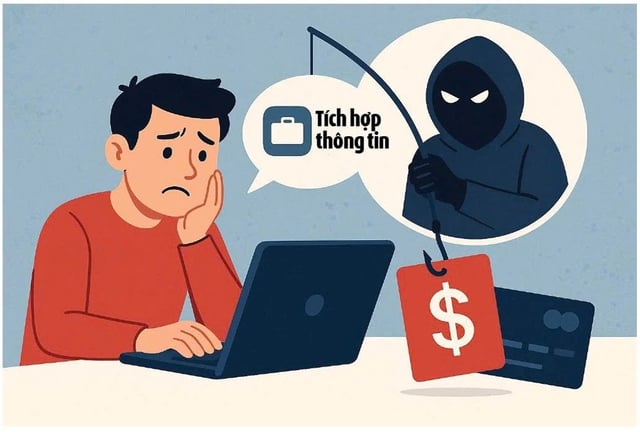
Online scammers meticulously research and gather personal information to lure victims into their traps.
PHOTO: QUANG THUAN, CREATED BY AI
Also related to taxes, Mr. H.D.H, the director of an event organizing company in Ho Chi Minh City, has been receiving numerous calls regarding tax declarations since July 1st. "These individuals impersonate tax officials, claiming that after the merger of provinces and cities on July 1st, businesses will have to re-declare their information, and that it needs to be done urgently, otherwise they will face back taxes and heavy fines. I am very cautious and ask many questions of these imposters; simply asking for the names of acquaintances who work at the same agency will expose them. Although I haven't been scammed yet, this form of impersonating tax officials is rampant and needs to be warned against," Mr. H. said.
Recently, there have been many cases of vehicle owners being tricked into installing fake applications by individuals impersonating vehicle inspection centers, especially in the central region. Specifically, these individuals instruct vehicle owners to access a fake link impersonating the Vietnam Registering and Inspection Department to declare personal information for the purpose of changing inspection stickers. When vehicle owners access this link, they risk being scammed and having their money stolen. To prevent this situation, the Vietnam Registering and Inspection Department has issued a notice to all vehicle inspection units warning vehicle owners in their areas of responsibility.
"Vehicle owners should absolutely not transfer money via calls or messages from unknown phone numbers (not publicly listed by the Vietnam Registering Agency). Furthermore, do not access any fake links impersonating the Agency," a representative from the Vietnam Registering Agency emphasized.
Currently, malicious individuals and criminal organizations are everywhere, able to secretly monitor and collect user information. Their methods of impersonation and technological use are becoming increasingly sophisticated... The most effective way to prevent this at this time is to raise awareness and equip users with the knowledge to protect themselves.
Mr. Ngo Minh Hieu (Project Director of Chongluadao.vn)
A cybersecurity expert commented: "Although impersonating government officials is not a new phenomenon, fraudsters have demonstrated adaptability and developed increasingly sophisticated methods. The choice of tax, business registration, or vehicle inspection agencies as targets shows their understanding of psychology. The first step in the scam is research and information gathering. They can use various sources, from leaked databases to publicly available information on social media, to build a list of targets and detailed profiles of each individual. Next, the second link is responsible for developing the script and training communication skills for the team directly carrying out the scam calls. With supporting tools such as phone number spoofing software or pre-prepared malicious applications, victims who follow their instructions will have their accounts compromised and all their money withdrawn in an instant."
Posting images on social media: Beware of traps.
At a recent online fraud prevention campaign launch event organized by the Ministry of Public Security in collaboration with Google, the Cyber Security and High-Tech Crime Prevention Department identified seven of the most common types of fraud, including: fraud impersonating educational institutions; fraud involving the recovery of outstanding loans; fraud related to service payments; fraud involving online shopping and travel; fraud impersonating officials and management agencies (Police, Procuratorate, Courts, Tax, Social Insurance, Vehicle Registration, etc.); emotional fraud for financial gain; and investment fraud on fake platforms.
To construct a scam and find suitable victims, the fraudsters must first steal valuable personal information such as national identity card numbers, phone numbers, addresses, vehicle information, and especially financial information, which can be used for various illegal purposes. This information can be sold to other criminal organizations, used to create fake accounts, or as the basis for future scam campaigns.
By installing malicious applications or tricking victims into providing login information, perpetrators can conduct unauthorized transactions, transfer money, or even borrow money using the victim's identity. With the development of electronic payments and digital banking, the potential for damage from this access hijacking is enormous. Once a malicious application is installed with full access permissions, perpetrators can monitor all of the victim's activities, from phone calls to text messages and emails, and may even use the camera and microphone for surveillance. This creates a long-term threat to personal privacy and security.
Mr. Ngo Minh Hieu, a cybersecurity expert and project director of Chongluadao.vn, shared: "Currently, malicious actors and criminal organizations are everywhere, able to silently monitor and collect user information. Their methods of impersonation and technological use are becoming increasingly sophisticated. They can use VPN services, proxy servers, and IP address spoofing techniques to make tracing them extremely difficult. Furthermore, applications can be programmed to automatically erase traces or disable themselves when detecting signs of investigation. The most effective way to prevent this at this stage is to raise awareness and equip users with the knowledge to protect themselves."
According to expert Ngo Minh Hieu, people currently lack awareness of protecting their personal information. For example, posting pictures of houses following trends on Google Maps or posting screenshots of VNeID updates and integrated information after mergers and the implementation of a two-tiered government system can allow malicious actors to collect a lot of sensitive personal information such as addresses and living locations; daily habits can be monitored, vehicle types, living standards, and security systems can be revealed. It is especially dangerous if photos are shared along with names, phone numbers, and email addresses, as anyone can become a target of fraud, impersonation, or cyberattacks.
The Cyber Security and High-Tech Crime Prevention Department has issued a warning: Fraudulent activities are emerging where individuals impersonate local authorities at the commune/ward level, announcing new administrative unit arrangements nationwide. These individuals instruct people to access links or install fake VNeID applications containing malware, luring them into providing OTP codes for bank accounts or biometric data to steal their assets.
People should be vigilant, not follow requests made over the phone, and only get updates directly at the local police station in their area of residence; report to the nearest police station for guidance.
Source: https://thanhnien.vn/tich-hop-giay-to-coi-chung-sap-bay-lua-dao-185250709195949638.htm

![[Photo] Prime Minister Pham Minh Chinh presides over a meeting on private sector economic development.](/_next/image?url=https%3A%2F%2Fvphoto.vietnam.vn%2Fthumb%2F1200x675%2Fvietnam%2Fresource%2FIMAGE%2F2025%2F12%2F20%2F1766237501876_thiet-ke-chua-co-ten-40-png.webp&w=3840&q=75)



































































































Comment (0)