

Amendments to the Law on the Capital City are necessary.
The Law on the Capital City is a particularly important law with profound political and social significance. The amendment of the Law closely adheres to the political, legal, and practical foundations of building, protecting, and developing the Capital City, aiming to promptly institutionalize the policies, requirements, and tasks set forth in the resolutions of the Central Committee and the Politburo, especially Resolution No. 15-NQ/TW dated May 5, 2022, of the Politburo on the direction and tasks for the development of Hanoi Capital City until 2030, with a vision to 2045, and to address the practical issues currently facing the construction, protection, and development of the Capital City…
The draft Law comprises 7 chapters and 59 articles (an increase of 3 chapters and 32 articles compared to the 2012 Law on the Capital City, including retaining 3 articles; amending and supplementing 18 articles; and introducing 38 new provisions).
At the 6th Session of the 15th National Assembly, after hearing the presentation and discussing in groups on the afternoon of November 10th, the National Assembly deputies generally highly appreciated the Government, the drafting committee, and directly the Ministry of Justice , Hanoi City, and the presiding body for verification, the National Assembly's Law Committee, for preparing the draft Law on the Capital City (amended) in a very thorough, serious, and high-quality manner, in accordance with the Law on the Promulgation of Legal Documents, and for sending the documents to the National Assembly early, ensuring sufficient time for the deputies to study.
Members of the National Assembly unanimously agreed on the necessity of enacting the Law and generally endorsed many specific mechanisms and policies for the Capital City, including new provisions to ensure effective state management in the Capital City.
Based on the synthesis of opinions discussed in the working groups and the plenary session at the 6th Session, the presiding agency for verification and the Drafting Committee of Hanoi City will refine and prepare a report on the acceptance, explanation, and completion of the Draft Law on the Capital City (amended) with the highest quality to submit to the National Assembly for consideration and approval at the 7th Session, creating a solid legal basis and generating new momentum in the construction, protection, and development of the Capital City in a comprehensive and sustainable manner, worthy of the position and role of the Capital City in the country's progress.
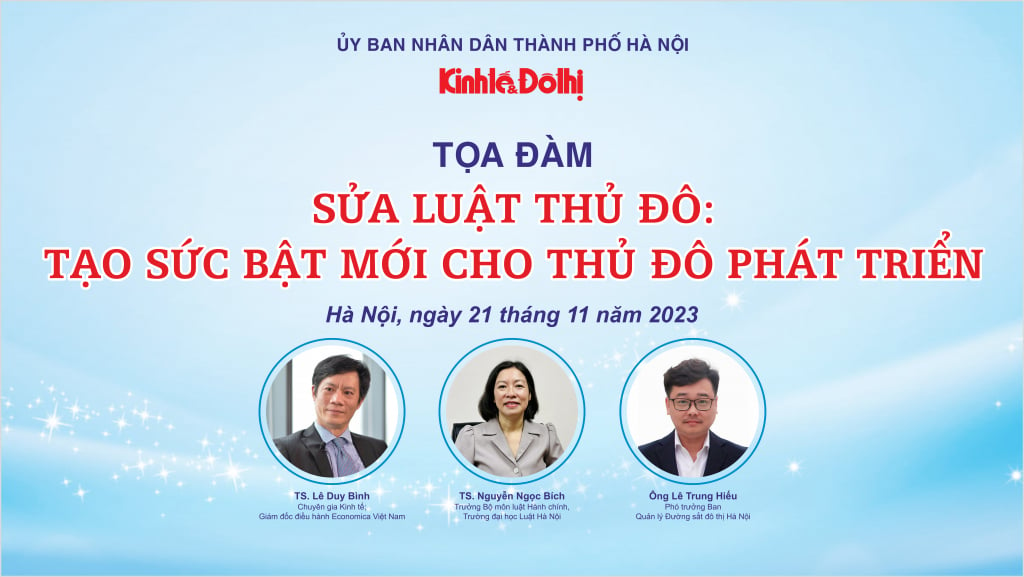
With the hope that a large number of readers will continue to contribute their opinions to the draft Law on the Capital City (amended) and agree with the new points mentioned in the draft Law, on the morning of November 21, 2023, the Economic and Urban Newspaper organized a seminar entitled "Amending the Law on the Capital City: Creating a New Momentum for the Capital City's Development".

The organizers presented flowers to the speakers participating in the seminar "Revising the Capital City Law: Creating New Momentum for the Capital's Development". Photo: Cong Phuong
Attending the seminar was Ms. Vu Thi Thanh Tu, Head of the Legal Education and Dissemination Department, Hanoi City Department of Justice.
Speakers participating in the panel discussion included: Dr. Le Duy Binh - Economic expert; Managing Director of Economica Vietnam; Dr. Nguyen Ngoc Bich - Head of the Department of Administrative Law, Hanoi Law University; and Mr. Le Trung Hieu - Deputy Head of the Hanoi Urban Railway Management Board.
On the organizing committee's side, there was Mr. Nguyen Xuan Khanh - Deputy Editor-in-Chief of the Economic and Urban Newspaper, along with the Head, Deputy Head, editors, reporters, and technicians of the Economic and Urban Newspaper.
The panel discussion was also attended by reporters representing central and Hanoi-based newspapers.
In his opening remarks at the seminar, Mr. Nguyen Xuan Khanh, Deputy Editor-in-Chief of the Economic and Urban Newspaper, stated that amending the 2012 Law on the Capital City is necessary to institutionalize the Party's guidelines and policies on building, developing, managing, and protecting the Capital City as outlined in Resolution No. 15-NQ/TW of the Politburo on the direction and tasks for the development of Hanoi until 2030, with a vision to 2045. This resolution identifies the goal of building and developing the Capital City into a "Cultural - Civilized - Modern" city and addressing the shortcomings and limitations identified since the implementation of the 2012 Law on the Capital City.
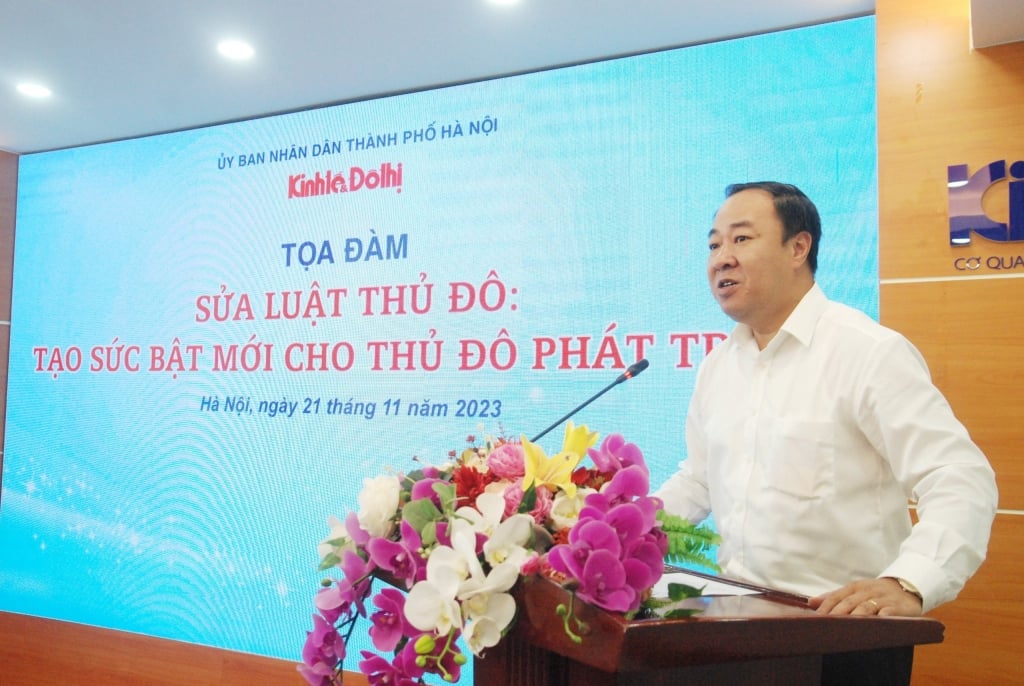
Mr. Nguyen Xuan Khanh - Deputy Editor-in-Chief of the Economic and Urban Newspaper, delivered the opening remarks at the seminar. Photo: Cong Phuong
The draft Law on the Capital City (amended) is based on five guiding principles: fully institutionalizing the Party's guidelines and policies on the construction and development of the Capital City; stipulating specific mechanisms and policies for the Capital City to ensure consistency with the Party's guidelines and policies and compliance with the 2013 Constitution; closely adhering to the nine policy groups already approved by the Government; detailing and specifying as much as possible the specific mechanisms and policies in the Law for immediate application; inheriting and developing the effective provisions of the 2012 Law on the Capital City that have been tested in practice; and codifying the specific mechanisms and policies currently being piloted for provinces and centrally-administered cities to suit the Capital City.
The draft Law on the Capital City contains many groundbreaking provisions to create opportunities for Hanoi's development commensurate with its potential, as well as to contribute to promoting linkages and development of the Capital Region. However, the drafting of this law is not outside the overall legal system.
The amendment of the Law on the Capital City needs to meet practical needs. Because Hanoi is the heart of the country, the people all want it to be built and developed in a way that is commensurate with its status and role, ensuring it becomes a major center for politics, culture, and society, and a green, clean, beautiful, civilized, and modern capital city.
Many issues were raised during the amendment of the Law, such as: groundbreaking regulations on attracting resources and financial investment, meeting the needs of government organization and economic development of the Capital. The development of TOD (Transit-Oriented Development), an effective mechanism for exploiting land resources, developing the economy and infrastructure, has been adopted by many developed countries worldwide. This is accompanied by the development of underground spaces, green spaces, and transportation spaces, as well as regulations on the effective utilization of talent, within the Capital's development strategy...
In particular, during the recent group discussion on the draft Law, National Assembly deputies unanimously agreed on the necessity of enacting the Law on the Capital City (amended) with the basic contents as presented in the Government's submission, in order to build a modern, smart Hanoi that leads and creates a ripple effect, linking urban areas, and driving the development of the region and the whole country; striving to develop to the level of capitals of developed countries in the region as required by the Party's resolutions.
To encourage discussion and exchange of ideas among readers, especially since the draft law will soon be submitted for comments from National Assembly deputies at the 6th Session of the 15th National Assembly, the Economic and Urban Newspaper is organizing this seminar.
"On behalf of the Organizing Committee, I would like to officially open the seminar 'Revising the Capital City Law: Creating New Momentum for the Capital's Development'" - Deputy Editor-in-Chief of the Economic and Urban Newspaper, Nguyen Xuan Khanh, emphasized.

Ms. Vu Thi Thanh Tu, Head of the Legal Education and Dissemination Department, Hanoi Department of Justice, speaks at the seminar. Photo: Cong Phuong
Building a city that is "Culturally Rich, Civilized, and Modern"
Regarding the necessity of amending the Capital City Law this time, according to Dr. Le Duy Binh, the 2012 Capital City Law has been in effect for more than 10 years. During its implementation, Hanoi has achieved important and very encouraging results, contributing to the development of the capital city in terms of economy, society, culture, education, etc.

Dr. Le Duy Binh - Economic expert; CEO of Economica Vietnam, speaking at the seminar. Photo: Cong Phuong
However, after 10 years, the country has taken new directions of development, and our capital city also faces new demands stemming from practical realities, especially regarding economic issues, social issues, science and education, and healthcare…
In Resolution No. 15-NQ/TW, the Politburo affirmed the particularly important strategic position and role, and the requirements and tasks for the development of Hanoi Capital City until 2030, with a vision to 2045; creating a breakthrough in mobilizing comprehensive strength, effectively exploiting the potential and advantages of the Capital City, combined with resources from the whole country and internationally, to build and develop Hanoi Capital City to truly be worthy of being the national political and administrative center, the heart of the country; a major center for economy, culture, education and training, science and technology and international integration; becoming a smart, modern, green, clean, beautiful, secure and safe city; developing rapidly, sustainably, with a ripple effect to promote the development of the Red River Delta region, the key economic region of Northern Vietnam and the whole country, meeting the expectations, trust and aspirations of the entire Party, army and people of the whole country for Hanoi Capital City.
Resolution No. 15-NQ/TW has concretized and clearly defined the objectives, requirements, tasks, and solutions.
This is the legal basis and an important condition for creating momentum for the development of the Capital City from now until 2030 and 2045, with the major orientation: Hanoi is a "Cultural - Civilized - Modern" city; worthy of being the national political and administrative center, the heart of the country; a major center for economy, culture, education and training, science and technology, and international integration.
Stemming from practical needs, we will build a Hanoi that meets the aspirations of its people and the people of the whole country, because the capital is the heart of the nation. The Law on the Capital City not only serves the capital city and its economy, but also contributes to the development of the entire country.
Therefore, the Capital City Law needs new mechanisms, mechanisms that are unique and superior in nature, to further accelerate the development of the Capital City, quickly and sustainably achieving the goals we have set.
These are the necessary foundations for this revised draft of the Capital City Law.
According to Dr. Nguyen Ngoc Bich, Head of the Administrative Law Department at Hanoi Law University, in Hanoi's unique context, while the capitals of many countries are merely political or cultural centers, our capital, Hanoi, is both a political and a cultural center. Dr. Bich cited the proverb, "Even if it's not fragrant, it's still jasmine; even if not elegant, it's still a person from Thang An," to support her argument that Hanoi is the cultural center of the entire country.
Given its special status, in 2000, the Standing Committee of the National Assembly issued the Ordinance on the Capital City, and in 2012, specific regulations for the Capital City were promulgated.
However, one point we must frankly acknowledge now is that the Capital City Ordinance and the Capital City Law of 2012 are still at the level of viewpoints and policies, and not yet specific regulations. From that policy process to implementation, we need specific regulations.

Dr. Nguyen Ngoc Bich - Head of the Department of Administrative Law, Hanoi Law University, shared her opinion at the seminar. Photo: Cong Phuong
That is the first reason for amending the Capital City Law.
Secondly, any legal document needs time to be evaluated and reviewed to determine its continued relevance. When it becomes outdated, amendment is inevitable. The extent of the amendments depends on the document's suitability to the demands of practice.
"This Capital City Law, which we often refer to as the amended Capital City Law, is, from my personal perspective, a 'new' law. This is because there's a provision that wasn't mentioned in the two previous documents, but this Capital City Law includes it: the regulation on the organization of the government in Hanoi," according to Dr. Nguyen Ngoc Bich.
Dr. Nguyen Ngoc Bich believes that this is a very important chapter to ensure that our Capital City Law can cover all the issues currently taking place, all the problems Hanoi is facing.
“Perhaps today, many regulations in the amended Capital City Law have been submitted to the National Assembly. If the National Assembly approves them, even though they are only provisions within the Capital City Law, specifically for Hanoi, who knows, when we implement them, they might have a very significant impact and could change the thinking of the National Assembly, all levels of government, and even the people. Then they could become general regulations for the whole country…” - said Dr. Nguyen Ngoc Bich.
“We are pioneering the implementation of new regulations. Once these regulations have had time, proven successful in Hanoi, then we will expand their implementation widely…” , emphasized Dr. Nguyen Ngoc Bich.

Mr. Le Trung Hieu, Deputy Head of the Hanoi Urban Railway Management Board, speaks at the seminar. Photo: Cong Phuong
Amending the Capital City Law: a great opportunity, creating advantages for Hanoi's development.
Speaking at the seminar, Mr. Le Trung Hieu, Deputy Head of the Hanoi Urban Railway Management Board, affirmed that the 2023 amended Law on the Capital City is a great opportunity, creating advantages for Hanoi to develop and rise to a new level and position not only in the country but also in the region and the world.
Among the nine key policy groups in the draft Law on the Capital City (amended), the most noteworthy are those focusing on mobilizing and effectively utilizing financial and budgetary resources for the development of the Capital City; allowing the implementation of forms other than those currently stipulated (PPP, BT, TOD); managing public assets and controlled pilot models; strongly decentralizing investment decision-making power to the city; and regulations to attract strategic investors and incentives to attract them.
According to statistics, Hanoi currently has approximately 6.4 million motorized road vehicles (including about 5.6 million motorbikes and 685,000 cars of all types), not including 1.2 million vehicles from other provinces and cities participating in traffic in the capital. The unbalanced development between transportation and infrastructure leads to overload and traffic congestion during peak hours. The consequence is high levels of emissions and environmental pollution in the capital. Therefore, this revised draft of the Law on the Capital City includes new regulations on urban development oriented towards public transportation (TOD).
Through research, work, and discussions with experts during the drafting of the Capital City Law (amended), and considering the specific characteristics of Hanoi, we have arrived at a definition of Transport-Oriented Development (TOD) that reflects the identity of the Capital City: “Transport-Oriented Development (TOD) is a comprehensive urban development solution that forms the basis for urban planning, reconstruction, and development. It uses urban rail transit hubs as focal points for population, commercial services, and offices within walking distance of public transport, aiming to improve land use efficiency, public works, public health, reduce private motorized vehicles, reduce environmental pollution emissions, and combine this with the preservation and promotion of cultural values.”
"Currently, we are implementing a strategy for urban railway development that must be completed by 2045, and substantially completed by 2035. This is a daunting task, and we are aware that investment resources are limited. We have to implement it through ODA loans, which come with many binding terms. In particular, the technical standards and technology must originate from the donor country. This leads to our urban railway systems having different funding sources for each line; some countries apply European standards, others apply Japanese standards, resulting in a lack of uniformity across urban railway lines," Mr. Le Trung Hieu stated.

The speakers strongly agreed on the need to amend the Law on the Capital City.
According to Article 39 of the Draft Law on the Capital City (amended), the mobilization of resources for urban railway development under the TOD (Transit-Oriented Development) scheme is regulated. With this regulation, Hanoi can generate significant revenue from auctioning land use rights and the right to use underground and elevated structures within TOD areas to reinvest in the development of urban railways and the city's public transportation system.
Furthermore, Hanoi continues to propose adding several regulations to the law to increase the value of land recovery, specifically: The Hanoi People's Council approved a plan to collect fees for the use of additional underground and above-ground space for existing residential areas within TOD zones in cases where the project owner requests adjustments to the height and depth of the construction beyond the previously approved architectural planning standards and the adjustments are approved by the competent authority...
According to phapluatxahoi.kinhtedothi.vn
Source
![[Photo] Ba Lang An Lighthouse - the "eye of the sea" amidst the "rock museum" of Quang Ngai province.](https://vphoto.vietnam.vn/thumb/1200x675/vietnam/resource/IMAGE/2026/05/29/1780038698840_anh-man-hinh-2026-05-29-luc-14-10-42.png)

![[Image] Pleasant weather helps students enter the 10th grade entrance exam with confidence.](https://vphoto.vietnam.vn/thumb/1200x675/vietnam/resource/IMAGE/2026/05/29/1780034401612_ngay-1-thi-lop-10-minh-duy-8-5009-jpg.webp)





























































































Comment (0)