

The US Constitution stipulates that the president has "broad powers to pardon and suspend sentences for crimes against the United States," but these powers are not unlimited, according to the BBC.
On December 1st, US President Joe Biden issued a presidential pardon for his son, Hunter Biden, who is facing sentences on two criminal charges.
The pardon was controversial, as Biden had previously publicly pledged not to pardon or commute Hunter's sentence, according to the BBC. However, President Biden argued that the cases against his son were politically motivated.
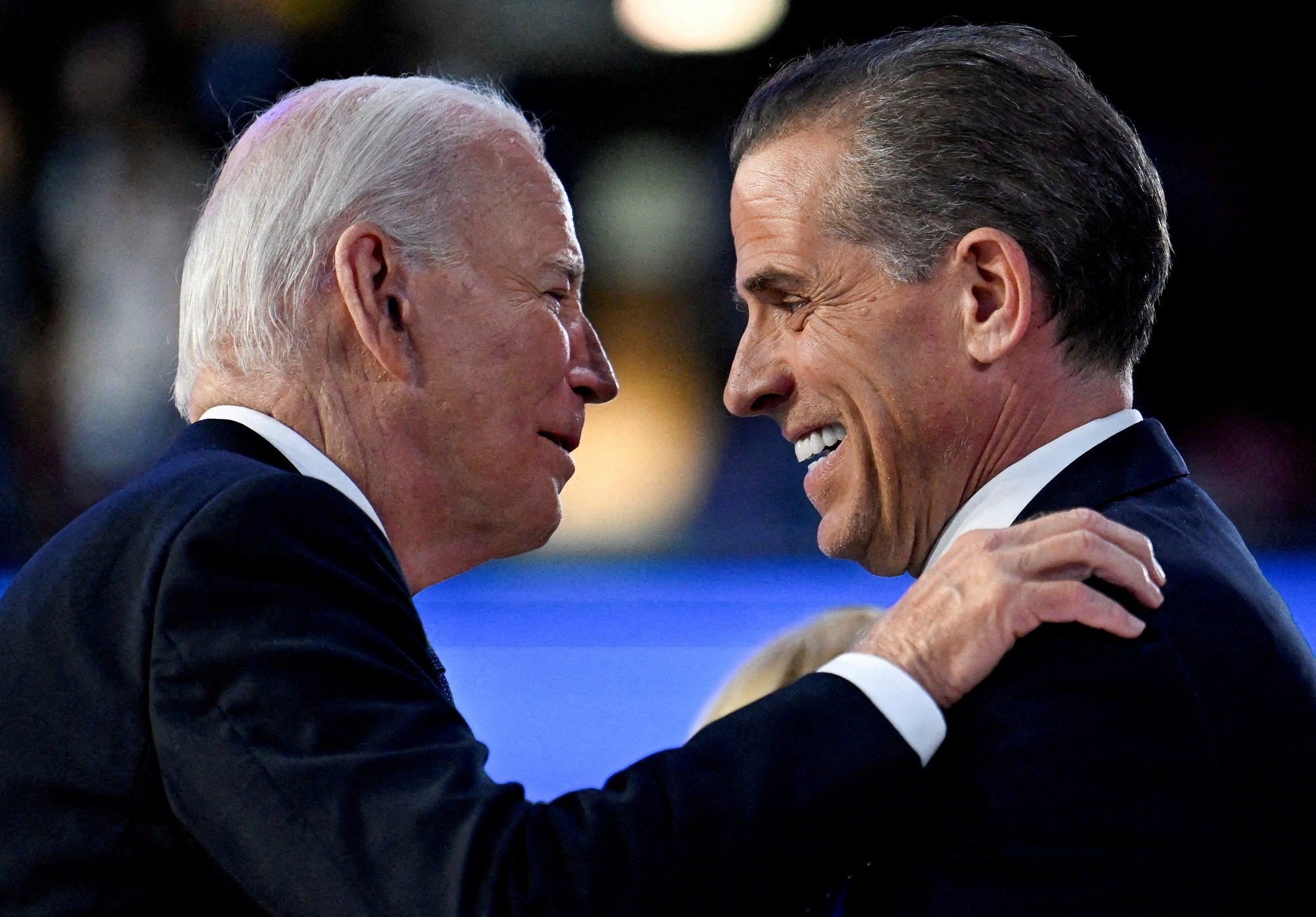
US President Joe Biden welcomes his son Hunter Biden at the Democratic National Convention in Chicago, Illinois, on August 19.
Biden's use of his pardon power continues a tradition among presidents on both sides of American politics of pardoning those close to them, according to the BBC.
What is the power of presidential pardon in the United States?
The US Constitution stipulates that the president has "broad powers to pardon and suspend executions for crimes against the United States, except in cases of impeachment," according to the BBC.
An amnesty represents legal forgiveness, ending any further punishment and restoring rights such as the ability to vote or run for public office.
While the president's power to grant pardons is considered broad, it is not unlimited. For example, the president can only issue pardons for federal crimes, according to the BBC.
Therefore, there is a question mark over the verdict of US President-elect Donald Trump in his hush money case in New York State. He will not be able to pardon himself in this state-level case when he returns to the White House next month, according to the BBC.
In June, Hunter was convicted by a federal grand jury in Delaware of making false statements about illegal drug use when purchasing a gun in 2018. By September, Hunter had also pleaded guilty to nine charges related to federal tax matters.
Following Hunter's pardon, judges overseeing his related cases may cancel sentencing hearings, which were scheduled for December 12 for the gun case and December 16 for the tax case, according to CNN.
How many pardons have other US presidents issued?
There is a long-standing precedent for U.S. presidents from both political parties to issue pardons, even for those close to them.
Hunter Biden is the 26th person to be pardoned during Biden's (Democratic) presidency. Most of the others were pardoned for drug-related offenses, according to CBS.
In 2020, while still president, Trump (a Republican) pardoned Charles Kushner, the father-in-law of his daughter Ivanka Trump. Kushner had been sentenced to two years in prison in 2004 for several offenses, including tax evasion.
In 2001, then-US President Bill Clinton pardoned his half-brother, Roger Clinton, for a cocaine-related crime dating back to 1985.
In both cases, pardons were granted to those who had already served their sentences. President Biden's intervention in his son's case occurred before sentencing.
According to the Pew Research Center, Trump issued 237 clemency decisions during his four years in the White House, including 143 pardons and 94 reduced sentences.
That number is significantly lower than that of his predecessor, Barack Obama. Obama issued 1,927 clemency decisions during his eight-year term, including 1,715 pardons and 212 amnesties.
One of the most controversial presidential pardons issued by the US was by Gerald Ford to his predecessor Richard Nixon in 1974. That pardon was described as an attempt to heal America, according to the BBC.
Source: https://thanhnien.vn/tong-thong-my-co-quyen-an-xa-den-muc-nao-185241203002001555.htm





























































































Comment (0)