

This year, Ho Chi Minh City will study how to calculate the green growth factor in the local GDRP.
This information was provided by Mr. Vo Van Hoan, Vice Chairman of the People's Committee of Ho Chi Minh City and Head of the Organizing Committee of the "Ho Chi Minh City Economic Forum 2023" (HEF), on the afternoon of September 15th. "The percentage of businesses using technologies to reduce emissions that contributes to growth must be quantifiable, not just general GRDP figures," Mr. Hoan stated.
This is one of the first concrete steps in Ho Chi Minh City's effort to transform its traditional economic model into a sustainable one, balancing growth and the environment, or "green economy".
At this year's HEF, the city announced the draft "Strategic Framework for Green Development to 2030 with a Vision to 2050" to gather feedback from experts and businesses both domestically and internationally. Mr. Vo Van Hoan stated that the city will finalize the policy framework and necessary criteria by the end of the year.
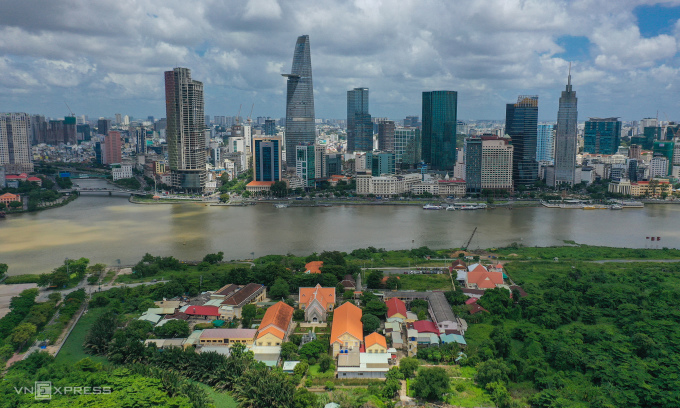
The center of Ho Chi Minh City, viewed from the Saigon River, Thu Thiem Peninsula area, Thu Duc City, July 2023. Photo: Quynh Tran
Ho Chi Minh City is also targeting several other specific actions. To develop the market for "green" products and services – that is, those meeting sustainable standards – public spending will be used as a pioneer to guide social consumption and ensure businesses have outlets for their products.
"We have many ways, such as injecting more money to stimulate investment in businesses, spending a little more to create a market for green products, and only then can we achieve green growth," Mr. Hoan said. Some examples include installing solar panels in offices or purchasing electric cars for government vehicles. Encouraging people to walk, cycle, use electric vehicles, and developing waterway transportation are also things that Ho Chi Minh City believes need to be done.
Furthermore, within the framework of the green economy, Can Gio has been selected to become a green, carbon-neutral district by 2035. The Ho Chi Minh City People's Committee aims to calculate the amount of oxygen produced and carbon absorbed by the Can Gio forest to sell carbon credits, in addition to issuing green bonds to mobilize financial resources. The area also has the potential to transition to electric vehicles and renewable energy. Currently, Can Gio already has a beach wind power project.
Many experts also suggested possible actions that could be taken soon and feasible learning models for Ho Chi Minh City during the HEF discussions.
Associate Professor Vu Minh Khuong, a policy and economics expert and senior lecturer at the Lee Kuan Yew School of Public Policy, suggests the 5S model as a guide to Singapore's green economic development.
The 5S framework includes: Survival; Strategy; Structure; Steward Selection; and Sagacity-seeking. In the first step, "Survival," it's crucial to recognize that green innovation is essential for survival; there's no other option.
Mr. Khuong cited Singapore as an example, noting that cleaning up rivers during the 1977-1987 period was a priority and a fundamental step before embarking on a green transformation. Ho Chi Minh City could learn from this approach to clean up its rivers and canals. "Green transformation should begin with things that are very practical for the people," he said.
To secure financial resources and encourage businesses to transition to a sustainable economy, Jochen Schmittmann, the International Monetary Fund (IMF) Resident Representative in Vietnam, suggested imposing a carbon emission tax.
This solution not only motivates businesses to make greater efforts to reduce emissions, thus saving more costs, but it also generates additional budget revenue. "The government can use this to reinvest in businesses that excel at reducing emissions or support businesses in further reducing emissions," the expert said.
Ricardo Valente, City Councillor for Economic and Financial Affairs of Porto, Portugal, shared his experience that all city bidding processes require bidders to meet ESG (Environmental, Social and Governance) standards.
In addition, 100% of the electricity used in public buildings in Porto is currently renewable, and wastewater is treated and reused to clean the streets. By 2024, the local airport will use 100% energy from waste incineration for electricity generation.
In parallel with the government's efforts, Mr. Vo Van Hoan recommended that businesses in the area pay attention to applying ESG, recognizing that profits come from technological innovation and improvement, not from the excessive use of resources and labor.
Meanwhile, people need to consume sufficiently, consume sustainably – choosing products that meet sustainability standards, and actively participate in environmental restoration. "Consumers should also participate in tree planting, environmental sanitation, waste management, and responsible consumption," Mr. Hoan said.
Telecommunications
Source link
![[Photo] Solemn bathing ceremony and Buddha procession in Hue](https://vphoto.vietnam.vn/thumb/1200x675/vietnam/resource/IMAGE/2026/05/31/1780228263543_1-jpg.webp)

![[Photo] Admire the coral "masterpiece" amidst the million-year-old heritage of Dak Lak province.](https://vphoto.vietnam.vn/thumb/1200x675/vietnam/resource/IMAGE/2026/05/31/1780221235105_anh-man-hinh-2026-05-31-luc-16-53-27.png)














![[Video] Sunset at Lap An Lagoon – Where the sun sets over the fishing nets](https://vphoto.vietnam.vn/thumb/340x192/vietnam/resource/IMAGE/2026/05/31/1780192137701_beach-landscape-sea-water-nature-grass-745871-pxhere-com.jpeg)








































![[Photo] Admire the coral "masterpiece" amidst the million-year-old heritage of Dak Lak province.](https://vphoto.vietnam.vn/thumb/402x226/vietnam/resource/IMAGE/2026/05/31/1780221235105_anh-man-hinh-2026-05-31-luc-16-53-27.png)






























Comment (0)