
The green damselfish farm of Mr. Ha Van Khuong's family in Puon village, Trung Son commune.
In 1994, Pượn village, Trung Sơn commune (formerly Quan Hóa district), was still isolated in the middle of the forest – even though it was only about 6km from the commune center, because the road hadn't been built yet, and the access path was precarious along the edge of a cliff. Hà Văn Khường and his wife – then just over 30 years old – and their four growing children were also facing a bleak future from poverty. Carrying the dream of one day "bringing his wife and children to Pạo to build a house" (a village in the same commune, located along provincial road 521), along with his shovel and pickaxe, Mr. Khường went down to the barren land by the Pượn stream, at the foot of Pha Đanh mountain, and diligently dug the soil and overturned rocks to create a fish pond.
“I dug it all by myself, it took a month to finish… I just took a risk, I didn’t think much about it,” the 63-year-old farmer recalled. After bringing water from the spring to the pond, he had to find fish fry to raise. This wasn’t easy either, requiring strength, perseverance, and experience. The only source of fish fry was the Ma River. In March, when the river water was low, at night, fish farmers would follow the Pượn stream – a journey of over 5km – to shallow pools in the river to catch fish fry. On the way back, they had to change the water constantly. But no matter how careful they were, the mortality rate was very high due to changes in temperature and living environment. Therefore, fish fry were extremely rare at that time.

The first fish pond that Mr. Khuong dug himself now has 260 breeding green damselfish.
Initially, the pond didn't have many fish. Along with carp and crucian carp, there were 30 green damselfish (also known as Bong fish or Doc fish) caught from the Ma River, a gift from his father-in-law to celebrate the pond's opening. "I butchered the big ones to improve my diet, and kept the smaller ones to raise. That continued until one day, I saw two fish swimming together, and that's when I realized the fish were reproducing in the pond." His connection with this special fish species began from there!
With just 3 pairs of fingerling fish the size of a chopstick tip, Mr. Hong sold them and earned 21 million VND. In the second year of the fingerling season, he used the money to rent machinery to build roads and dig 4 more ponds for raising fish...
The first clutch of green damselfish eggs that Mr. Khuong collected and put into the nursery tank yielded unexpected results. Without any guidance, the farmer, who had only completed the third grade, meticulously used chicken feathers to stir the eggs to prevent them from sticking together. After the fish hatched, he fed them egg yolks, then cornmeal, cassava flour, porridge, etc. Twenty days later, the fish were transferred to a larger pond and raised for another three months until they reached market size. With just three pairs of fingerlings, each the size of a chopstick tip, Mr. Khuong sold them and earned 21 million dong. In the second year of the fingerling season, he used the money to rent machinery to build roads and excavate four more ponds. He also bought a horse to transport cement to reinforce the entire pond banks. In the second fingerling season, with four ponds, his family earned a profit of 150 million dong.

Over the past three decades, Mr. Khuong's family has gradually invested in and improved the infrastructure and facilities for raising green damselfish.
The longer they raise the fish, the better they grow and reproduce. On average, each pair of fish produces about 8,000 fingerlings. At the same time, the demand for green carp is "booming" in the market, so the profits of the fish farm increase year by year. In the third year, the profit was 300 million VND, in the fourth year it reached 600 million VND... Since then, on average, Mr. Khuong's family earns 300-400 million VND per year from selling fingerlings and commercial fish. Mr. Khuong uses part of this money to pay his children and grandchildren – who are also his employees – and the rest is saved and reinvested. To date, a green carp farm with 14 interconnected ponds has been quite comprehensively invested in, including housing, roads, electricity, water supply systems, feed grinders, etc.
“Initially, we thought we’d save up to move house once we sold the fish. Then, when we finally sold the fish, the government built a concrete road into the village, so the whole family stayed here until now,” Mr. Khuong recounted with a joyful smile, adding another “fortunate encounter” with the green damselfish.

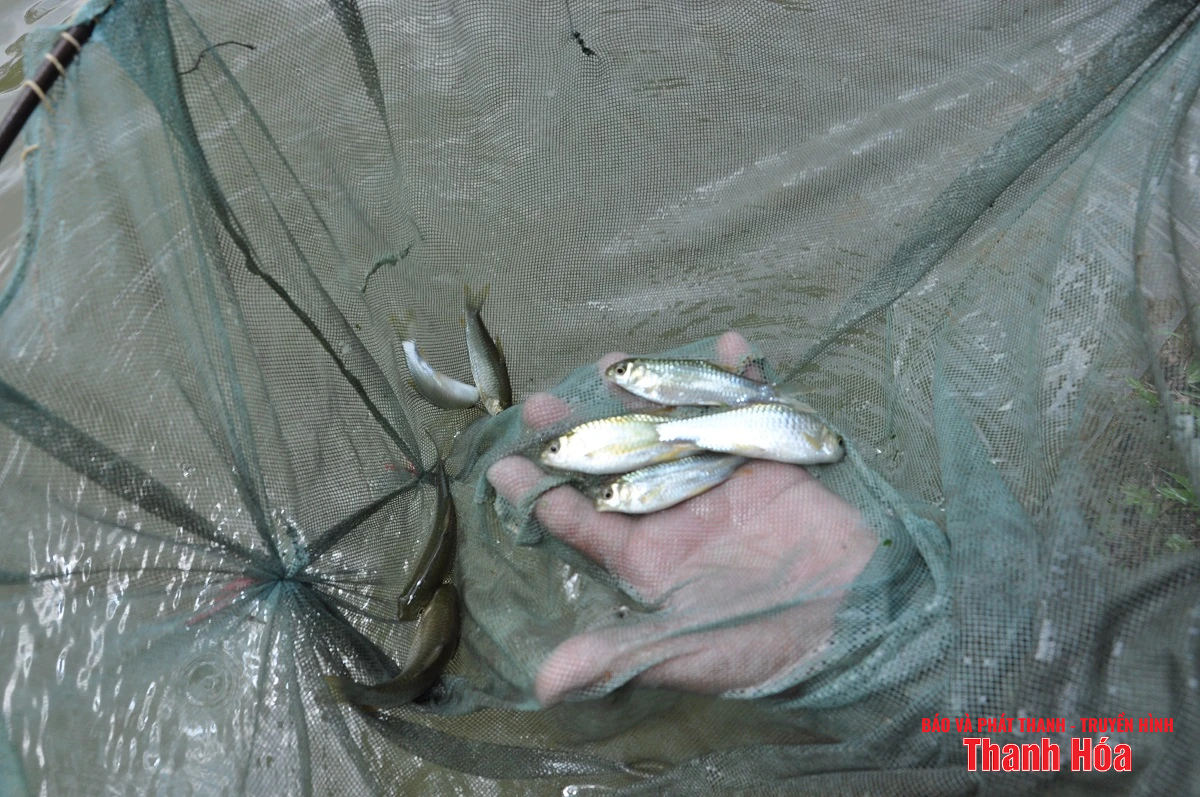
Bluefin catfish fingerlings in a fish pond.
The fish in the ponds come in various sizes, from fry to commercially farmed fish. Currently, fingerlings cost 3,000 VND/each; commercially farmed fish cost 150,000 VND/kg. In March alone, Mr. Khuong earned 200 million VND from selling fingerlings.
...the first fish pond, dug by Mr. Khuong himself, now houses 260 breeding green damselfish, selected over three decades, with some weighing up to 8-10 kg.
To put it simply, the most precious thing is the first fish pond dug by Mr. Khuong himself. It now houses 260 breeding green damselfish, carefully selected over three decades, with some weighing up to 8-10 kg. What's remarkable, and also a testament to the favorable location and pristine environment, is that not a single fish has ever died here.
The water continues to flow through the ponds daily, and the fish, accustomed to people, become close-knit, swimming freely and showing no signs of ceasing to reproduce. “Except for the winter months, the green damselfish reproduce twice a year, from February to September. Female fish have two ovaries, and the first spawning occurs about 20 days before the second,” Mr. Khuong shared. “That’s why our family has fish to sell regularly. Previously, our customers were mainly villagers and traders, but now my children sell online, and we have customers from all over the province, from North to South. We just pack the fish in plastic bags, pump in oxygen, and send them to customers via delivery services.”
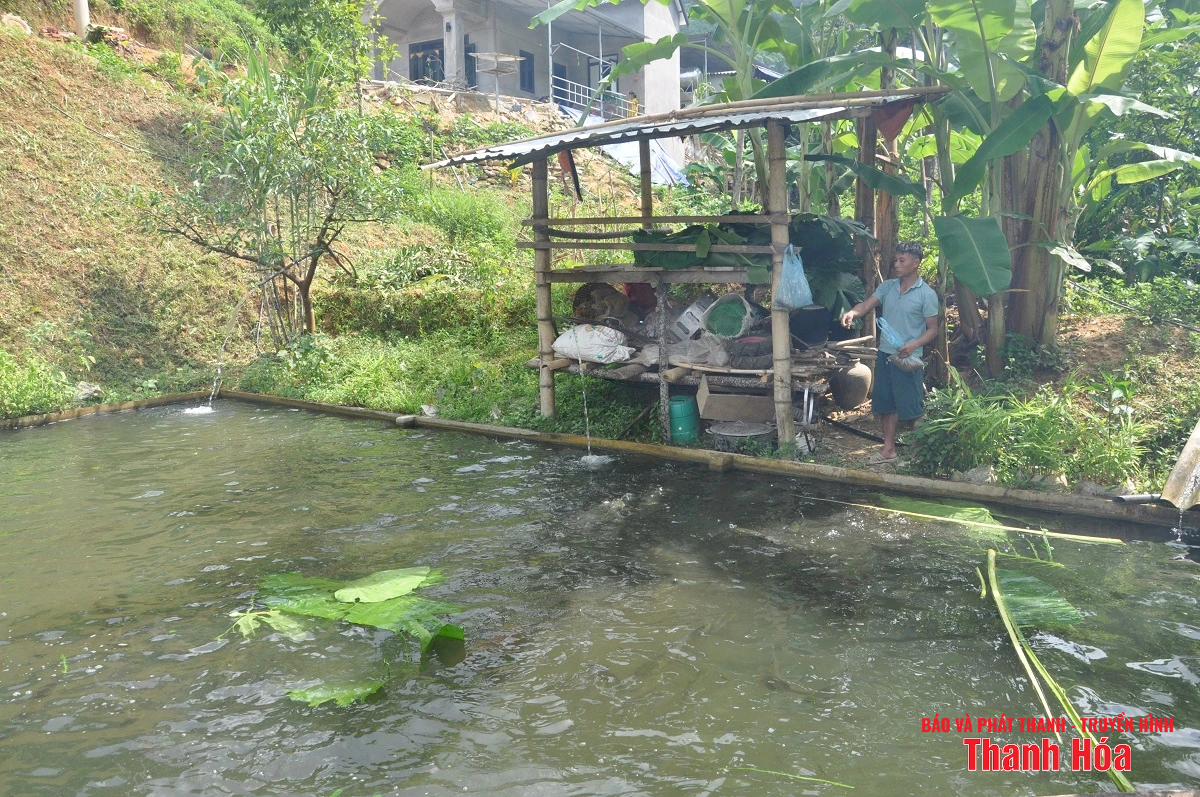
A family in Pượn village raises green damselfish in cement tanks.
"For the villagers, in the past, they bought fingerlings to raise for commercial purposes. Although the economic value was higher than other fish, the green damselfish grew slowly, taking 3 years to reach a weight of about 1kg, resulting in slow income. Now, some households import fingerlings from me at 3,000 VND/fish, raise them for a while longer until the fish are bigger, sell them at a higher price, and then pay me back the principal," said the farmer in his worn-out work clothes, his face simple and kind, explaining the "slow payment" investment model for the villagers.
"...some households buy my fish fry at 3,000 VND/each, raise them for a while until the fish grow bigger, sell them at a higher price, and then pay me back the principal," – The farmer, dressed in faded green work clothes, with a simple, kind face, recounted the "deferred payment" investment model for the villagers.
The village of Pượn has 39 households, each with a pond or cement tank for raising green damselfish. Mr. Vi Văn Thằn (73 years old, former Chairman of the People's Committee of Trung Sơn commune) – along with Mr. Khường – were the first two people in the village to raise green damselfish. He further shared: “Green damselfish are easy to raise and almost never get sick. Their food is also easy to find, mainly leaves from plants like bananas, sweet potatoes, taro, and various tubers and fruits... However, the fish must be raised in a place with flowing water and can only reproduce in suitable natural conditions. Therefore, Mr. Khường's fish farm is a 'gift from heaven' for breeding this type of fish, thus providing a local source of fingerlings for the villagers.”


The school of green damselfish coiled around the person's hand.
...
During our time in Trung Son, we enjoyed the unique flavor of the green carp – a dish that, if you ever visit this highland commune, you'll be recommended. And if you have the chance, you should visit the green carp farm, experience the feeling of thousands of small fish swarming around your hands, and be warmly welcomed by the locals.
Notes by Nguyen Phong
Source: https://baothanhhoa.vn/trai-ca-dam-xanh-ben-suoi-puon-258534.htm


![[Photo] Solemn bathing ceremony and Buddha procession in Hue](https://vphoto.vietnam.vn/thumb/1200x675/vietnam/resource/IMAGE/2026/05/31/1780228263543_1-jpg.webp)
![[Photo] The General Secretary, President and his wife begin their state visit to the Philippines.](https://vphoto.vietnam.vn/thumb/1200x675/vietnam/resource/IMAGE/2026/05/31/1780230559452_anh-man-hinh-2026-05-31-luc-19-28-11.png)


![[Photo] Admire the coral "masterpiece" amidst the million-year-old heritage of Dak Lak province.](https://vphoto.vietnam.vn/thumb/1200x675/vietnam/resource/IMAGE/2026/05/31/1780221235105_anh-man-hinh-2026-05-31-luc-16-53-27.png)





















![[Video] Sunset at Lap An Lagoon – Where the sun sets over the fishing nets](https://vphoto.vietnam.vn/thumb/340x192/vietnam/resource/IMAGE/2026/05/31/1780192137701_beach-landscape-sea-water-nature-grass-745871-pxhere-com.jpeg)







































![[Photo] Admire the coral "masterpiece" amidst the million-year-old heritage of Dak Lak province.](https://vphoto.vietnam.vn/thumb/402x226/vietnam/resource/IMAGE/2026/05/31/1780221235105_anh-man-hinh-2026-05-31-luc-16-53-27.png)































Comment (0)