

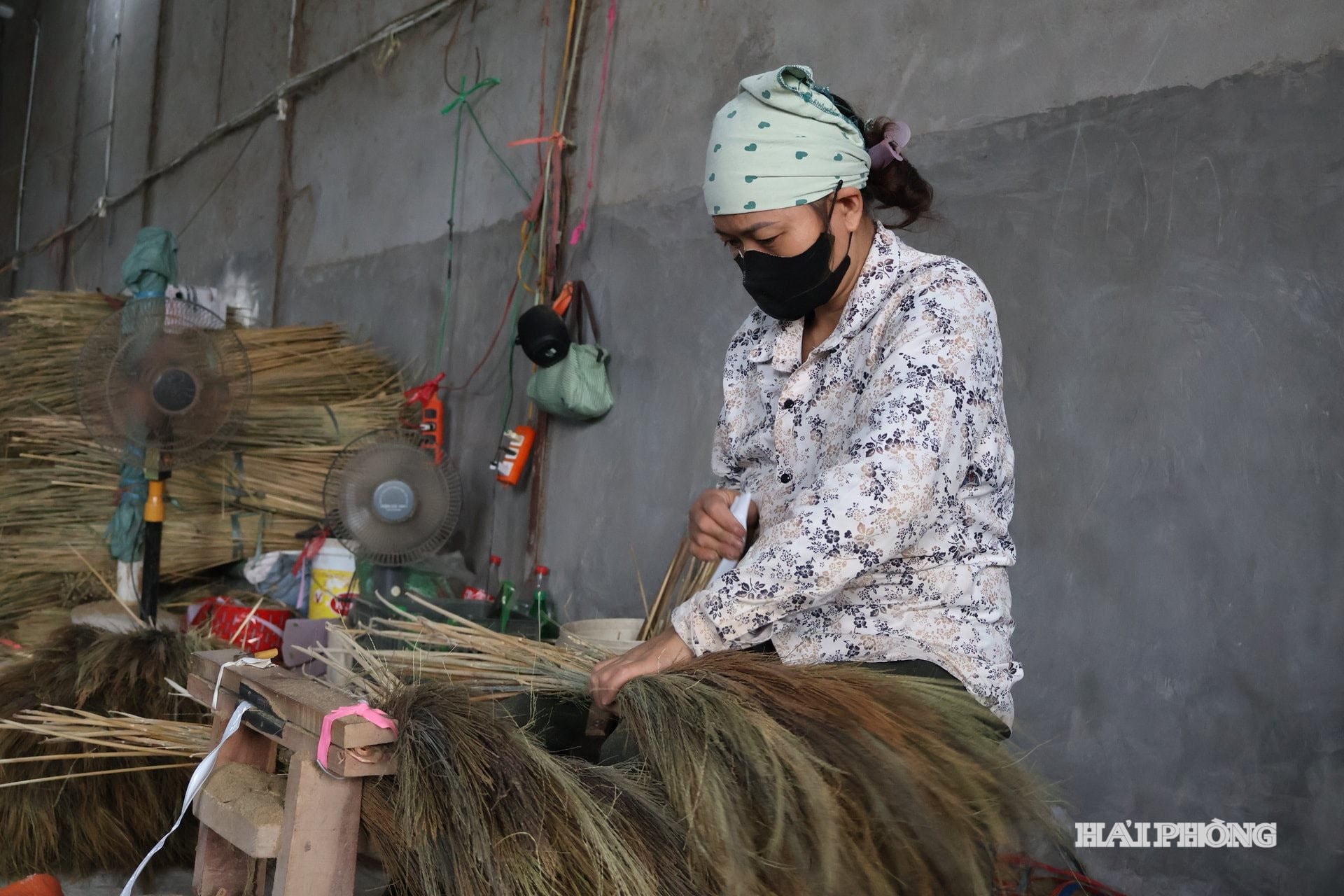
Those who practice this craft are becoming increasingly rare.
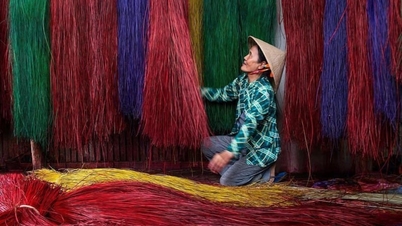
There was a time when Ly Do was considered a shining example of broom-making in the local area. Along the village lanes, the sight of bundles of golden broom grass covering the yards, and the sounds of splitting handles and tying brooms echoing from morning till night, became a familiar rhythm of life. The craft not only provided income for many households in the village but also created jobs for laborers in neighboring areas.
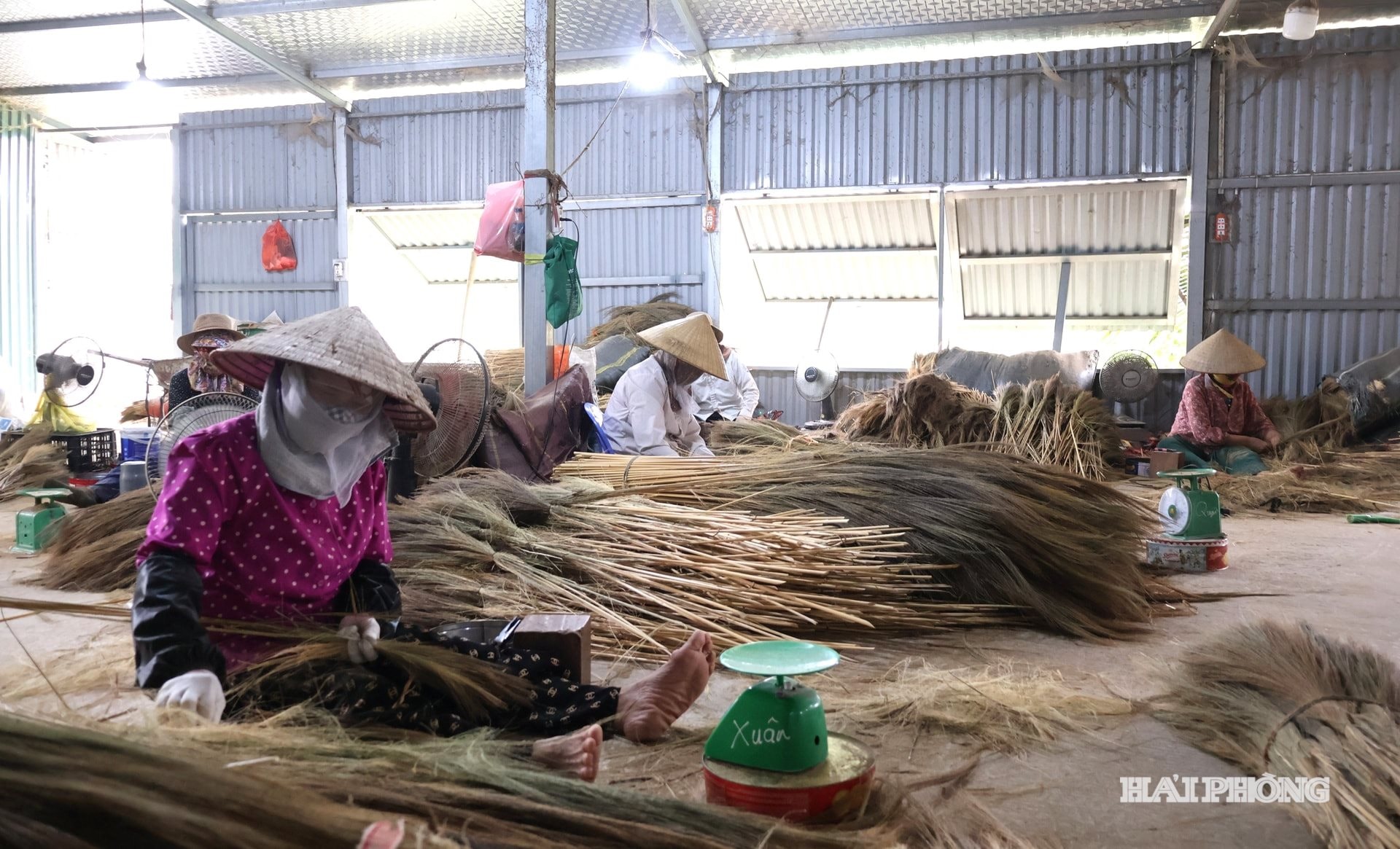
Previously, the entire village had about 10 production facilities, providing employment for nearly 500 workers. Besides domestic consumption, the products were also exported abroad. In 2024, the broom-making products of Mr. Le Van Tien's family were recognized as achieving OCOP 3-star standards, further affirming the quality and reputation of the village's traditional craft products. However, behind this positive milestone lies the reality that the scale of production is gradually shrinking. Currently, only 6 households in the village maintain relatively large-scale production, each employing 20 to 40 workers. Compared to the period of strong growth, the number of facilities and workers has decreased significantly.
The biggest challenge currently is the shortage of new workers. The broom-making craft relies mainly on manual processes such as selecting reeds, bundling, tying, and pressing brooms, requiring patience and skill. Meanwhile, young workers tend to choose jobs in industrial zones, businesses, or the service sector with more stable incomes.
In the workshops that are still operating, the workforce mainly consists of middle-aged and elderly people, or those who take advantage of their free time during the agricultural off-season to do extra work. This indicates a serious shortage of successors in the craft villages – a crucial factor in the long-term survival of the craft.
Ms. Tran Thi Huong, owner of the Quang Huong broom-making facility, said: "The biggest difficulty right now is manpower. This profession is mainly done by hand, requiring hardworking and experienced people. Older people are still involved because they are familiar with the trade, while most young people go to work in factories with higher incomes, so very few people pursue this profession."
Market competitive pressure
Besides the labor shortage, the broom-making craft in Ly Do also faces significant pressure from changing consumer demands. In recent years, products such as plastic brooms, mops, and vacuum cleaners have become increasingly popular, especially in urban areas. The convenience and diverse designs of these products have significantly narrowed the market for traditional brooms.
According to producers, demand for these products is no longer as consistent as before, with orders mainly depending on regular customers, traders, or traditional distributors. Despite having products that meet OCOP standards, building a common brand for the entire craft village and expanding distribution channels has not yet yielded significant results.
One of the challenges facing the craft village is that while the products are of high quality, the market hasn't expanded proportionally. In the context of rapidly developing e-commerce, reliance on traditional distribution channels limits the competitiveness of the products. An income of 3-4 million VND per person per month shows that broom-making remains a source of income for older workers and those who utilize their free time during the agricultural off-season. However, for young workers, this income level makes it difficult to compete with other professions.
Mr. Vu Dinh Minh, Head of Ly Do village, said that the locality was recognized as a broom-making craft village in 2015. Over the years, households have proactively improved product quality, maintained employment, and sought markets. However, for sustainable development, the craft village urgently needs supportive policies regarding trade promotion, product advertising, market expansion, and creating conditions to attract labor.
From the experience in Ly Do, it is clear that to sustain the craft, the core element lies not only in OCOP titles or certifications but also in stable output, sufficient income to retain workers, and the ability to adapt to new market demands. Only when both the market and labor issues are simultaneously resolved can the traditional broom-making craft continue to thrive, becoming a long-term and sustainable livelihood for the local people.
HUYEN TRANGSource: https://baohaiphong.vn/tran-tro-lang-nghe-choi-chit-ly-do-540631.html




![[Photo] General Secretary and President To Lam presides over a meeting on preparations for the review of one year of operation of the three-tiered government system.](https://vphoto.vietnam.vn/thumb/1200x675/vietnam/resource/IMAGE/2026/06/02/1780391821195_a1-bnd-4595-9717-jpg.webp)





















































































Comment (0)