

Artemis has faced numerous obstacles and delays. The Artemis I unmanned mission took place in November 2022, after a series of postponements and cancellations. In February of this year, NASA also had to delay the Artemis II launch after encountering problems during the final fuel loading rehearsal.

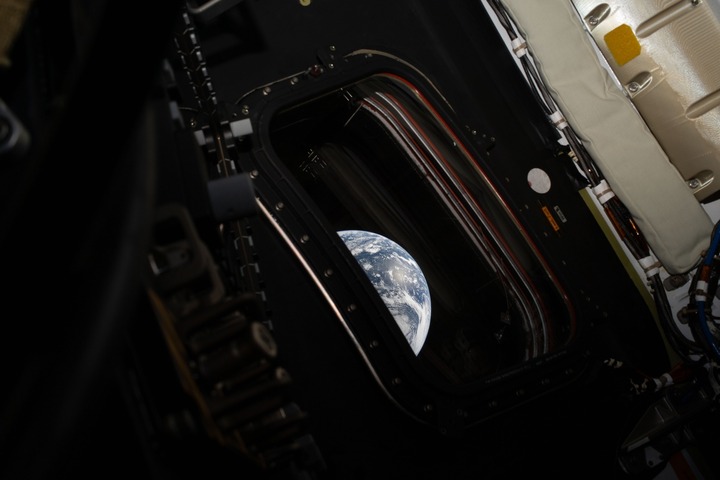
Earth as seen through one of the main windows of the Orion spacecraft during the Artemis II mission. (Image: NASA)
Unless other major problems arise during Artemis II, NASA will test sophisticated commercial technologies in low Earth orbit during the Artemis III mission in 2027, including docking the Orion spacecraft with a SpaceX or Blue Origin lander.
This mission focuses on testing the new life systems, engines, and lunar rover (Axiom EMU) before undertaking crewed lunar landings. NASA aims for the first lunar landing in 2028 with the Artemis IV mission.
By the 2030s, NASA expects to begin developing settlements, rovers, and cargo landing sites, aiming to establish a sustainable presence on the lunar surface.
The Orion spacecraft, carrying four astronauts for the Artemis II mission, was launched into space by an SLS rocket system at 5:35 AM on April 2nd ( Hanoi time). After entering Earth orbit, the spacecraft performed a crucial engine burn to escape and head towards the Moon.
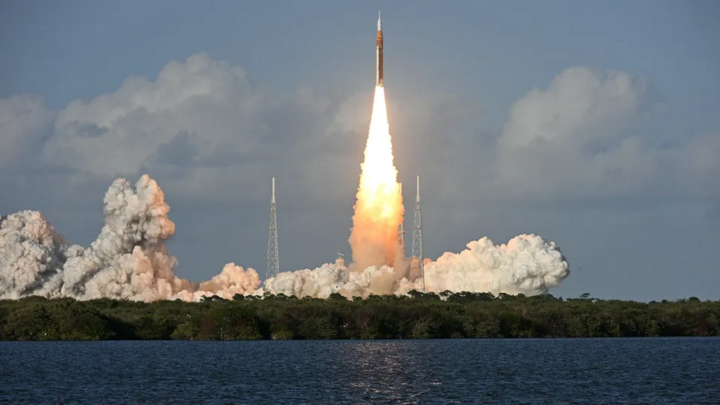
The SLS rocket launched the Orion spacecraft carrying the Artemis II crew at the Kennedy Space Center, USA, on April 1st. (Photo: Getty Images)
About two days after launch, Orion reached its "mid-course" milestone, at a distance of over 219,000 km from Earth. By the fifth day, the spacecraft entered the Moon's gravitational pull, officially entering space around the satellite.
On the sixth day of the mission, the crew performed a flyby of the far side of the Moon, a mission lasting approximately 7 hours and considered the most important. During this flight, the Orion spacecraft temporarily lost contact with Earth for about 40 minutes because the Moon blocked the signal.
Around the same time, Artemis II set a new record for the furthest manned flight from Earth in history, reaching a maximum distance of approximately 406,773 km, surpassing the milestone of Apollo 13 in 1970 (approximately 400,171 km). The spacecraft also approached the Moon at its closest distance of approximately 6,500 km.
Video of the solar eclipse as the Orion spacecraft flew behind the Moon. (Source: NASA)
During the 7-hour flyby, the crew conducted numerous scientific observations, photographed the surface, studied geological structures, and witnessed the solar eclipse from space.
After completing its loop, the Orion spacecraft used the Moon's gravitational pull to return to Earth in a "freedom of return" orbit.
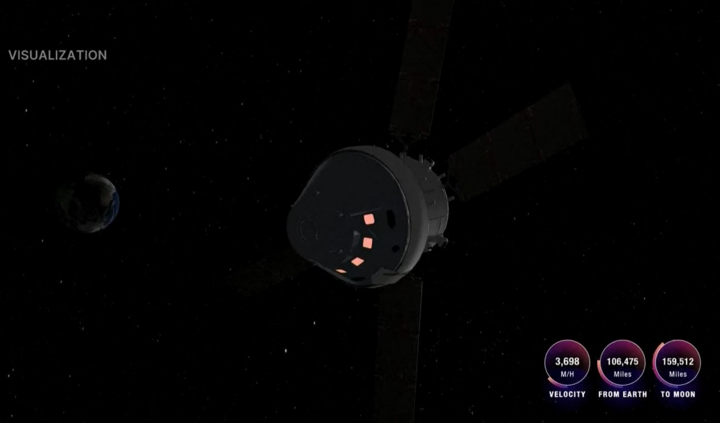
The Orion spacecraft, carrying the Artemis II crew, is heading towards Earth. (Screenshot)
On the ninth day of the mission, which was also the crew's final full day in space, NASA announced that the Artemis II astronauts had reached the 'halfway' mark between the Moon and Earth.
The Orion spacecraft will land in the Pacific Ocean at approximately 8:07 PM on April 10th (7:07 AM on April 11th Hanoi time) off the coast of San Diego, USA.
Despite facing numerous risks on its journey to the Moon, experts believe the most dangerous phase of Artemis II lies in its final stage: re-entering Earth's atmosphere.
Upon its return, the Orion spacecraft re-entered the atmosphere at speeds of up to approximately 40,000 km/h, more than 30 times the speed of sound, generating external temperatures that could exceed 2,700 degrees Celsius. This placed immense pressure on the heat shield – a vital component protecting the spacecraft.
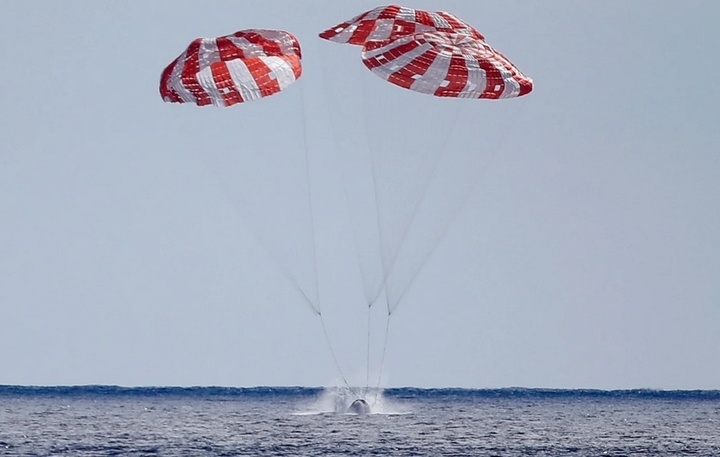
NASA's Orion spacecraft landed in the Pacific Ocean in December 2022 after its unmanned Artemis I mission to the Moon. (Photo: Getty Images)
The issue became noticeable after Artemis I in 2022, when the heat shield showed unusual pitting and cracking. Although the spacecraft still landed safely, these signs raised concerns about the durability of the Avcoat material under harsh conditions.
In Artemis II, NASA still uses a similar heat shield design, but has adjusted the re-entry trajectory. Instead of flying in a "leapfrog" fashion like Artemis I, the spacecraft will follow a higher trajectory to reduce heat load and limit the risk of damage.
NASA stated that it spent more than a year analyzing and testing the system, confirming it was safe enough to bring the crew back. However, some experts remain cautious, arguing that the risks cannot be completely eliminated.
According to the plan, the Orion spacecraft will land in the sea off the coast of San Diego. This is not only the end of the journey, but also a crucial test that will determine the success of the entire mission.
Source: https://vtcnews.vn/truc-tiep-phi-hanh-doan-artemis-ii-tro-ve-trai-dat-ar1012335.html




![[Photo] The heat at the fireworks display site on the opening night of the Da Nang International Fireworks Festival 2026](https://vphoto.vietnam.vn/thumb/1200x675/vietnam/resource/IMAGE/2026/05/27/1779889741485_ndo_br_z7872039145157-fecaba5112f39e8352544099d7ef4738-5140-jpg.webp)









































































































Comment (0)