


When trendy toys meet traditional heritage
At the first China New Culture and Creativity Fair and the Trendy Toy Festival held in Beijing, the lines of people formed from early morning almost constantly.
Many visitors come to hunt for famous collectibles like Labubu or Dimoo, but they leave with items that go beyond the world of art toys, from accessories inspired by the Sanxingdui archaeological site and handcrafted Tianjin gourds to traditional embroidery products that are part of China's intangible cultural heritage.
Taking place over 10 days at Chaoyang Park, the fair transformed the lakeside area into a space where trendy toy culture and traditional crafts intersected.
Art toy stalls are interspersed with folk craft displays, attracting visitors who constantly move around and explore.
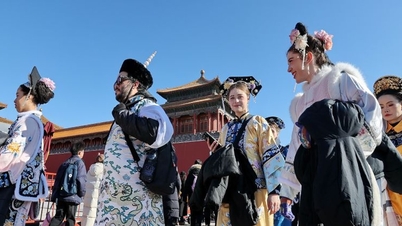
In the exhibition area, many major institutions such as the Palace Museum, the National Museum of China, and the Capital Museum brought their most representative cultural products.
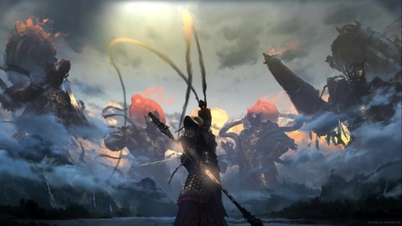
Young people gathered in large numbers in front of the booths displaying Labubu merchandise, products based on the game "Black Mythology: Goku," or designs inspired by Sanxingdui.
Initially, many people lined up to buy the blinds, but were soon drawn to the handcrafted jewelry in a traditional style.

For many attendees, the fair was more than just a shopping destination; it was a multi-layered cultural experience. A parent from Dongcheng District, Beijing, said he spent hours visiting the event with his fourth-grade son. Initially, the boy only wanted to buy products related to "Black Mythology: Monkey King," but later became interested in traditional handicrafts.
Researcher Bu Xiting at the School of Cultural Industry Management, Communication University of China, believes this trend reflects the growing cultural confidence among Chinese youth. According to him, young people today are increasingly attracted to products that are both entertaining and emotionally engaging.
He argues that China's trendy toy industry is rapidly growing thanks to the explosion of domestic brands, increasingly strong design capabilities, and a blend of traditional culture with contemporary aesthetics. The spread of social media also contributes to the rapid rise of domestic collectible characters and products into phenomena.
"Today, consumers are not just buying products; they are also looking for the cultural value, emotions, and social connection behind those items," he said.

When heritage enters modern life
As China's first national-level creative culture fair combining exhibitions, trade, experiences, and industry forums, the event spans an area of 66,000 square meters.
The exhibition area brings together 46 major museums and cultural organizations from across the country, along with performances and displays from 43 intangible cultural heritage projects, including Hebei jade carving, Sichuan brocade weaving, and many other traditional crafts.
The Palace Museum offers tea sets inspired by five famous Chinese pottery styles, dragon-shaped bookmarks, and royal-patterned blankets.
Meanwhile, the National Museum of China attracts visitors with ice cream shaped like phoenix crowns, jewelry inspired by ancient artifacts, and magnet designs based on ancient paintings. The Capital Museum, on the other hand, draws attention with its playful dolls and ice cream products inspired by historical sites.
One of the most popular stalls was that of Zhao Wei, an artisan who inherited the traditional gourd-making craft of Tianjin. Here, he directly demonstrated the techniques of carving, sculpting, and painting to transform gourds into miniature statues, accessories, bracelets, necklaces, and decorative items.
Despite the rainy weather for several days, Zhao said that visitor numbers remained stable throughout the event.
According to him, traditional crafts can only survive in the long term if they find a way to connect with the younger generation. Therefore, transforming heritage products into familiar, aesthetically pleasing, and easy-to-use items in modern life is very important.
Source: https://baovanhoa.vn/the-gioi/trung-quoc-tre-hoa-di-san-bang-do-choi-thoi-thuong-231444.html

![[Image] Pleasant weather helps students enter the 10th grade entrance exam with confidence.](https://vphoto.vietnam.vn/thumb/1200x675/vietnam/resource/IMAGE/2026/05/29/1780034401612_ngay-1-thi-lop-10-minh-duy-8-5009-jpg.webp)

![[Photo] Ba Lang An Lighthouse - the "eye of the sea" amidst the "rock museum" of Quang Ngai province.](https://vphoto.vietnam.vn/thumb/1200x675/vietnam/resource/IMAGE/2026/05/29/1780038698840_anh-man-hinh-2026-05-29-luc-14-10-42.png)
































































Comment (0)