

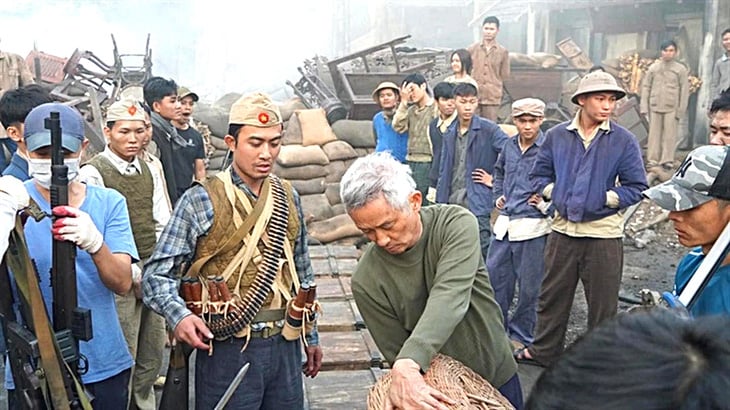
Director Phi Tien Son on the set of the film "Peach, Pho and Piano" - Photo: Provided by the director.
Regarding the film "Dao, Pho and Piano ," alongside the praise, there were quite a few criticisms about the setting. Some commented that it felt "fake."
It's impossible to recreate the old scene.
In the special feature "From Hanoi in the winter of 1946 to Peaches, Pho, and Piano " (March 3rd morning in Hanoi), director Phi Tien Son recounted how someone pointed out that the tank in the film was not a tank of that era.
Hearing this, he was very happy because "as long as the audience is still interested and scrutinizing, filmmakers making films about historical topics still have hope."
Director Dao, in the film "Pho and Piano," also shared that in our country, making films on this topic faces many difficulties and challenges.
In many countries, when making historical films, most of the settings are recreated, except for those that are truly iconic. Only by recreating everything can the camera angles be adjusted to capture the desired shots.
But in Vietnam, filmmakers don't have much money, and even if they did, they wouldn't have enough personnel. Not to mention, Vietnam lacks specialized, professional materials. Filmmakers mostly have to find, modify, and borrow a lot of resources.
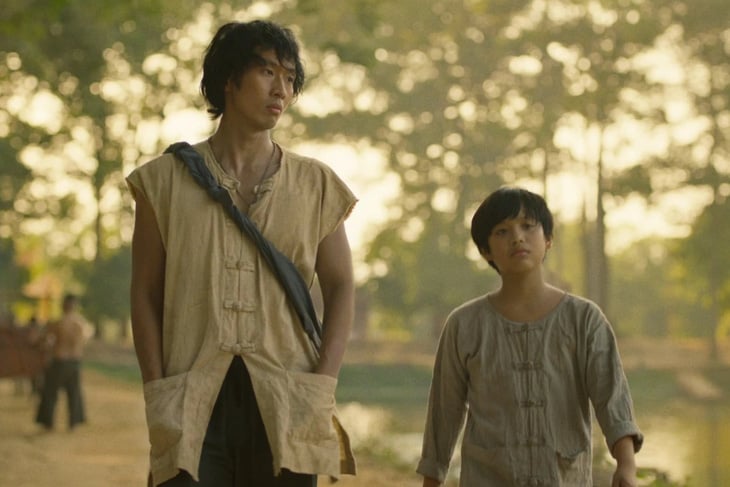
The film "Southern Forest Land" is considered to have done a good job in terms of setting - Photo: DPCC
Peach, Pho, and Piano is set in Hanoi in late 1946 and early 1947. At that time, many neighborhoods were in ruins.
According to Phi Tien Son, recreating the historical setting is impossible. In Hanoi today, it's not easy to find three old houses standing next to each other. The film crew had to borrow a plot of land in a military barracks to build the set. The artist had to design everything, from constructing the roads and sidewalks to commissioning the tanks...
Mr. Phi Tien Son said that audiences always look for grandeur and meticulous detail; and for the film crew, given the difficulties and costs involved, achieving what they did was already fortunate.
Not to mention, because this is a state-funded film, when it comes to the financial aspects related to set construction, not all budget managers understand and approve it.
Fear of causing offense, fear of infringing upon historical truth...

Artist Pham Quoc Trung - Photo: DAU DUNG
Artist Pham Quoc Trung - the art designer for the film Hanoi in the Winter of 1946 (directed by Dang Nhat Minh, 1997) - once visited film sets in China.
They have a vast system of film studios and numerous private companies involved in set design. They can film in any period you want.
Props and costumes—they can have as many as you want. They sell them off, rent them out, and reuse them from one film crew to another.
Therefore, the budgets for historical films are not significantly different from those for films on contemporary topics.
In the film "Hanoi in the Winter of 1946 ," all the costumes had to be custom-made.
Mr. Phi Tien Son pointed out the "widening gap" between state-produced and privately-produced films in the realm of historical themes. For a long time, commercial filmmakers have been hesitant to tackle this subject because they fear causing offense and violating historical facts...
Citing the case of "Southern Forest Land ," artist Pham Quoc Trung argued that it was a good film in terms of setting, but due to very small details and negative effects from social media, the film's revenue was affected.
"If the government doesn't invest money, it should at least have policies to support and create favorable conditions for private filmmakers to dare to make films on historical themes," he said.
Source



































































































Comment (0)