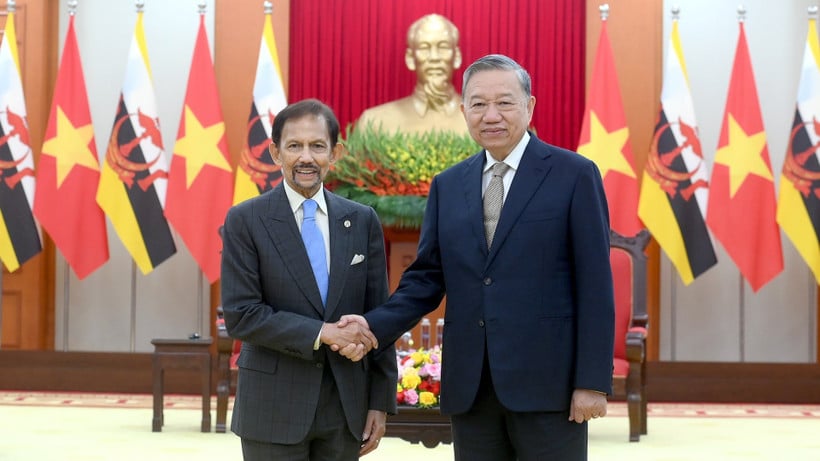
General Secretary To Lam and the Sultan of Brunei Darussalam, Haji Hassanal Bolkiah. (Photo: DANG KHOA)
1. At the invitation of Mr. Luong Cuong, President of the Socialist Republic of Vietnam, His Majesty Haji Hassanal Bolkiah Mu'izzaddin Waddaulah, Emir of Brunei Darussalam, paid a State visit to Vietnam from November 30 to December 2, 2025.
2. During the visit, the King attended the official welcoming ceremony, held talks with President Luong Cuong, met with General Secretary of the Central Committee of the Communist Party of Vietnam To Lam, and held meetings with Prime Minister Pham Minh Chinh and Chairman of the National Assembly Tran Thanh Man.
3. The leaders of the two countries acknowledged the socio-economic developments in both countries and expressed pleasure at the substantive and positive progress in bilateral relations since the upgrading of relations to a Comprehensive Partnership in 2019. The leaders emphasized the importance of the Action Program for implementing the Vietnam-Brunei Darussalam Comprehensive Partnership for the period 2023-2027, and agreed to closely coordinate to comprehensively and effectively implement the Action Program.
4. The leaders of the two countries affirmed their commitment to further strengthen cooperation in all areas, including politics, defense and security, trade and investment, energy, education, culture and social affairs, people-to-people exchanges, and other areas of mutual interest, as well as cooperation within multilateral frameworks.
Political Cooperation
5. The leaders of the two countries acknowledged the importance of maintaining exchanges of delegations and high-level contacts through all channels—State, Government, Parliament, people-to-people, and local—to strengthen political trust and mutual understanding. The leaders of the two countries agreed to organize activities to commemorate the 35th anniversary of the establishment of diplomatic relations between Vietnam and Brunei Darussalam in 2027. Both sides recognized the effectiveness of the Joint Committee on Bilateral Cooperation (JCBC) mechanism, co-chaired by the Foreign Ministers of the two countries, as well as existing specialized dialogue and cooperation mechanisms.
Defense and Security Cooperation
6. The leaders of the two countries acknowledged the positive results of cooperation between the Ministries of Defense and the Armed Forces of the two countries in the following areas: implementing the 2005 Memorandum of Understanding on Defense Cooperation and the 2013 Memorandum of Understanding on Naval Cooperation; establishing and maintaining effective cooperation mechanisms between the defense forces of the two countries, including the Joint Working Group on Defense Cooperation; enhancing the professional capacity of officers and military personnel of both countries through training and joint courses; promoting cooperation in the fields of maritime security and safety, defense industry, cybersecurity, counter-terrorism, and intelligence exchange; and seeking cooperation between the Vietnam Coast Guard and maritime law enforcement agencies of Brunei.
7. The leaders of the two countries committed to continuing close coordination and mutual support at multilateral defense forums, especially within the ASEAN framework such as the ASEAN Defence Ministers' Meeting (ADMM) and ASEAN Plus (ADMM+), the ASEAN Chiefs of Defence Forces Meeting (ACDFM) and the ASEAN Regional Forum (ARF).
8. The leaders of the two countries also agreed to promote maritime cooperation between the parties through dialogue and sharing of experiences and information, as well as addressing maritime security challenges in accordance with international law, especially the 1982 United Nations Convention on the Law of the Sea (UNCLOS), in order to ensure maritime security and safety.
9. The leaders of the two countries reaffirmed the importance of cooperation in the field of security through the sharing of information and experience in combating organized transnational crime such as drug trafficking, human trafficking, illegal migration, terrorism, cybercrime, and money laundering. Both sides expressed satisfaction with regional cooperation within the framework of the ASEAN Ministerial Meeting on Transnational Crime (AMMTC), the ASEAN Police Chiefs Meeting (ASEANPOL), and the ASEAN Intelligence Community Meeting (AICC).
The leaders of the two countries welcomed the new progress in security cooperation within the bilateral and ASEAN frameworks, including negotiations on agreements on combating transnational crime, extradition, and the transfer of convicted prisoners. They also welcomed the opening ceremony for the signing of the United Nations Convention against Cybercrime in Hanoi and agreed to adjust internal procedures for ratification of the Convention, contributing to its early entry into force.
Economic Cooperation
10. Trade: The leaders of both countries expressed satisfaction with the ahead-of-schedule achievement of the bilateral trade target of US$500 million by 2025, and agreed to closely coordinate to double bilateral trade by 2035 based on diversifying import and export products and aiming for a balanced trade balance.
11. The leaders of the two countries agreed to promote trade and encourage businesses and business associations of both countries to strengthen exchanges, including enhancing linkages and cooperation in agricultural, forestry, and fisheries products. The leaders also agreed to seek measures to facilitate bilateral trade, including improving customs procedures and leveraging the FTAs to which both sides are members. Both sides expressed openness to further discussions on rice trade cooperation, particularly creating opportunities for importers to enhance mutually beneficial cooperation in food security. The leaders also encouraged the business communities of both countries to boost trade and freight transport activities through BIMP-EAGA and the Mekong sub-region.
12. Investment: Vietnam reaffirms its commitment to facilitating investment from Brunei Darussalam through the Brunei Investment Authority (BIA), other Brunei organizations and investors in projects developing the International Financial Centre. Brunei Darussalam welcomes and extends support to Vietnamese investors expanding their business operations in Brunei Darussalam, particularly in sectors aligned with the goals and priorities of the country's Development Vision 2023 (Wawasan 2035).
13. Digital Economy: The leaders of the two countries agreed to promote cooperation in new areas such as the digital economy, green transformation, and circular economy through sharing successful practices, strengthening capacity, encouraging cooperation among relevant agencies, organizations, and businesses, and establishing mechanisms for collaborative research between institutes and universities.
14. Halal Cooperation: Leaders of both countries recognize the enormous potential for cooperation in the Halal industry, including promoting cooperation between Halal certification bodies of the two countries, aiming for mutual recognition of Halal certifications. Vietnam encourages Bruneian businesses to invest in building Halal industrial parks and developing projects for the production of Halal food and products in Vietnam.
Brunei Darussalam encourages Vietnamese businesses and localities to cooperate with Bruneian partners in the production and processing of Halal-compliant food for the domestic markets of both countries and for export to third countries. The leaders of both countries agreed that they will share experiences on Halal-related issues, including best practices and processes in Halal food production; and support capacity building for experts in this field through training programs and experience transfer.
15. Agriculture and Fisheries: The leaders of the two countries agreed to strengthen cooperation in agriculture, fisheries, and food security by encouraging businesses, universities, and research institutions to promote exchanges and collaborative research in these fields. Brunei Darussalam committed to facilitating Vietnamese businesses to expand investment in agriculture, fisheries, and food security by strengthening cooperation with businesses and partners on a mutually beneficial basis, aiming to ensure the recovery of the regional food supply chain. Brunei Darussalam encouraged investment from Vietnam in the fisheries sector through joint ventures with registered local businesses to promote a competitive, transparent, and sustainable fisheries industry.
16. The leaders of the two countries agreed to strengthen information exchange and cooperation to address the issue of illegal, unreported, and unregulated (IUU) fishing. Brunei Darussalam acknowledged and appreciated Vietnam's efforts in strengthening fisheries management and sustainable practices, and looked forward to positive developments in Vietnam's cooperation with the European Commission.
Energy Cooperation
17. The leaders of both countries welcomed the cooperation of energy companies from both sides on a commercial basis in the oil and gas sector, in accordance with international law and the principles of mutual respect, equality, and mutual benefit. The leaders of both countries welcomed the increased participation and promotion of cooperation in oil and gas trade and services, particularly by the Vietnam National Energy Industry Corporation (PVN) and Brunei Energy Trading and Services Company (BEST), in midstream and downstream projects; encouraged potential cooperation in various other areas of the oil and gas industry; and welcomed the continued exchange between relevant agencies. Brunei Darussalam encouraged greater participation of Vietnamese businesses, including potential trade and investment opportunities.
18. Brunei Darussalam highly appreciates the positive contributions of the Vietnam Drilling and Well Services Corporation (PV Drilling) in providing drilling services to the oil and gas industry of Brunei Darussalam, especially in the upstream sector. Both sides encourage PV Drilling and its partners in Brunei Darussalam to continue expanding cooperation in drilling and well provision, and affirm their mutual support in facilitating these processes when necessary.
19. The leaders of the two countries agreed to further strengthen cooperation, expanding into the field of energy transition, through expert exchanges, training and capacity building, enhanced business and investment cooperation, and mutual consideration of services and opportunities between the two countries.
People-to-people exchange
20. The leaders of the two countries agreed to strengthen cooperation between educational institutions through student and teacher exchanges, joint research and training programs, cultural activities, and internships. The leaders also welcomed the Vietnamese language courses at the University of Brunei Darussalam (UBD), which aim to promote mutual understanding and stronger people-to-people relations.
21. The leaders of the two countries also agreed to promote linkages through sports and cultural activities, regional and international tourism events, and promotional activities. The leaders of the two countries agreed on the potential for strengthening air connectivity, contributing to the common goal of promoting substantive cooperation and deepening people-to-people exchanges.
22. The leaders of the two countries agreed to promote cooperation through parliamentary channels and continue to coordinate closely at multilateral inter-parliamentary forums, especially on regional and international issues of common concern. Both sides considered establishing a Vietnam-Brunei Darussalam Friendship Association and a Brunei Darussalam-Vietnam Friendship Association when conditions permit.
Regional and International Issues
23. The leaders of the two countries emphasized the importance of maintaining multilateralism and a rules-based international order based on the principles stipulated in the United Nations Charter and on the basis of international law to maintain peace, security, prosperity, and sustainable development. In this regard, the leaders of the two countries expressed satisfaction with the good cooperation and close consultation between the two countries in regional and international forums, especially within ASEAN and ASEAN-led mechanisms, the United Nations, the Asia-Pacific Economic Cooperation (APEC) Forum, and the Non-Aligned Movement (NAM). Brunei Darussalam expressed its unwavering support for Vietnam in its role as APEC Chair in 2027.
Both sides reaffirmed their commitment to continue coordinating efforts to support the strengthening and reform of global institutions, including the World Trade Organization (WTO), in order to advance common interests and address global, regional, and sub-regional challenges of shared concern.
24. The leaders of the two countries agreed to promote cooperation to achieve beneficial results from participation in free trade agreements such as the Regional Comprehensive Economic Partnership (RCEP), the Comprehensive and Progressive Trans-Pacific Partnership (CPTPP), and the ASEAN Trade in Goods Agreement (ATIGA).
25. The leaders of the two countries emphasized the importance of strengthening ASEAN's central role and unity, committing to enhancing coordination to promote the ASEAN Community building process, effectively implementing the ASEAN Community Vision 2045 and strategic plans, expanding and deepening ASEAN cooperation and cooperation between ASEAN and its partners, especially in areas of common interest such as trade, investment, digital transformation, innovation, science and technology, climate change response, connectivity, food security, water resources and energy.
26. The leaders of the two countries emphasized the important and complementary role of sub-regional development in the process of regional integration and the building of the ASEAN Community, particularly in the areas of strengthening economic integration and narrowing the development gap. The leaders of the two countries committed to promoting sustainable, inclusive, and equitable development within the ASEAN Community by linking sub-regional growth with the overall development of ASEAN and strengthening relations between ASEAN and sub-regional cooperation frameworks.
27. The leaders of the two countries emphasized the importance of adhering to international law, particularly the 1982 United Nations Convention on the Law of the Sea (UNCLOS), which sets out the legal framework within which all activities in the oceans and seas must be conducted. Both sides reaffirmed their commitment to maintaining peace, security, stability, safety, and freedom of navigation and overflight in the South China Sea and recognized the benefits of having the South China Sea as a peaceful, stable, and prosperous maritime region. The leaders of the two countries stressed the importance of self-restraint and demilitarization, and refraining from actions that could further complicate the situation and escalate tensions in the South China Sea. Both sides committed to supporting the peaceful resolution of disputes, including full respect for diplomatic and legal processes, and refraining from the threat or use of force, in accordance with international law, including UNCLOS 1982.
28. The leaders of the two countries emphasized the importance of all relevant countries in promoting a peaceful, harmonious, and favorable environment, with the aim of building trust and enhancing mutual confidence in the region. In this regard, the leaders reaffirmed the importance of the full and effective implementation of the 2002 Declaration on the Conduct of Parties in the South China Sea (DOC), and looked forward to the early achievement of an effective and substantive Code of Conduct in the South China Sea (COC) consistent with international law, particularly UNCLOS 1982.
29. During the visit, the two sides signed the following documents:
- Memorandum of Understanding (MOU) between the Government of the Socialist Republic of Vietnam and the Government of the Kingdom of Brunei Darussalam on Maritime Cooperation
- MOU between the Ministry of Agriculture and Environment of the Socialist Republic of Vietnam
Vietnam and the Ministry of Natural Resources and Tourism of the Kingdom of Brunei Darussalam on Cooperation in using a hotline to exchange information on illegal, unreported and unregulated fishing. - MOU between the Ministry of Agriculture and Environment of the Socialist Republic of Vietnam
Vietnam and the Ministry of Natural Resources and Tourism of the Kingdom of Brunei Darussalam on cooperation in the field of fisheries.
30. The leaders of the two countries expressed satisfaction with the open and frank exchange in the spirit of friendship and mutual understanding, and wished to strengthen cooperation in areas of mutual interest. The King thanked the leaders and people of Vietnam for the warm and thoughtful welcome extended to the Brunei Darussalam delegation throughout the visit and respectfully invited Vietnamese leaders to visit Brunei Darussalam at a suitable time.
Source: https://nhandan.vn/tuyen-bo-chung-viet-nam-brunei-darussalam-post927376.html



![[Image] Pleasant weather helps students enter the 10th grade entrance exam with confidence.](https://vphoto.vietnam.vn/thumb/1200x675/vietnam/resource/IMAGE/2026/05/29/1780034401612_ngay-1-thi-lop-10-minh-duy-8-5009-jpg.webp)
![[Photo] Ba Lang An Lighthouse - the "eye of the sea" amidst the "rock museum" of Quang Ngai province.](https://vphoto.vietnam.vn/thumb/1200x675/vietnam/resource/IMAGE/2026/05/29/1780038698840_anh-man-hinh-2026-05-29-luc-14-10-42.png)






































































Comment (0)