

The brutality of these wars has been recorded in history and literature, but amidst that brutality and suffering, the will, strength, solidarity, and unwavering belief in victory and a peaceful future for the nation were also activated, nurtured, and powerfully promoted.
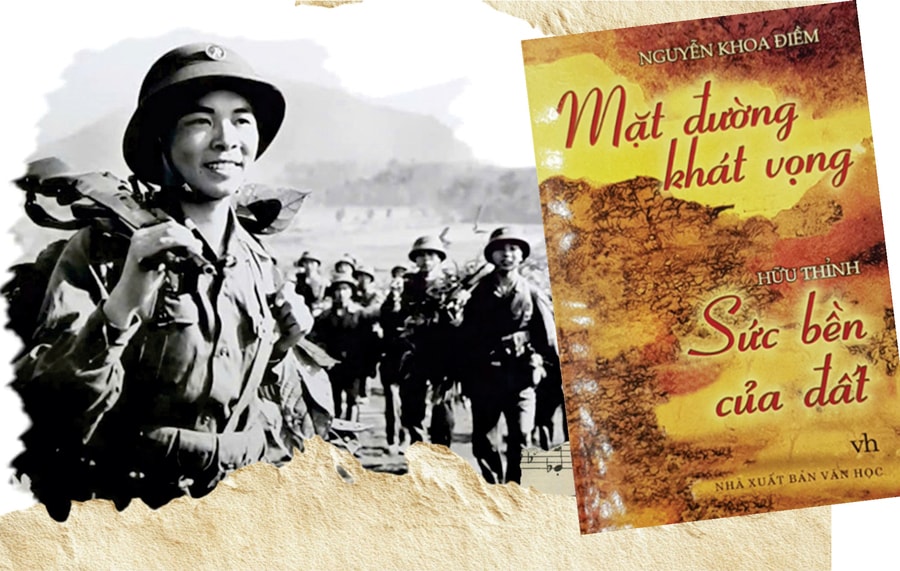
Looking back at the epic revolutionary literary legacy of Vietnam (1945-1975), the most prominent aspect is the expression of the strength of will, the unwavering belief in ultimate victory, and the spirit of overcoming the harsh hardships of war to live, fight, and defeat the invading enemy. This is not a simplification of human imagery, but rather literature has found the key to exploring and showcasing human qualities in the face of life-or-death challenges: “My fields and rice paddies I entrust to my dear friend to cultivate / The empty house I leave to the wind to shake / The well by the banyan tree remembers the soldier who went to war” (“Comrade” - Chính Hữu); “This land has already recorded our crimes / We do not know how to quell our resentment /… / Because the sun is about to rise / The horizon is clear / The Duong River flows turbulently / To sweep away into the sea / So many enemy outposts destroyed / So many tears / So much sweat / So much darkness / So much suffering” (“On the Other Side of the Duong River” - Hoàng Cầm)…
And there are still prose works about war and soldiers, from the early days of the resistance against the French, through the war against the Americans, and the wars to protect the southwestern and northern borders. Nam Cao firmly asserted a very practical idea, not only for writers of that time: "Live first, then write." One must live, live as a human being. Similarly, in the thoughts of Trang ("The Picked-Up Wife" - Kim Lân), the red flag with a yellow star flying over the Sop dike is a guiding signal for people to overcome the hardships of hunger and death in the year of the Rooster (1945). On the ramparts of Hanoi in the early days of the nationwide resistance, Nguyen Huy Tuong, with "Living Forever with the Capital" and "Hoa Rampart," revived the elegant beauty, patriotism, love for the capital, and love for life. This was not a spur-of-the-moment patriotism, but stemmed from the meaning of survival, connected to the aspiration for peace in each house, each street corner, each life.
People in war are like those pushed to the brink. We have talked and written a lot about the heroic, majestic beauty, the truth, and the glory of the Vietnamese people in war. But we also need to look deeper, more calmly, and especially to look closely at the essence of human nature, to see that people like Núp ("The Country Rises Up") or Tnú, Mai, Dít, Heng in "The Xà Nu Forest" (Nguyên Ngọc); people like Kinh, Lữ, Khuê in the novel "Footprints of a Soldier"; people who rose up to fight to protect their land, their villages, their lives, and their right to live in Anh Đức's works ("Hòn Đất", "The Letter from Cà Mau "); Innocent children live amidst war, amidst the comings and goings of battle—fighting alongside their courageous mother in "The Mother with a Gun," and the sisters Viet and Chien in "Children in the Family" (Nguyen Thi)... They fight to reclaim their lives, against the threat of oppression and destruction from the enemy. Therefore, the way they rise up, transforming themselves into steel, weapons, to fight against the enemy cannot be simply explained in a one-sided way.
There are choices we never want. There are choices that come with many sacrifices. There are choices that are unique. Therefore, looking at the Vietnamese people during the war, at the most horrific point of the conflict, we lack the experience to judge or evaluate their choices. The writer Nguyen Ngoc Tu once had a very insightful point: How can we talk about a safe harbor for those who have never drifted adrift? So, put yourself in a life-or-death situation, make a choice, and your survival instinct will speak, summoning your physical and mental strength for an action that, after all, you may never be able to fully explain why you did it.
What explains the verses in the epic poem "The Road of Aspiration": "Year after year, people of all ages / Boys and girls the same age as us / They lived and died / Simply and peacefully / No one remembers their faces or names / But they created the nation" (Nguyen Khoa Diem)? What explains the defiant, proud stance of the liberation soldier: "He fell on the Tan Son Nhat runway / But he struggled to stand up, leaning his rifle on the wreckage of the helicopter / And he died while standing and shooting / His blood flowed with the rainbow of gunfire /…/ From his stance on the Tan Son Nhat runway / The homeland soared into the vastness of spring" (Le Anh Xuan)?
What explains the millions of Vietnamese people who braved the flames of war, embracing death as a source of pride, a sacrifice, a selfless exchange? Young men and women, generations past and present, leaving their villages and towns to enter the war, many of whom perished on the battlefield, shared one thing in common: they dedicated their youth and strength to regaining peace, to protecting their homes, their villages, their bamboo groves and rice paddies: “Communists love life, but when necessary, they can still die peacefully. To die while still loving life, a life they have earned with sweat, tears, blood, and bones for twenty-three years” (“Dang Thuy Tram’s Diary”, Vietnam Writers Association Publishing House, 2022, p. 51).
Wartime literature depicted these decisive actions and elevated them into a source of inspiration for humanity and the era. Revolutionary ideals, the truth of conscience and justice, the price of peace… these may be reasonable answers, but ultimately, it must first and foremost be the human desire to live in the face of destruction, the threat of being deprived of one's rights and values by war. Therefore, the Vietnamese people, inherently small and physically weak, suddenly transformed into heroes, warriors, and legends that struck fear into powerful foreign invaders. Isn't the story of Saint Gióng, who, from a young boy, suddenly grew into a giant, a simple yet wise folk explanation of this?
There are many reasons to explain the strength of the Vietnamese people during the war. War is unusual, so the presence of the extraordinary is also commonplace. Now, in the leisurely, peaceful, and uneventful state of the post-war period, people forget the dangers of war, forget the claws of the abyss, and thus, they question the people and literature of the wartime era, arguing that everything was strained, exaggerated, distorted, or simplistic in portraying human beings and the true nature of literary art. That is also another common occurrence in life. However, when looking at the epic literary legacy of the wartime period 1945-1975 and continuing after 1975, perhaps caution and a balanced perspective are the reasonable and appropriate responses to these historical events.
After all, a critique of war is necessary. But as the issue was raised at the beginning of this article, in the most severe trials, the will and strength of humanity are tempered, enabling them to survive disasters. Everything, ultimately, comes after that fundamental principle of survival, beyond good and evil.
Source: https://hanoimoi.vn/vai-suy-ngam-ve-van-hoc-de-tai-chien-war-747543.html






























































Comment (0)