

Recently, the number of patients hospitalized due to Streptococcus suis infection has increased at medical facilities, with many patients falling into critical condition or even losing their lives.
For example, at Bach Mai Hospital, the number of patients admitted due to swine streptococcal infection has been recorded, and all patients were weakened because they were attacked by this bacteria.
According to Dr. Do Duy Cuong, Director of the Center for Tropical Diseases at Bach Mai Hospital, the center is currently providing emergency care and treatment to two patients suffering from meningitis and sepsis caused by Streptococcus suis bacteria.
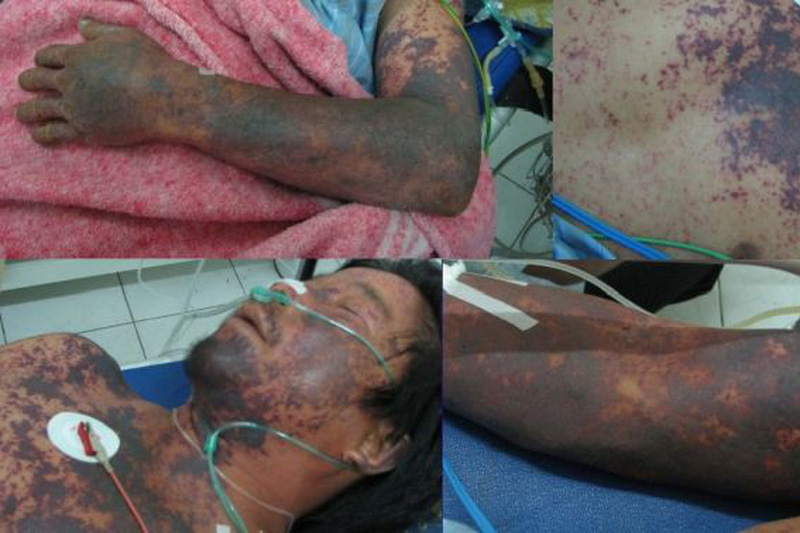
A man was hospitalized after a pig slaughtering incident resulted in his death (photo courtesy of the source).
One case involved someone contracting the disease after slaughtering and eating meat from a sick pig, while another involved someone with streptococcal infection from eating raw pig blood.
At noon on March 6th, Mr. Ha Van E. (73 years old, residing in Duy Tien, Ha Nam ) was given a sick pig weighing about 50 kg by his neighbor. He slaughtered the pig and cooked the meal by himself.
After a day, Mr. E. developed a headache, nausea, high fever, and delirium. His family took him to Hung Ha Hospital ( Hung Yen province ), where he was diagnosed with suspected sepsis/multiple organ failure.
Due to his worsening condition, Mr. E. was transferred to the Center for Tropical Diseases - Bach Mai Hospital on March 8th.
At the Center for Tropical Diseases - Bach Mai Hospital, the patient received emergency care, intensive resuscitation, high-dose antibiotics, and comprehensive care. Clinical symptoms included multiple organ failure, and cerebrospinal fluid (CSF) aspiration revealed elevated protein levels (2.58 g/l), Gram-positive cocci arranged in pairs, and blood culture showed Streptococcus suis. This is a typical case of Streptococcus suis meningitis following epidemiological factors such as contact with sick or dead pigs (during the slaughtering process) and consumption of contaminated pork.
Another patient, Mr. Dinh Van Kh. (41 years old, from Hung Yen), contracted purulent meningitis caused by Streptococcus suis after eating duck blood soup 9 days prior to admission. According to his family, 9 days before being admitted to the hospital, the patient ate duck blood soup purchased from the market.
One day later, the patient developed a fever of unknown temperature accompanied by headache and extreme fatigue. The patient was then taken to Pho Noi General Hospital in Hung Yen for pain relief treatment.
On March 13th, the patient experienced severe headaches, restlessness, and agitation, and was therefore taken to the Center for Tropical Diseases at Bach Mai Hospital. Based on clinical experience and the results of cerebrospinal fluid culture showing Streptococcus suis, the doctors unanimously diagnosed the patient with Streptococcus suis meningitis after consuming raw duck blood soup.
To help people become more aware of preventing this dangerous disease, in an interview with the press, Mr. Do Duy Cuong stated that Streptococcus suis is a disease transmitted from pigs to humans.
Most cases are related to slaughtering, eating raw blood soup, or other undercooked pork dishes... Some restaurants now mix pig blood with duck, goose, or goat blood to sell in their shops, but tests still detect Streptococcus suis bacteria.
Additionally, there are some cases where patients contract the disease even without consuming raw blood or slaughtering pigs, possibly due to eating infected pork that was prepared while still raw, or coming into contact with infected pigs through skin lesions or scratches during food preparation.
Infection with Streptococcus suis in humans manifests in three forms: septicemia, purulent meningitis, or a combination of both. The incubation period for Streptococcus suis in humans ranges from a few hours to 4-5 days, depending on the individual.
When infected with Streptococcus suis, patients exhibit symptoms such as fever, chills, nausea, vomiting, and possibly diarrhea, leading many to mistake it for common digestive disorders or food poisoning.
In severe cases, patients may exhibit symptoms such as tinnitus, deafness, stiff neck, impaired consciousness, delirium, necrotic skin lesions due to sepsis, multiple organ failure, coagulation disorders, and septic shock, leading to rapid death if not detected and treated promptly.
Each year, the Center for Tropical Diseases at Bach Mai Hospital receives and treats dozens of cases of septicemia and meningitis caused by Streptococcus suis, with patients admitted in critical condition and a mortality rate of up to 20-30%.
Even if the patient survives, the rate of sequelae is very high, most commonly irreversible hearing loss.
Doctors advise that Streptococcus suis bacteria can be completely destroyed when food is thoroughly cooked. Currently, there is no vaccine for this disease, so to prevent it, people should not slaughter sick or dead pigs.
Gloves and protective equipment should be worn when handling raw or undercooked pork, and hands should be washed thoroughly after processing meat. People also need to abandon unhealthy eating habits such as blood pudding (including pork blood pudding and blood pudding made from goat, goose, or duck).
When symptoms of the disease appear, it is necessary to go to medical facilities for examination and timely diagnosis and treatment.
Source


![[Image] Central Party Office summarizes work in 2025](/_next/image?url=https%3A%2F%2Fvphoto.vietnam.vn%2Fthumb%2F1200x675%2Fvietnam%2Fresource%2FIMAGE%2F2025%2F12%2F18%2F1766065572073_vptw-hoi-nghi-tong-ket-89-1204-jpg.webp&w=3840&q=75)


























































































Comment (0)