

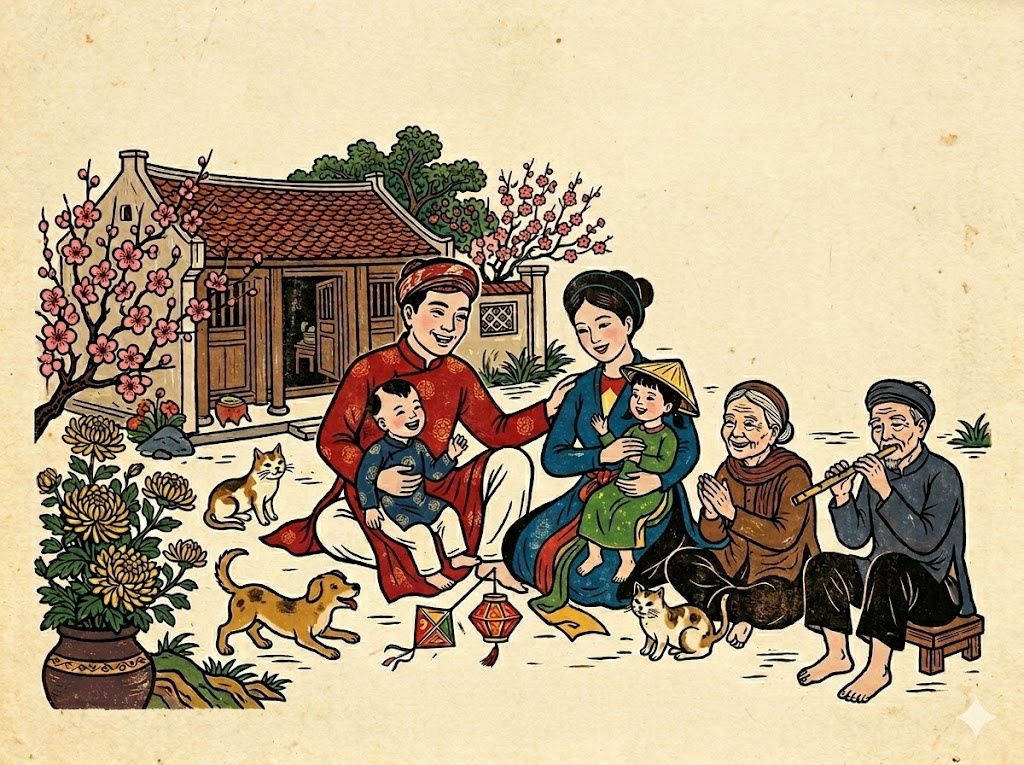
"Children are born before their fathers, grandchildren are born to keep the house before their grandfathers" is one of those folk verses that many people find paradoxical when they first hear it. However, according to Associate Professor Dr. Trinh Sam's "Strange yet Familiar Vietnamese ," this is actually a way of expressing a very characteristic relational way of thinking of the Vietnamese people.
According to conventional logic, the father must exist before the child is born. However, from a relationship and social function perspective, a man only truly becomes a "father" when the child is born. In other words, the birth of the child establishes the role of father. Therefore, the author argues that "the child comes before the father" is reasonable when placed within the structure of family relationships.
Associate Professor Trinh Sam argues that the Vietnamese language has many expressions that are "strange yet familiar," seemingly illogical at first glance, but accepted by the community because they carry symbolic and cultural meanings. For example, Vietnamese people say "share rice and cut clothes" even though the clothes, once cut, cannot be worn; or they use phrases like "furious to the core," "relieved," or "thinking to oneself" to express emotions and thoughts.
The author suggests that Vietnamese people tend to use their own bodies to perceive the world . Therefore, the abdominal area is not only a biological organ but also becomes a repository of emotions, thoughts, and moods.
"It seems that the abdominal region is the second thinking organ of the Vietnamese people, and it appears that here, emotional expressions are related to body parts according to the model: Emotion X + body part. This, according to cognitive theory, stems from humans using their understanding of their own bodies to perceive the world," he wrote.
Not only in everyday life, but also in folk songs, "illogicality" appears. The line "In the morning, the shadow is still long; in the evening, the shadow is already round" is considered physically incorrect because shadows are only round at noon. However, Vietnamese people still find this line "harmonious" and poetic because it fits the familiar contrasting structure of "morning departure/evening return".
Through these examples, the author argues that the Vietnamese language does not operate entirely according to formal logic, but rather reflects how Vietnamese people perceive the world through their life experiences, culture, and community relationships.
Source: https://znews.vn/vi-sao-sinh-con-roi-moi-sinh-cha-post1653810.html
![[Image] Hanoi's urban life under the challenge of a "scorching hot" environment](https://vphoto.vietnam.vn/thumb/1200x675/vietnam/resource/IMAGE/2026/05/25/1779706979265_nang-nong-t5-2026-minh-duy-7-4636-jpg.webp)


![[Image] Close-up view of the interchange connecting the two expressways and Long Thanh Airport.](https://vphoto.vietnam.vn/thumb/1200x675/vietnam/resource/IMAGE/2026/05/25/1779703378210_ndo_br_z7863716673926-224453a31600126cce10622af6290afd-4549-jpg.webp)

















































































Comment (0)