

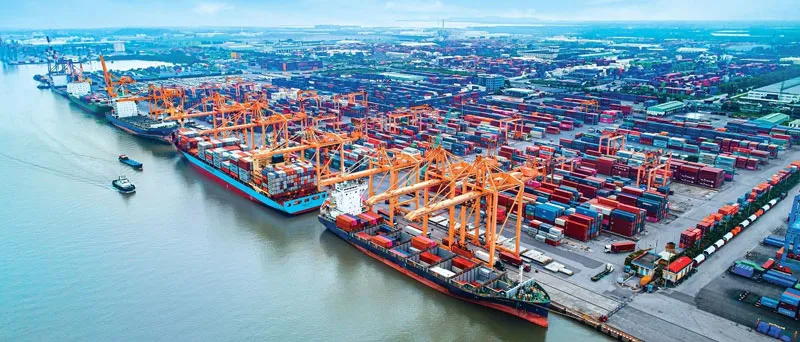
Logistics cooperation with ASEAN helps strengthen Vietnam's link in the regional supply chain.
Nguyen Anh Son, Director of the Import-Export Department ( Ministry of Industry and Trade ), affirmed that, in the context of the strong restructuring of global supply chains, logistics cooperation between Vietnam and ASEAN countries will strongly contribute to the growth of bilateral trade in goods and services.
Although ASEAN is one of the world's most dynamically growing trade regions, intra-regional trade currently falls short of its full potential.
One of the main reasons is the high cost of logistics and the uneven level of logistics connectivity in the region.
Vietnam-ASEAN trade turnover in 2025 is projected to reach approximately US$91 billion, an increase of US$7 billion compared to the previous year. Of this, Vietnam's exports to ASEAN will reach US$38.4 billion, a 3.8% increase, while imports from ASEAN will total US$52.5 billion, a 12% increase.
Vietnam's trade deficit with ASEAN is $14.19 billion, an increase of approximately $4 billion compared to 2024.
Compared to the trade volume of over $3 billion at the beginning of ASEAN's accession, the scale of trade has increased nearly 30 times.
"Joining forces with ASEAN countries to develop logistics is an opportunity for Vietnam to gradually become an important link in the regional supply chain, thereby promoting intra-regional trade, exploiting existing FTAs, and bringing a competitive advantage to export goods," Mr. Son said.
With a population of approximately 700 million people, ASEAN is transforming into one of the world's most dynamic economic blocs. As global supply chains shift and diversify ("ASEAN+1" strategy), the region is becoming a crucial manufacturing and consumption hub.
For Vietnam in particular, import and export turnover with ASEAN consistently ranks among the top. This creates an urgent need but also a golden opportunity to optimize cross-border logistics infrastructure, costs, and services.
According to the Ministry of Industry and Trade, logistics cooperation with ASEAN focuses on several directions. Firstly, connecting infrastructure and cross-border transport corridors, especially within the framework of ASEAN and the East-West economic corridors. Promoting transnational road transport routes connecting Vietnam - Laos - Northeast Thailand aims to reduce the time and cost of transporting goods within the bloc.
Secondly, cooperation in developing green logistics, smart logistics, data sharing, and the application of digital technology in supply chain management.
Thirdly, attracting investment and transferring management experience from large logistics corporations in the region to Vietnam will enhance the capacity of domestic logistics businesses.
Mr. Nguyen Anh Son affirmed that future cooperation opportunities will not be limited to transportation or warehousing, but will expand to value-added services such as regional distribution centers, cross-border e-commerce logistics, cold chain logistics, logistics serving semiconductors, energy, and the green economy.
This direction is also consistent with the spirit of Decision No. 2229/QD-TTg of the Prime Minister on the Strategy for the Development of Vietnam's Logistics Services for the period 2025-2035, with a vision to 2050 (Logistics Strategy), which emphasizes the need to strengthen international linkages, develop modern logistics, and enhance Vietnam's role in regional and global supply chains.
In the context of ASEAN moving towards building a highly connected logistics ecosystem operating on digital data and reducing carbon emissions, Vietnam has many favorable conditions to participate more deeply in the region's smart logistics ecosystem thanks to its large trade volume, rapid e-commerce development, and important connecting position in the Asian supply chain.
According to assessments, the potential for cooperation between Vietnam and ASEAN countries continues to expand in the direction of digitalization. Firstly, this includes data connectivity and the digitalization of the logistics chain.
ASEAN countries can fully promote the sharing of customs, transportation, port, warehousing, and traceability data on a common digital platform or interconnected mechanisms. This will significantly reduce customs clearance time, limit paperwork costs, improve real-time tracking of goods flows, and optimize cross-border supply chain operations.
Next is cooperation in developing smart logistics. Several countries, such as Singapore and Malaysia, are leading the way in smart ports, applying AI, IoT, blockchain, and big data in logistics coordination. This presents an opportunity for Vietnam to strengthen cooperation in human resource training, technology transfer, building smart ports, digital logistics centers, and modern supply chain management systems.
"If utilized effectively, Vietnamese logistics businesses will significantly improve productivity and reduce operating costs," Mr. Son expects.
Furthermore, cooperation in developing green logistics and sustainable supply chains is also a major focus to meet carbon emission reduction, traceability, and ESG standards. Specifically, ASEAN needs to collaborate on developing common standards for green logistics, green transport, green warehousing, and mechanisms for measuring emissions within the logistics chain.
Source: https://money.vtv.vn/viet-nam-asean-bat-tay-phat-trien-logistics-109260529153241325.htm
![[Photo] Admire the coral "masterpiece" amidst the million-year-old heritage of Dak Lak province.](https://vphoto.vietnam.vn/thumb/1200x675/vietnam/resource/IMAGE/2026/05/30/1780107638639_y25-jpg.webp)

















































































Comment (0)