

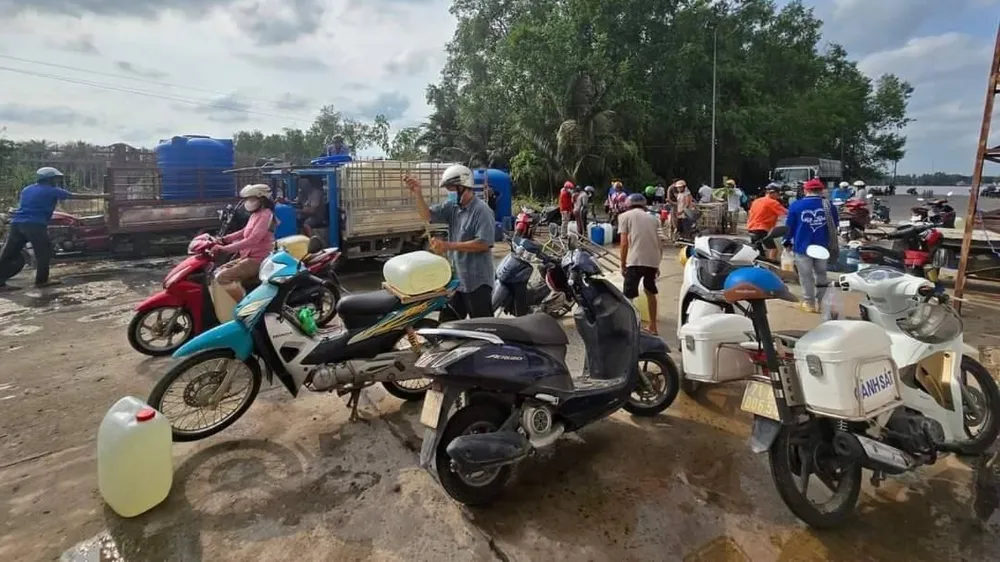
For areas located 21km or more from the river mouth, salinity is likely to increase rapidly from January 14th to 16th, then increase slightly and remain relatively stable from January 17th to 20th.
The 4‰ salinity boundary is predicted to penetrate deep into the inland areas along many river routes.
Specifically, on the Cua Dai River, the 4‰ salinity boundary could penetrate as far as Giao Long commune, about 43.6km from the river mouth. On the Ham Luong River, salinity has penetrated to Tan Hao and Dong Khoi communes, about 33.9km from the river mouth. On the Co Chien River, the 4‰ salinity boundary could reach Huong My commune and Long Duc ward, about 35.5km from the river mouth. On the Hau River, salinity is likely to penetrate as far as An Phu Tan commune, about 46km from the river mouth.
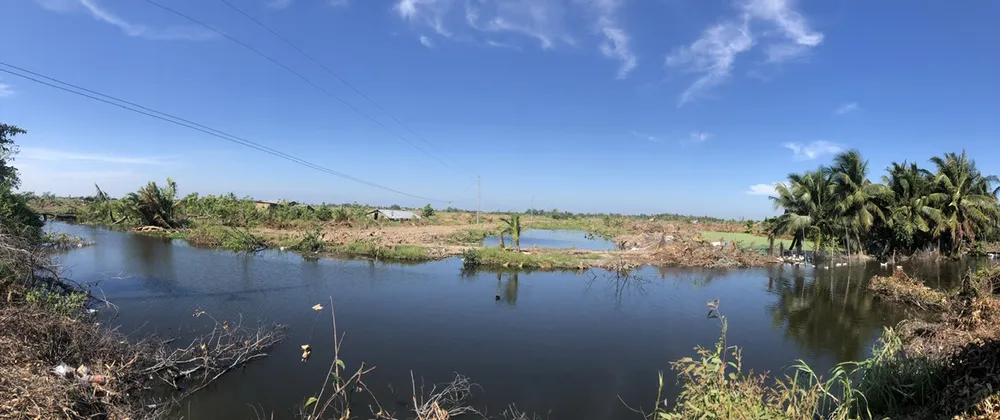
For the 1‰ salinity boundary, the level of intrusion is predicted to be deeper. On the Cua Dai River, the 1‰ salinity boundary could reach Giao Long commune, about 47.2km from the river mouth.
On the Ham Luong River, saltwater intrusion has reached Ben Tre ward, approximately 49.2km from the river mouth. On the Co Chien River, saltwater intrusion may affect the communes of Nhuan Phu Tan, Quoi Thien, and Quoi An, with a distance of up to 55.5km. On the Hau River, the 1‰ salinity boundary is likely to penetrate approximately 60km inland, reaching the area of An Phu Tan commune.
The meteorological agency also warned that the risk level for natural disasters due to saltwater intrusion is currently at level 2. Saltwater intrusion could affect agricultural production, livestock farming, and the drinking water supply for people in areas with salinity levels of 0.5‰ or higher.
Source: https://www.sggp.org.vn/vinh-long-do-man-tren-cac-song-chinh-tang-dan-post833441.html
![[Photo] General Secretary and President To Lam presides over a meeting on preparations for the review of one year of operation of the three-tiered government system.](https://vphoto.vietnam.vn/thumb/1200x675/vietnam/resource/IMAGE/2026/06/02/1780391821195_a1-bnd-4595-9717-jpg.webp)




![Water security in the Mekong Delta: [Part 2] 'The vicious cycle of degradation' is difficult to reverse.](https://vphoto.vietnam.vn/thumb/402x226/vietnam/resource/IMAGE/2026/05/29/1780020596526_4209-han-dbscl1-094000_891.jpeg)












































































Comment (0)