

Countries around the world are rapidly developing high-powered laser weapons for military missions on land and at sea, in the air, and in outer space.
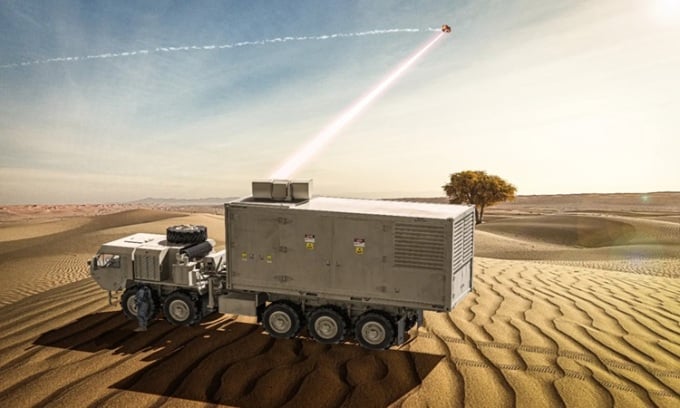
Laser weapons mounted on trucks. Photo: Popular Science
Images of small, inexpensive drones filling the sky or gliding over waves are prompting the military to develop and deploy laser weapons to replace costly defensive measures like missiles, according to Iain Boyd, a professor of aerospace engineering at the University of Colorado Boulder.
Lasers use electricity to create photons, or particles of light. These photons travel through a amplifying medium, rapidly increasing their number. All of these photons are then focused into a narrow beam by a laser guidance system, according to The Conversation .
For decades since the first laser was introduced in 1960, engineers have developed a range of lasers that produce photons at various wavelengths in the electromagnetic spectrum, from infrared to ultraviolet. High-power laser systems used in military applications are based on solid-state lasers, which use special crystals to convert input energy into photons. A key characteristic of high-power solid-state lasers is that the photons are produced in the infrared region of the electromagnetic spectrum and are invisible to the naked eye.
When interacting with a surface, a laser beam produces different effects based on its wavelength, beam power, and the material on the surface. Low-power lasers produce photons in the visible region of the spectrum and can be used as a light source for pointers and for demonstrations at public events. These laser beams are so low in power that they reflect off the surface without causing any damage.
Higher-power laser systems are used to cut through biological tissue in many medical processes. The highest-powered lasers can heat, vaporize, melt, and burn a wide variety of materials, used in industrial processes for welding and cutting. Besides the laser's power level, the ability to deliver diverse effects is also determined by the distance between the laser and the target.
Laser weapons
Partly due to the development of high-power industrial lasers, militaries around the world are increasingly using laser weapons. A fundamental advantage of high-power laser weapons is their ability to operate continuously. Unlike traditional weapons such as guns with limited ammunition, high-power lasers can fire continuously as long as there is a power source.
The U.S. military is deploying high-powered lasers mounted on trucks to shoot down a range of targets including drones, helicopters, mortar rounds, and missiles. The U.S. Navy uses high-powered lasers on ships for self-defense against small, fast-moving vessels on the sea surface, as well as missiles and drones. The U.S. Air Force is developing high-powered lasers on aircraft for offensive and defensive missions. Russia is also developing ground-based high-powered lasers to "blind" enemy satellites.
Limitations of laser weapons
A major challenge for units using high-power lasers is the amount of power required to be effective over long distances. Unlike industrial lasers that are only a few centimeters from their target, military operations involve much greater distances. To defend against close-range threats such as mortar rounds or small boats, laser weapons need to hit their target before they inflict damage.
However, incinerating materials at a safe distance requires laser beams with power ranging from tens to hundreds of kilowatts. The smallest prototype laser weapons use 10 kilowatts of electricity, equivalent to an electric car. The latest high-power laser weapons under development require 300 kilowatts of electricity, enough to power 30 households. Because high-power lasers are only 50% efficient, they generate enormous energy waste.
This means high-power lasers require power generation and cooling infrastructure, which can limit the effectiveness of different support platforms. Military trucks and Air Force fighter jets have the least space for high-power laser weapons, so these systems are limited to targets requiring relatively low power, such as sinking drones or neutralizing missiles. Ships and large aircraft can accommodate higher-power lasers capable of incinerating boats and ground vehicles. Ground-based systems are the least restricted, thus offering the highest power and the ability to engage missiles at greater distances.
Another significant limitation of high-power laser weapons requiring a support platform relates to operating time. Because trucks, ships, or aircraft must carry the power source for the laser, limiting the power supply's capacity, the laser can only be used for a limited time before needing to be recharged. Furthermore, the effectiveness of laser weapons is reduced in rain, fog, and smoke, which cause the beam to scatter. The laser beam also needs several seconds to lock onto a target before inflicting damage.
In the future, laser weapons are likely to continue developing with increased power levels, expanding their target range.
An Khang (According to The Conversation )
Source link
![[Image] Pleasant weather helps students enter the 10th grade entrance exam with confidence.](https://vphoto.vietnam.vn/thumb/1200x675/vietnam/resource/IMAGE/2026/05/29/1780034401612_ngay-1-thi-lop-10-minh-duy-8-5009-jpg.webp)



![[Photo] Ba Lang An Lighthouse - the "eye of the sea" amidst the "rock museum" of Quang Ngai province.](https://vphoto.vietnam.vn/thumb/1200x675/vietnam/resource/IMAGE/2026/05/29/1780038698840_anh-man-hinh-2026-05-29-luc-14-10-42.png)















![[GALLERY] The million-dollar 007 blockbuster is causing a sensation on Steam, is it worth buying?](https://vphoto.vietnam.vn/thumb/402x226/vietnam/resource/IMAGE/2026/05/29/1780064112088_ta-2-png.webp)




















































































Comment (0)