

Voyager 1, the farthest man-made object, is currently about 24 billion kilometers from Earth and the Sun, but it is still bright enough for the human eye to observe.
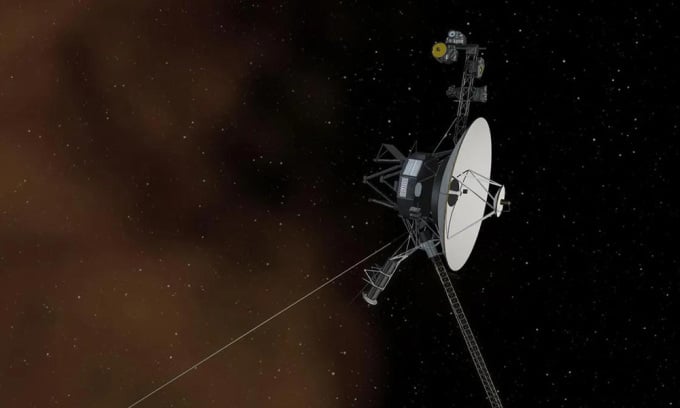
Illustration of the Voyager spacecraft. Photo: NASA/JPL-Caltech
In 1977, NASA's Voyager 1 spacecraft launched into space, beginning its journey to explore the universe and bring knowledge back to humanity. Today, Voyager 1 is the farthest man-made object from Earth, traveling more than 24 billion kilometers. The spacecraft operates in interstellar space, very far from the Sun. So, if standing next to Voyager 1, would a person be able to see it, or would they only see complete darkness?
"That's a really interesting question," Business Insider quoted experimental astrophysicist Michael Zemcov, a professor at the Rochester Institute of Technology, on October 24. He said that although both Voyager 1 and Voyager 2 (both launched in 1977 and currently more than 19 billion kilometers from Earth) are very far away, that area is still relatively bright.
First, we need to compare the distance of the Voyager 1 spacecraft to the distance between the Earth and the Sun (the average distance between the Earth and the Sun is 150 million km). Then, we use this distance to calculate the intensity of sunlight at that distance from the Sun.
As a result, the brightness at Voyager 1's location was about 1/25,000th of the brightness on Earth during the day. But this level of brightness was still about 15 times greater than the light Earth receives on a clear full moon night.
With this light, a person could clearly see the sunward side of Voyager 1, though perhaps not all the colors. They could even read a book there.
Even as it continues to fly further, Voyager 1 will remain illuminated for a considerable period due to the Sun's immense influence. According to Zemcov, the Voyager pair could remain within the Sun's light for hundreds, even thousands of years.
The distance the two Voyager spacecraft have traveled is astonishing. But according to Zemcov, considering the vastness of space, they still have a very long way to go.
Thu Thao (According to Business Insider )
Source link
![[Photo] General Secretary and President To Lam presides over a meeting with the Central Organizing Committee.](https://vphoto.vietnam.vn/thumb/1200x675/vietnam/resource/IMAGE/2026/06/03/1780482764658_a1-bnd-4741-3342-jpg.webp)


![[Photo] Secretary of the National Assembly Party Committee, Chairman of the National Assembly presides over the meeting of the Standing Committee and Executive Committee of the National Assembly Party Committee.](https://vphoto.vietnam.vn/thumb/1200x675/vietnam/resource/IMAGE/2026/06/03/1780480353201_ndo_br_bnd-2585-jpg.webp)

![[Photo] First session of the 14th Congress of the Vietnam Trade Union](https://vphoto.vietnam.vn/thumb/1200x675/vietnam/resource/IMAGE/2026/06/03/1780465947883_ndo_br_img-3852-jpg.webp)

















































![[Video] Sunset at Lap An Lagoon – Where the sun sets over the fishing nets](https://vphoto.vietnam.vn/thumb/1200x675/vietnam/resource/IMAGE/2026/05/31/1780192137701_beach-landscape-sea-water-nature-grass-745871-pxhere-com.jpeg)































Comment (0)