

Vertical gardens are a model of planting vegetation to cover the vertical surfaces of buildings, such as walls or building exteriors. By utilizing vertical space, this model helps bring nature into urban areas without requiring a large amount of ground space.
Although it originated in Europe, this model has been implemented most widely and effectively in Latin America.
“In Europe, it’s considered noteworthy for a capital city to have a few prominent vertical gardens,” Spanish botanist Ignacio Solano told Euronews. “But in Buenos Aires, Mexico, or Guatemala, there are hundreds of vertical gardens that have been built.”
Since French botanist Patrick Blanc pioneered this concept in the 1980s, Europe has produced many iconic structures. A prime example is the Bosco Verticale in Milan – a high-rise apartment building with over 21,000 trees and shrubs planted on its balconies, capable of absorbing nearly 20,000 kg of carbon annually and providing habitat for around 20 species of birds.
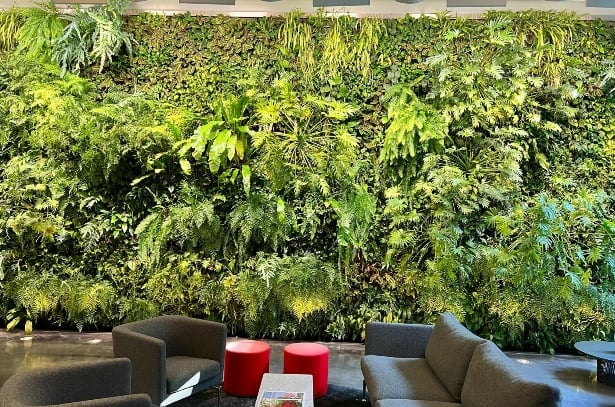
Vertical gardens are becoming a solution to help cities reduce heat, filter air, and enhance biodiversity. Photo : sempergreen.
With European capitals continuing to face harsh summers, expanding such green spaces is being seen as a practical solution to protect public health. These systems not only help cool urban areas but also filter fine dust, absorb CO2, and create habitats for birds and insects, thus contributing to the maintenance of biodiversity in cities lacking traditional park spaces.
Through his company Paisajismo Urbano, based in Alicante, Spain, Solano is working to change misconceptions about vertical garden technology and guide cities toward greener development. He says that to date, they have supported the installation of nearly one million square meters of vertical gardens globally.
Integrating rainforests into urban areas.
Originally a biologist, Solano spent over 14 years surveying tropical ecosystems, from the Chocó rainforest in Colombia to islands like Madagascar and Réunion. His goal was to understand how plants grow and interact in their natural environments in order to apply this knowledge to urban spaces.
According to Solano, choosing the right plant species for a vertical garden is a crucial and highly specialized step. All factors, such as the height, climate, and sun exposure of the structure, must be carefully considered.
The plants are grouped based on their adaptability and nutritional needs. The majority grow without soil, instead being nourished by nutrient-rich water through hydroponic systems.
Solano claims that this model produces three times the amount of oxygen and grows three times faster than traditional ground-based green spaces.
"Essentially, what we are creating is a biological filter right in the heart of the city," he said.
He also stated that modern systems consume almost no water and only require maintenance once a year.
Anyone can do vertical gardening.
For over two decades, Solano's company has continuously researched and developed vertical garden technology and methods for selecting suitable plants. These solutions are now being delivered through By Botanik, the company's franchise in Guatemala City.
This company organizes intensive training courses for students across the Americas, not only teaching plant care techniques but also sharing its business model, from sales skills and contract signing to methods for selecting suitable plants for each project.
The courses are designed to be accessible to everyone.
"You don't need to be a botanist, an architect, or an engineer," Solano said. "The most important thing is enthusiasm and a willingness to learn."
According to him, after only about five days of training, trainees were able to identify plant groups, understand their origins, and determine the most suitable locations for planting on green walls. To date, approximately 85% of trainees have implemented practical projects after the course.
Source: https://nongnghiepmoitruong.vn/vuon-thang-dung--giai-phap-thiet-thuc-giup-do-thi-ha-nhiet-d813813.html

![[Image] Nearly 125,000 Hanoi students completed the Literature exam for the 10th grade entrance exam.](https://vphoto.vietnam.vn/thumb/1200x675/vietnam/resource/IMAGE/2026/05/30/1780117233041_ndo_br_thiet-ke-chua-co-ten-2-png.webp)




























































































Comment (0)