

Associate Professor Dr. Dam Hoang Phuc, Director of the Automotive Engineering Training Program ( Hanoi University of Science and Technology), directly conducted experimental research on the effectiveness of biofuels in new generation automobiles in Vietnam. He has written an article on the "Transportation" section of the Construction Newspaper sharing some scientific information related to E10 gasoline.
Tri Thức - Znews is quoting the article verbatim.
 |
Associate Professor Dr. Dam Hoang Phuc is the person directly conducting experimental research on the effectiveness of biofuels in new generation automobiles in Vietnam. Photo: Provided by the author. |
From June 1st, 2026, all unleaded gasoline on the Vietnamese market will switch to E10 bioethanol fuel according to Circular 50/2025/TT-BCT. This decision has sparked a wave of concern among car users. A series of questions have been raised: Will E10 damage engines? Will it consume more fuel? Can older cars use it?
What do the experimental data say?
A research team from Hanoi University of Science and Technology directly compared RON95, E5, and E10 fuels in a Toyota Corolla Cross – both the pure gasoline (ICE) and hybrid (HEV) versions – under standard laboratory conditions and on real roads in Hanoi, including peak and off-peak hours in the city center and on Thang Long Boulevard.
Regarding fuel consumption: Surprisingly, under congested urban conditions – the most common driving environment for users in Hanoi and Ho Chi Minh City – ICE vehicles using E10 fuel consumed 2.3% less than those using RON95, while HEV vehicles using E10 consumed 7.8% less. At high speeds on highways (90-120 km/h), E10 also showed lower fuel consumption than RON95 in both types of vehicles.
In terms of power output, the results vary by vehicle type: ICE vehicles experience a 6% decrease in maximum power with E10 – this is a fact that shouldn't be hidden. However, HEV vehicles see a 2.15% increase in power when using E10, due to the high octane ethanol's effectiveness in controlling the combustion process within the hybrid system.
In terms of emissions, ICE vehicles using E10 reduce harmful HC by 10.87% and CO by 14.95% compared to RON95. This is a clear and measurable environmental benefit.
The incident is real.
The reality is that there have been and will be technical problems when users switch to E10. However, it's important to clarify: there are two completely different groups of causes, and blaming everything on "E10 causing car malfunctions" is inaccurate.
The first reason is that the fuel quality at the point of sale does not meet standards.
Ethanol has stricter storage requirements than regular gasoline: it is sensitive to moisture, prone to phase separation if the storage tank is not airtight or does not meet technical standards, and requires a faster turnover cycle to avoid degradation.
If gas stations do not strictly adhere to storage procedures – tanks are not properly maintained, fuel is stored for too long without proper control – then the E10 fuel reaching consumers may no longer meet standards.
High water content in gasoline reduces combustion efficiency, causing unstable running, or even engine stalling. When the vehicle malfunctions, users blame E10 gasoline – while the real culprit may be improper storage and distribution.
The second reason is that the solubility of ethanol "triggers" a potential problem in older vehicles.
Ethanol has a higher cleaning power than mineral gasoline. In vehicles that have used mineral gasoline for many years, dirt and tar often accumulate gradually in the fuel tank, pipes, and fuel filter – silently without causing obvious symptoms. When switching to E10, the solubility of ethanol begins to break down this layer of deposits.
If the fuel mixture is changed abruptly with a large amount of sediment buildup, a significant amount of sediment is drawn into the fuel stream at the same time, leading to clogging of the fuel filter or injectors - especially on vehicles in poor technical condition.
To be clear, E10 isn't the cause of these car failures. These were pre-existing problems; E10 simply accelerated and made them more apparent. Without E10, these cars would still have problems, just later and more difficult to diagnose.
In that sense, E10 also acts as a health check for the fuel system.
Recommendations to the State management agency.
This is the crucial point requiring decisive action: E10 quality control cannot stop at the refinery. A system of regular and unannounced inspections is needed at each point of sale, including checks on actual ethanol content, fuel moisture content, and tank conditions.
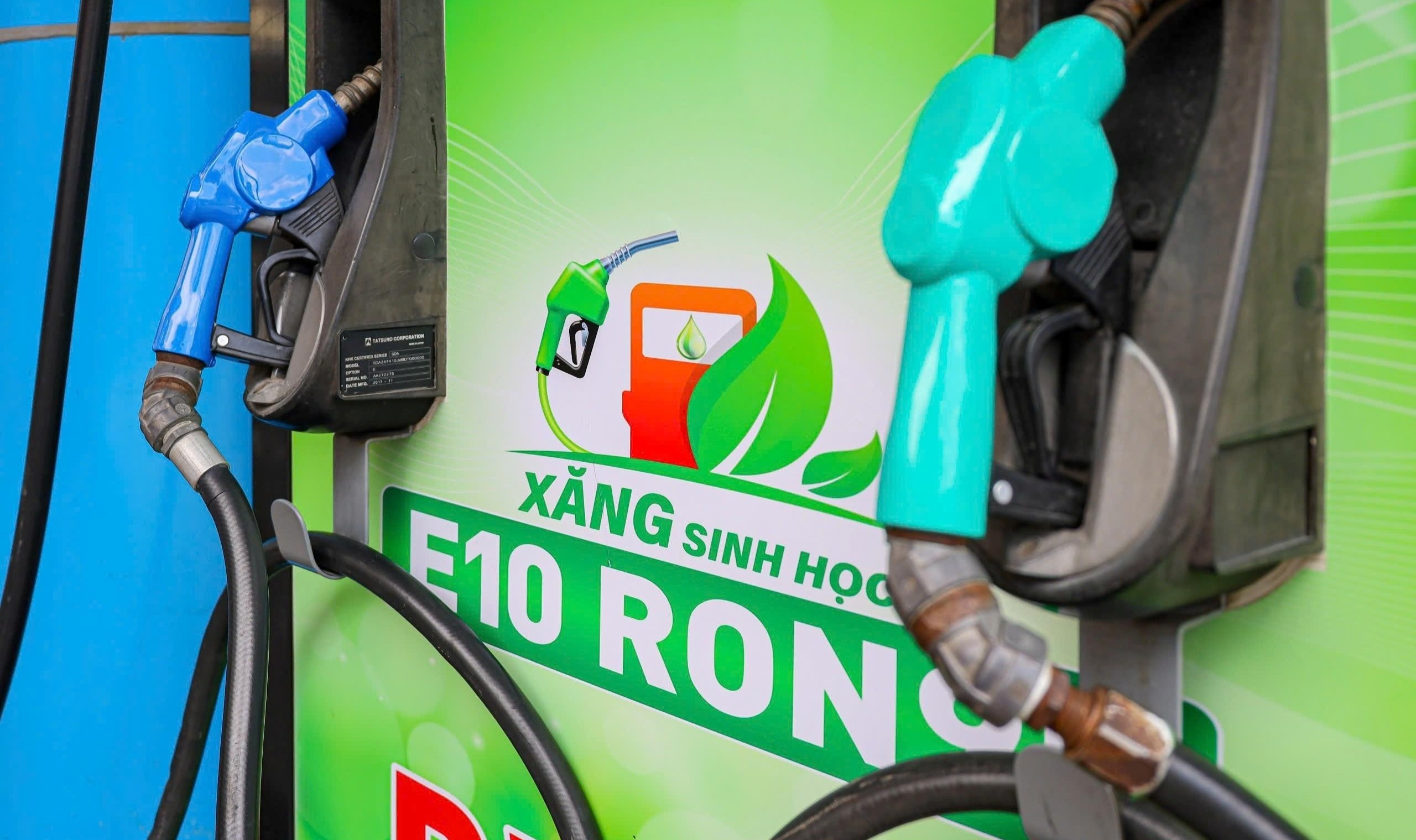 |
From June 1st, all unleaded gasoline on the Vietnamese market will switch to E10 bioethanol. Photo: Provided. |
Without sufficiently strong regulations at the distribution stage, E10 will gain a bad reputation for reasons not attributable to the technology itself, and the emission reduction targets will not be achieved, even though the fault lies not with the technology but with management.
How should consumers prepare?
The core principle is that transformation should be prepared, not abrupt.
For older vehicles, it's advisable to clean the fuel tank and perform a complete fuel system maintenance beforehand, such as replacing spark plugs if they're old, replacing the fuel filter, and checking the fuel injectors. The cost isn't high, but it eliminates a significant number of potential problems.
Then, gradually switch: pour about 1/4 of the E10 tank into the remaining RON95 gasoline, drive until the tank is half full, then refill with E10, and repeat once. This method allows ethanol to gradually remove deposits instead of flushing a large amount of deposits into the system at once. Newer fuel-injected (FI) vehicles have ECUs that automatically adjust to the fuel type, so no manual intervention is needed; just give the vehicle time to adapt.
Prioritize refueling at gas stations with high sales volume, where fuel is frequently circulated, reducing the risk of E10 deteriorating due to prolonged storage. For vehicles that are frequently left unused for extended periods, it's advisable to nearly empty the fuel tank before storing the vehicle.
After a few weeks of using E10, the fuel system should be checked once, including the pump pressure and the condition of the rubber hoses, to confirm that the transition is proceeding normally.
Special note regarding additives
The market currently offers many additive products advertised to support the transition to biofuels. From a scientific perspective, we lack experimental data to evaluate the effectiveness of these products, so we cannot offer specific recommendations.
However, there is a legal principle consumers need to understand: any additive added to gasoline must comply with current fuel regulations. Products of unknown origin or without certification of compliance with fuel standards should absolutely not be used, no matter how attractive the advertising may be.
The safest and most practical approach remains: cleaning the fuel tank, maintaining the fuel system, and gradually switching to E10, without needing anything else. If, after completing these steps, the car still has problems, it's almost certain that there was a pre-existing issue, and E10 was simply the catalyst that brought it to light sooner.
E10 is not a perfect solution, but current concerns far outweigh the actual risks. Experimental studies on Hanoi roads show that with modern vehicles and standard fuel, E10 can completely replace RON95 without significant disadvantages, and may even be more advantageous in congested urban conditions.
But "meeting fuel standards" is a prerequisite, not a default. For E10 to play its proper role in Vietnam's emissions reduction roadmap, the responsibility lies not only with consumers or car manufacturers but also with quality control throughout the entire process, from the factory to each fuel tank at every point of sale nationwide.
That's what's truly concerning and worth demanding action on.
Source: https://znews.vn/xang-e10-su-that-tu-phong-thi-nghiem-post1654069.html



![[Photo] The courage of new recruits of Brigade 144 on the training ground.](https://vphoto.vietnam.vn/thumb/1200x675/vietnam/resource/IMAGE/2026/05/27/1779881651341_anh-man-hinh-2026-05-27-luc-18-32-52.png)
![[Photo] The heat at the fireworks display site on the opening night of the Da Nang International Fireworks Festival 2026](https://vphoto.vietnam.vn/thumb/1200x675/vietnam/resource/IMAGE/2026/05/27/1779889741485_ndo_br_z7872039145157-fecaba5112f39e8352544099d7ef4738-5140-jpg.webp)

























































































Comment (0)