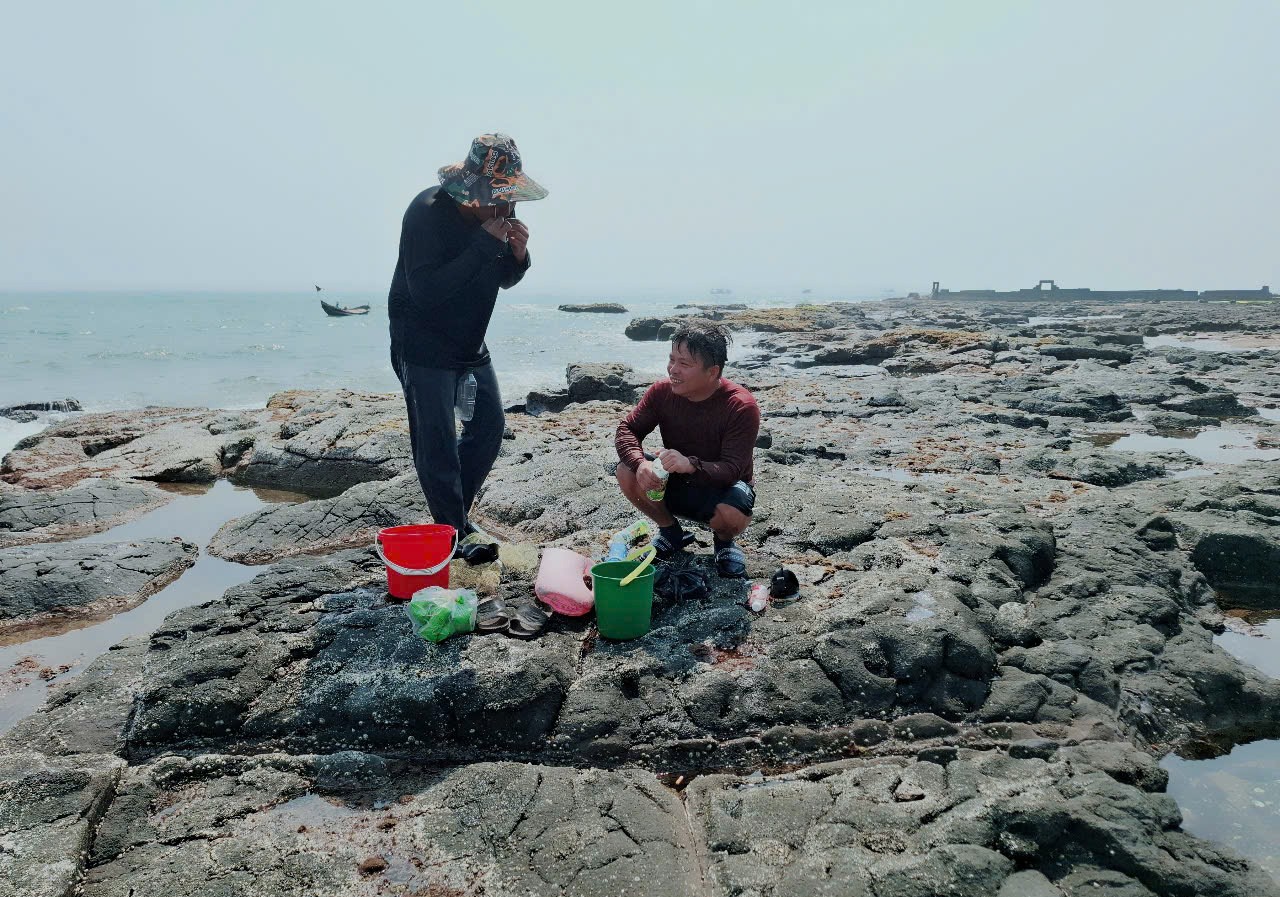
A moment of rest for the divers after a diving trip to catch lobster larvae - Photo: SH
From 9 a.m., the rocky area at the end of Cua Tung beach was bustling with laughter and chatter. The divers excitedly asked each other if they had caught many juvenile lobsters.
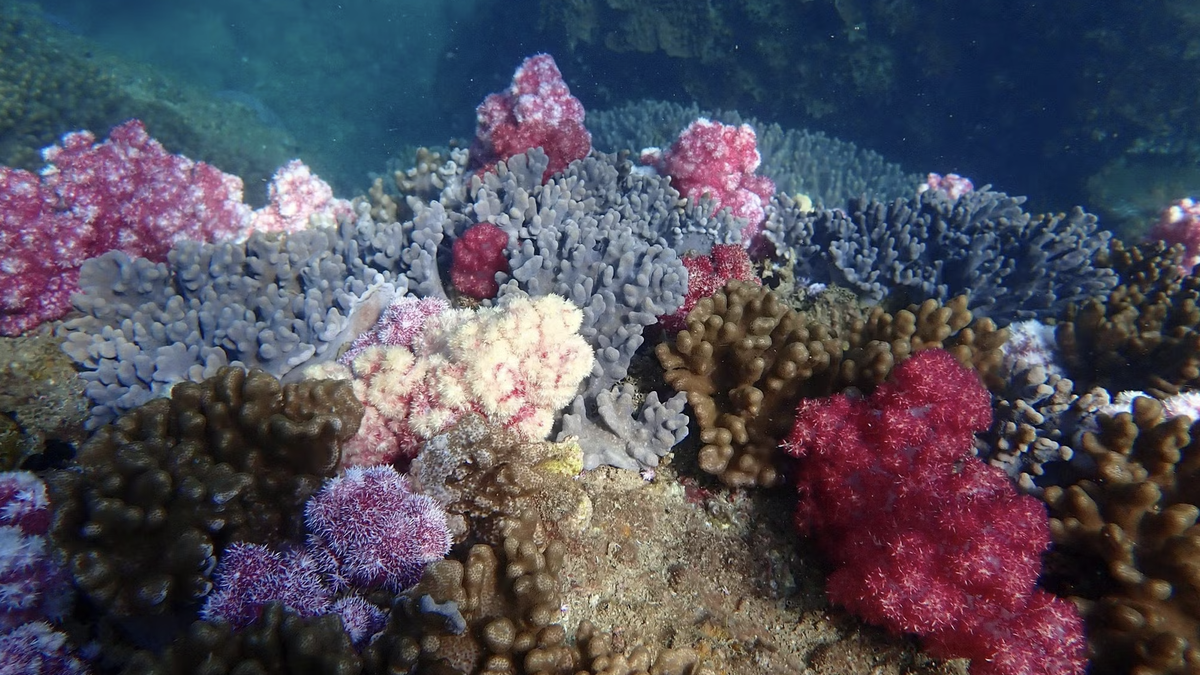
After nearly an hour of diving underwater, Mr. Nguyen Van Son from Hoa Ly Hai neighborhood, Cua Tung town, quickly came ashore and put the plastic bottle containing 3-4 juvenile lobsters he had caught into a bucket of seawater. Taking a moment to rest before going back into the sea, Mr. Son said that from February to April of the lunar calendar each year, when the weather is calm and the sea is still, juvenile lobsters gather in large numbers at the reefs and coral formations. This is also the time when divers in Cua Tung town prepare their equipment for a season of diving to catch juvenile lobsters... to sell to traders. The job of diving to catch juvenile lobsters is not for everyone; it is only for healthy young men with very sharp eyesight to spot the few antennae of juvenile lobsters sticking out in the crevices of the reefs.
Lobster juveniles are very small and agile; divers need to be very observant to spot them hiding in crevices and small holes in the rocks. They use a bicycle spoke to poke them, and when disturbed, the lobster will spring out. The diver quickly grabs them and puts them into a plastic bottle they carry with them. Because lobsters cling to reefs, divers have to stay close to the rocks during the dive, making them very susceptible to being knocked over by waves, falling against underwater rocks, causing injuries, or being cut by mussels or barnacles, resulting in bleeding. On average, divers near the shore catch about 30-40 lobster juveniles per day, selling them to traders for 36,000 VND per lobster.
Mr. Tran Xuan Vu from Hoa Ly Hai neighborhood shared that the divers who catch juvenile lobsters near the shore are not "professional" divers, so the catch is very small. "Professional" divers have to go further out to sea to harvest them.
Becoming a "professional" diver is simple; you just need to invest around 30-40 million VND to buy a small boat, an air transfer system, a diving suit, goggles, a specialized waterproof flashlight, gloves, plastic shoes, and a lead weight of about 10-15 kg (worn around the waist to help the diver sink quickly to the seabed and move along the seabed)... and then you can go out to sea to practice your profession.
Typically, the fishing trips are about 0.3-0.5 nautical miles from the coast. Upon reaching the location, the divers start the engine and connect a hose from the engine to the air generator, which then leads to a large air tank (the kind commonly found at tire repair shops). This tank supplies oxygen to the divers through a rubber air hose about 70-100 meters long (about the size of a thumb).
After carefully checking each piece of equipment they brought into the sea, including the air tubes, the divers put on their tubes, goggles, and lead weights (weighing about 10-15 kg) before plunging into the sea and disappearing from sight. Only one person remained on the boat, on standby to handle any emergencies and waiting to receive the juvenile lobsters the divers had caught from the seabed.
Descending to the seabed, the divers slowly move, weaving through the crevices and gaps in the reefs to find where lobsters usually lay their eggs and where the hatchlings often hide. Divers need keen eyesight and experience to spot lobster larvae hidden in the rock crevices.
Each dive can take about 3-4 hours under the reef. They shine their lights and stare intently at the rocks, which are more than 3-4 meters deep, to catch juvenile lobsters. On average, skilled divers can catch around 100-200 juvenile lobsters per day, selling them to traders for an income of 3-6 million VND.
It is known that lobster cage farming in provinces such as Phu Yen, Khanh Hoa , and Quang Ngai is developing strongly and depends on natural sources of lobster larvae. Because the local supply of lobster larvae only meets about 50% of the demand, farmers have to rely on sources from other localities. Natural lobster larvae are resistant to disease, easy to raise, and grow quickly, so lobster farm owners are willing to spend large sums of money to buy them from traders.
While the income is relatively high, this profession is always fraught with danger. Many have suffered injuries or even lost their lives due to incidents such as broken air hoses getting caught in the propellers of boats, kinked air hoses, or malfunctioning air transfer systems. Upon detecting danger, divers must quickly remove the lead weights, discard the bags containing the seafood, and surface. Even a few minutes or seconds' delay can lead to a lack of oxygen, causing numbness in the limbs, bleeding from the nose, mouth, and ears. Even if they survive, they will likely suffer lifelong disabilities.
The lobster breeding grounds in the rocky reefs of Cua Tung town are considered a "bounty from the sea" for many fishermen. Those who make a living diving understand the hardships, difficulties, and dangers involved, but the reward of earning millions of dong after a day's work is a source of joy and motivation for them to continue in the profession.
Sy Hoang
Source: https://baoquangtri.vn/xuong-ran-bien-bat-tom-hum-giong-192574.htm



![[Photo] General Secretary and President To Lam presides over the meeting to approve the draft report on the results of the second inspection by the Politburo of the Standing Committee of the Hanoi City Party Committee.](https://vphoto.vietnam.vn/thumb/1200x675/vietnam/resource/IMAGE/2026/05/26/1779789811432_a2-bnd-4430-9620-jpg.webp)















































































Comment (0)