

During food preparation, especially when frying or stir-frying, a mixture of steam and tiny oil and grease particles rises and is drawn into the range hood's ventilation system. Upon contact with the metal surface of the filter and the suction chamber, this grease cools rapidly, condenses, and adheres firmly to the surface.
Over time, due to oxidation from the air, this grease becomes thick and sticky, turning into stubborn deposits that clog gaps, reduce airflow, and force the engine to work under greater load, resulting in increased power consumption and noise.
Typically, to thoroughly clean a range hood, users are advised to completely remove the metal filter mesh and drip tray. However, frequent disassembly and reassembly, if not done correctly, can lead to broken plastic locking clips, dented thin aluminum mesh, or, more dangerously, accidental water leakage onto the circuit board causing short circuits and fires.
Faced with this risk, applying basic chemical and physical principles to in-place cleaning is becoming a smart solution. This method of cleaning range hoods without disassembly optimizes time and helps protect the integrity of the system.
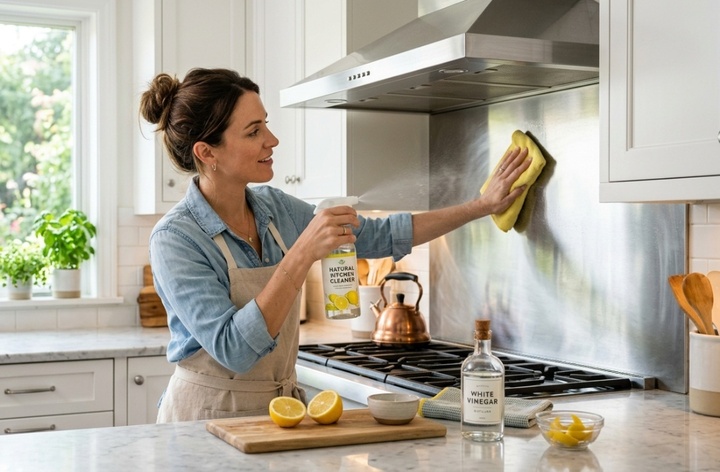
Lemons and white vinegar are widely used in kitchen cleaning. (Photo: FP)
Method 1: Using vinegar and lemon
This is an absolutely safe solution, using saturated steam combined with natural acidity to remove plaque without any strong mechanical force applied to the machine. Animal fats and vegetable oils both have specific melting points. As hot steam rises, it provides a continuous supply of heat, causing the grease film to change from a solid to a liquid state.
Simultaneously, the citric acid in lemons and the acetic acid in vinegar act as a bio-solvent, gently breaking down the bonds of organic plaque while also eliminating lingering odors in the intake chamber.
Steps to clean your range hood using vinegar and lemon:
- Prepare a wide-mouthed pot, pour in about 1 liter of clean water along with a small bowl of white vinegar or the juice of 3 to 4 lemons, and add the peels to the pot to take advantage of the essential oils.
- Place the pot on the stove directly below the center of the range hood. Turn on the stove and bring the water to a boil, while simultaneously starting the range hood at the lowest power setting so that the fan slowly draws the hot air upwards.
- Maintain a low simmer for about 15 to 20 minutes. The steam, carrying acidic solvents, will penetrate into the small grooves of the filter mesh and the inner chamber of the machine.
- Turn off the stove and completely shut off the range hood. At this point, the grease has liquefied, so you just need to use a slightly damp microfiber cloth to gently wipe the mesh surface. All the dirt will come off easily without scrubbing.
Method 2: Using baking soda and soap
For appliances that haven't been cleaned in a long time, where the grease has dried and hardened, simple steaming may not be effective enough. Applying the alkaline properties of baking soda will provide a more powerful stain-removing effect.
Baking soda is an alkaline compound. When it comes into contact with the fatty acids in grease, it triggers a natural saponification reaction. When combined with the surfactants in dishwashing liquid, this mixture reduces surface tension, allowing the solution to penetrate deeply and emulsify the grease into suspended molecules that are easy to wipe away.
Steps to clean your range hood using baking soda and soap:
- Mix 300ml of warm water, 2 tablespoons of baking soda, and a few drops of dish soap in a handheld spray bottle. Shake vigorously until the baking soda is completely dissolved.
- Cover the area beneath the stovetop with newspaper or a sheet of plastic to catch any dripping dirty water.
- Spray the solution directly and apply a thick layer to the entire underside of the aluminum filter mesh.
- Leave it in this state for about 10 to 15 minutes, allowing time for the chemical reaction to complete.
- Using a damp cloth soaked in warm water and wrung out, wipe along the grooves of the filter mesh. The burnt-on residue will be quickly detached and stick to the cloth.
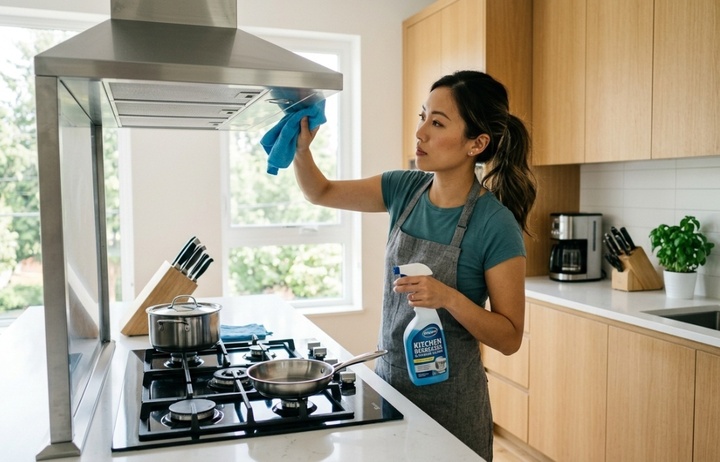
Using specialized cleaning solutions makes cleaning and maintaining your range hood easier. Photo: FSN
Method 3: Using a specialized solution
If the turbine housing inside the engine, a hard-to-reach area for cleaning, is covered in grease, you need to utilize the engine's aerodynamic principles to deliver specialized cleaning agents deep inside.
By utilizing the swirling suction force of the fan, molecules of the specialized cleaning solution, in the form of a foam spray or containing grease-dissolving enzymes, are carried away and evenly coated over the entire surface of the hidden fan blades. The chemicals automatically break down the grease structure, and due to gravity, the liquid grease flows back down.
Steps to follow:
- Carefully coat the stovetop. Start the range hood on high power.
- Use a kitchen degreaser spray to mist directly into the vents of the range hood. Aerodynamic forces will immediately draw these chemical mist particles deep into the motor chamber.
- Continue spraying about 4-5 times, then turn off the machine. Wait about 5 to 10 minutes for the chemicals to break down the concentrated structure of the oil and grease.
- When you see the cloudy grease starting to drip onto the mesh and collection tray, use a damp cloth to wipe away any excess grease. Repeat the spraying process once more if a lot of grease is still coming out.
Note when cleaning a non-removable range hood.
Disconnect the power before performing any physical actions: Before proceeding with the step of wiping the metal mesh with a damp cloth, always ensure that the power cord is unplugged or the circuit breaker is switched off to eliminate any risk of electric shock.
Avoid getting the control panel area wet: The area containing the mechanical or touch-sensitive buttons houses very sensitive electronic circuits. Absolutely do not spray any liquid solutions on this area; only use a very dry cloth to gently wipe the surface.
Maintain a reasonable frequency: Don't wait until the appliance makes loud noises or yellow grease drips onto food before cleaning. Applying these cleaning methods regularly every 2 to 3 weeks will prevent deep buildup, keep the motor running smoothly, extend the appliance's lifespan, and create a clean kitchen environment.
Source: https://vtcnews.vn/3-cach-lam-sach-may-hut-mui-khong-can-thao-roi-ar1020234.html







































































































Comment (0)