

At that time, Vietnamese education entered the digital age with the flame of innovation ignited in every policy, every program, and every school.
The new general education curriculum – From knowledge to competence
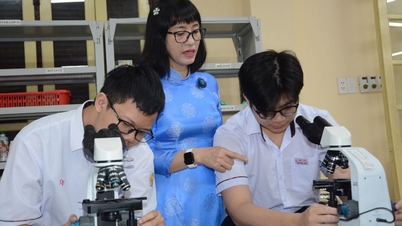
In the summer of 2020, at a school in the western region, teacher Le Huong organized lessons based on the 2018 General Education Program for her students. Gone were the dry formulas and lengthy lectures; instead, the curriculum included experiential activities, discussions, and career guidance.
The 2018 General Education Program is the result of a profound shift in perspective; the education program must develop five core qualities and ten core competencies for students, helping them become well-rounded citizens who are self-learners, collaborative, and creative.
In this program, thematic integrated subjects are arranged flexibly, helping students avoid rote learning and instead apply knowledge to real life. The program is implemented according to a roadmap starting from grade 1 (academic year 2020–2021), gradually expanding to grade 12 in the academic year 2024–2025.



This marks the first time that Vietnamese general education has placed a strong emphasis on competencies and career guidance, moving away from the purely knowledge-transmission approach.
Digital transformation and online learning – When classrooms have no brick walls.
Kim Loc, a high school student in Hanoi, recalls the time in 2021 when the city experienced a COVID-19 outbreak: “Classes switched to online. On rainy days, when the internet was slow, the teacher and students still tried to connect through the screen. Strangely, the absence of classroom presence didn't diminish our love of learning.”
The COVID-19 pandemic has dramatically changed education. Online learning has become a mandatory solution. Stories of Zoom classes, Google Meet, and VNEdu have become commonplace. Students can still learn even without going to school, and even without seeing their teachers, they can still be inspired.
The entire education system is beginning to invest heavily in smart schools, e-learning, and digital platforms to support testing and assessment – so that no one is left behind in the digital revolution.
International integration and quality assurance
Vietnamese education is not only transforming domestically, but is also beginning to embrace the trend of internationalization.



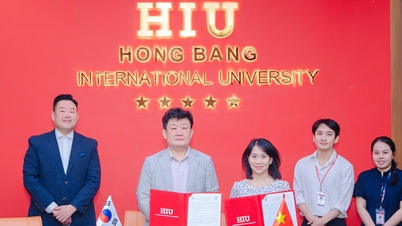
Universities open their admissions portals in English, sign international cooperation agreements, and exchange students with partner universities. Educational institutions participate in international accreditation to ensure quality control, creating a foundation for Vietnamese education to connect globally.
The accreditation criteria from AUN-QA (ASEAN University Network – Quality Assurance) are present in many major universities. Teachers are encouraged to pursue further education abroad, bringing back doctoral-level knowledge to serve the curriculum and teaching. This is a way to raise the level, not only in quantity but also in quality, to keep pace with the trend of integration.
Popular education in the digital age
One morning in early 2025, at a vocational training center in Thanh Hoa , the teaching staff launched a digital skills training program for older workers. Participants were provided with online learning accounts and accessed lectures on tablets at the center. This was a vivid illustration of the concept of "Digital Literacy for the People"—a modern version of the literacy campaign that once spread literacy throughout the country.
Digital literacy for all is more than just a concept – it's a call from the education sector to bring digital skills to all citizens, regardless of age, geography, or educational level. According to the Ministry of Education and Training, the goals for 2026 include: 100% of officials and civil servants possessing digital competence; 100% of primary school students and above having digital skills; 100% of adults having basic digital skills; and up to 60 million adults confirming they have achieved digital literacy on the VNeID platform.

Digital transformation is no longer just a concept, but has become a driving force changing the very nature of educational institutions. The Ministry of Education and Training is implementing digital student records in all 63 provinces/cities starting from the 2023-2024 school year, initially showing many clear benefits: cost savings, reduced paperwork, and faster and more accurate management.
The Massive Open Online Course (MOOC) model, combined with AI, applied in digital skills training, has opened up a wealth of knowledge for thousands of learners, regardless of age or geography.
From Nguyen Huu Huan High School (Thu Duc) to Nguyen Du High School (District 10), the smart school model with area-wide Wi-Fi, standardized data repositories, and computer-based testing has become a reality.
In the field of higher education and management, the DotB EMS platform, available at over 100 training centers, supports training management and student information from enrollment to graduation; DotB SEA helps connect students, parents, and schools.
Education experts emphasize: “Digital transformation… can only be achieved if everyone is equipped with adequate digital skills and information security awareness.”
For Vietnam to rise strongly
The development of science, technology, innovation, and digital transformation is a decisive factor in the development of nations; it is a prerequisite and the best opportunity for Vietnam to develop into a prosperous and powerful country in the new era. However, the majority of the population is not yet fully equipped with knowledge and skills in digital technology. Therefore, "eradicating illiteracy" in digital transformation has become a particularly important and urgent task for Vietnam to avoid falling behind and to rise strongly on the international stage.
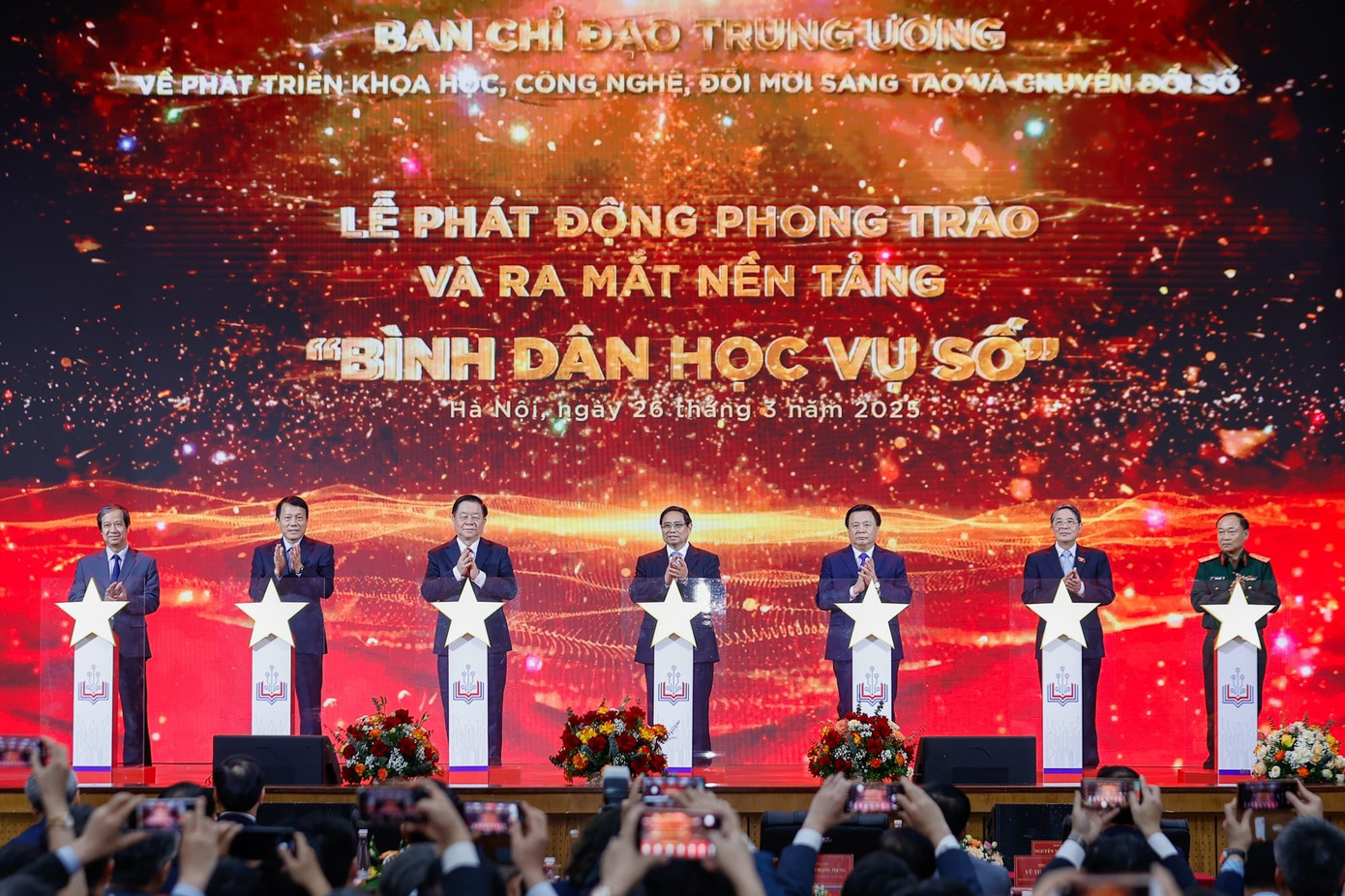
Resolution No. 57-NQ/TW dated December 22, 2024, of the Politburo on breakthroughs in national science, technology, innovation, and digital transformation emphasizes: “Strengthening the comprehensive leadership of the Party, promoting the combined strength of the entire political system, and the active participation of entrepreneurs, businesses, and the people in the development of national science, technology, innovation, and digital transformation.”
This is identified as a profound and comprehensive revolution across all fields; implemented decisively, persistently, synchronously, consistently, and over the long term with groundbreaking and revolutionary solutions. Therefore, in the context of the world entering the digital age, the "Popular Education Movement" has donned a new guise - "Digital Popular Education Movement". It can be said that the "Digital Popular Education Movement" is a crucial task in the national digital transformation process. Disseminating digital knowledge to the entire population is the foundation for building a knowledge-based society and forming a generation of proactive, creative, and adaptable digital citizens.
General Secretary To Lam once remarked: "This is not just an educational initiative; the 'Digital Popular Education' movement is also a bridge between the past and the future. By building upon historical lessons, we strive to create a society that is not only rich in knowledge but also strong in technology, ready for integration and development."
This journey has only just begun. But with a digital literacy policy, a learning society, and technology as a springboard, Vietnam is continuing to write the story of "knowledge for all" - not just reading, but writing the future.
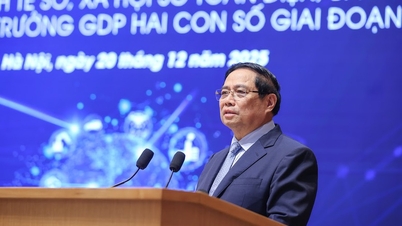
Prime Minister Pham Minh Chinh affirmed: “The ‘Digital Mass Education’ program is an important task to concretize the Party’s guidelines and policies as outlined in Resolution No. 57-NQ/TW of the Politburo; to respond to and implement General Secretary To Lam’s directive on lifelong learning and to launch the ‘Digital Mass Education’ movement.”
Over the past period, the national digital transformation effort has achieved many positive results. Accordingly, the "Digital Literacy Movement" has been implemented with three platforms. Specifically, the One Touch and MobiEdu open online learning platforms have trained over 1.2 million officials, civil servants, and workers, while also providing free digital skills training to over 40 million people. The Digital Literacy Movement platform has trained over 200,000 officials, civil servants, and members of the armed forces.
The country is facing a historic opportunity to enter a new era of strong development, driven primarily by science, technology, innovation, and digital transformation. The Prime Minister noted that the entire nation must undertake the particularly important and urgent task of popularizing knowledge and technology related to digital transformation and digital skills among the entire population. The goal is to "go door to door, guide every individual" to implement "digital literacy for the masses."

80 years of educational reform: From 'the enemy of ignorance' to a national education system.
Source: https://tienphong.vn/80-nam-doi-moi-giao-duc-tang-toc-trong-ky-nguyen-so-post1771503.tpo

![[Photo] Prime Minister Pham Minh Chinh attends the Conference on the Implementation of Tasks for 2026 of the Industry and Trade Sector](/_next/image?url=https%3A%2F%2Fvphoto.vietnam.vn%2Fthumb%2F1200x675%2Fvietnam%2Fresource%2FIMAGE%2F2025%2F12%2F19%2F1766159500458_ndo_br_shared31-jpg.webp&w=3840&q=75)
































































































Comment (0)