

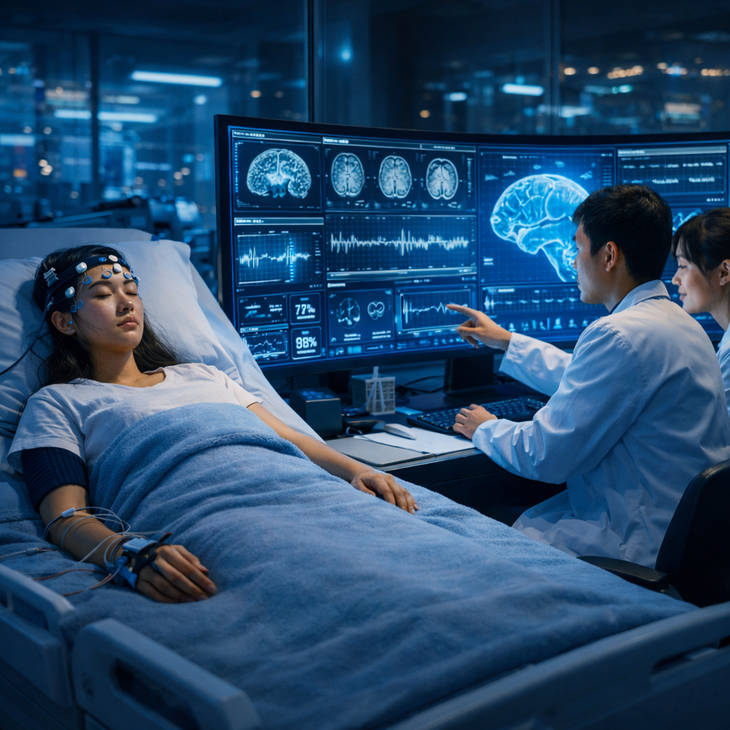
Artificial intelligence could become a powerful tool in the field of healthcare.
Advances in artificial intelligence are changing the way scientists approach sleep. Instead of simply assessing sleep duration or quality, scientists have developed AI models capable of analyzing multiple biological signals collected overnight to predict health risks.
This approach shows that sleep is no longer a passive period, but becomes important data for monitoring and early diagnosis.
What does sleep reveal about a person's health?
For many years, sleep was typically assessed by its duration and how alert one feels upon waking. However, medical studies suggest that sleep contains much more information than that.
While sleeping, the body continuously emits biological signals such as heart rate, breathing rate, brain activity, and body movements. These signals directly reflect how the organs function and coordinate with each other.
According to scientists, sleep disorders are closely linked to many health problems such as cardiovascular disease, metabolic disorders, memory impairment, and mental health issues.
Sleep apnea, irregular heartbeat, or fragmented sleep can appear very early, before symptoms become apparent.
The remarkable thing is that these signs are often difficult to recognize subjectively. A person might think they're getting enough sleep, while their biological data suggests their body is experiencing prolonged stress or respiratory problems.
It is this gap between personal perception and actual data that has made sleep a field of greater interest to researchers.
How does AI diagnose health issues based on sleep?
Unlike traditional sleep tracking methods that focus only on duration or depth, new AI models approach sleep as a complex set of biological data.
In published studies, AI was trained on a variety of sleep data, including brain activity, heart rate, respiration, and body movements throughout the night.
According to the research team at Stanford University, the AI model was built on a large-scale dataset, recording hundreds of thousands of hours of sleep tracked from many people over a long period.
By comparing medical records, the system can detect patterns that would be difficult to identify through manual analysis. Based on this, AI makes predictions about the risk of cardiovascular, neurological, metabolic disorders, and certain mental health problems.
The key takeaway is that the AI isn't looking for a single pattern. Instead, the model analyzes how parameters change and interact throughout sleep. Small fluctuations in heart rate, breathing rate, or sleep patterns can have different meanings when placed within the context of larger datasets.
Researchers emphasize that AI does not replace doctors or provide direct medical diagnoses. The technology's role is to support early risk detection, providing doctors and users with more information to proactively monitor their health. This cautious approach is what has led to the research findings receiving serious attention from the scientific community.
From the laboratory to real-life applications
Although these studies are still in the experimental phase, they have opened up prospects for AI applications in healthcare . The findings suggest the potential to leverage sleep data to identify abnormal bodily changes, providing valuable health information before obvious symptoms appear.
The gap between research and practical application remains quite large. The deployment of AI in health monitoring requires ensuring clinical validation, compliance with legal regulations, and prudent data usage.
Once these factors are perfected, sleep could become a crucial source of health information, with AI playing a supporting analytical role, helping doctors and users understand the body's signals, opening up new prospects for personalized medicine and continuous health monitoring.
Source: https://tuoitre.vn/ai-doc-giac-ngu-de-doan-suc-khoe-khong-con-la-doan-mo-20260109111324387.htm
![[Image] Pleasant weather helps students enter the 10th grade entrance exam with confidence.](https://vphoto.vietnam.vn/thumb/1200x675/vietnam/resource/IMAGE/2026/05/29/1780034401612_ngay-1-thi-lop-10-minh-duy-8-5009-jpg.webp)




![[Photo] Ba Lang An Lighthouse - the "eye of the sea" amidst the "rock museum" of Quang Ngai province.](https://vphoto.vietnam.vn/thumb/1200x675/vietnam/resource/IMAGE/2026/05/29/1780038698840_anh-man-hinh-2026-05-29-luc-14-10-42.png)












































































































Comment (0)