

- Beware of AI training programs marketed as academies.
- Vinh Phuoc Commune launches AI and robot system to serve public administration.
- Accelerating digital transformation and AI application in the business community of Ca Mau.
Early access to technology
In the context of rapidly developing digital technology , Resolution 71 -NQ/TW of the Politburo sets out an important direction: to accelerate transformation in education and apply artificial intelligence (AI) to the entire teaching and learning process. This is not simply a long-term strategy, but also an urgent requirement, forcing the education sector to quickly innovate its management, organization, and knowledge transmission methods. On April 15th, the People's Committee of Ca Mau province approved the Project for the Development of Digital Education until 2030, which is expected to create a clear shift in the operation of the local education system.
Ngan Dua Primary School has been selected by the Ca Mau Provincial Department of Education and Training to pilot AI education, starting from the second semester of the 2025-2026 school year. The school integrates AI content into various subjects and educational activities, with Informatics playing a core role. Instead of emphasizing complex programming and technical skills, the school prioritizes hands-on learning experiences through free, open-source tools. Simultaneously, the school organizes thematic lessons such as "Getting acquainted with artificial intelligence around us," "Safe and responsible AI," and a "I Explore AI" club, aiming for creative competitions and creating a vibrant learning environment for students.
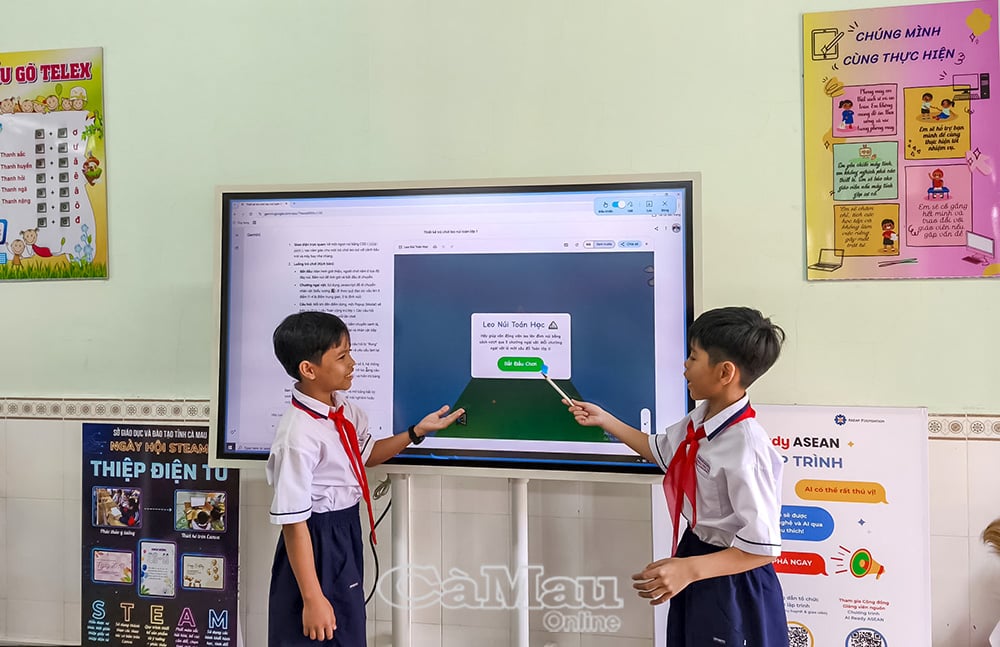 Students from Ngan Dua Primary School give a presentation on AI.
AI helps personalize learning paths and increase learning engagement through interactive content. Early exposure to AI helps children develop digital skills, logical thinking, critical thinking, and problem-solving skills. At the primary school level, AI education contributes to shaping a correct understanding: AI is simply a tool created by humans to serve life, thereby building habits of using technology safely, healthily, and responsibly. For schools, AI becomes a powerful "assistant" helping teachers design visual learning materials, innovate teaching methods, and reduce manual work.
Besides the benefits, the application of AI in primary school also presents many difficulties and challenges. In reality, students initially approach the new method with enthusiasm, as the content is designed to be relatable, with increased practice through games and visual aids. Their curiosity is clearly piqued when they interact with AI applications such as facial recognition, object recognition, voice assistants, or creating learning products quickly from ideas and scenarios. This contributes to creating interest and boosting students' learning spirit.
Danh Gia Huy, a student in class 5A2 at Ngan Dua Primary School, said: “Learning AI is fun because we can create vivid images and videos in our lessons. It was a little difficult at first, but with the teacher's guidance, I understood and was able to do it.” Another student in the same class, Tran Phu Vinh, said: “What I like most is being able to use AI to create things according to my own ideas.”
 Students discuss the AI lesson in class.
Infrastructure pressure, capacity, and the challenge of using AI effectively.
However, implementation also faces numerous challenges. A segment of students from disadvantaged backgrounds, with limited access to technology at home, are unfamiliar with AI. Furthermore, their awareness of information security is limited, making them prone to inadvertently sharing personal data such as addresses and passwords when using AI without adult permission. Without close guidance and supervision, students also risk becoming dependent on AI, impacting their independent thinking abilities.
The biggest obstacle currently is the lack of physical facilities and technological infrastructure. Teaching AI requires fully equipped computer labs with stable internet connections, while investment resources are limited.
Furthermore, capacity building is also a challenge, as teachers need in-depth training in knowledge, skills in utilizing, and methods for integrating AI. Risks such as personal data leaks, privacy violations, or the potential for AI to provide misleading or biased information also necessitate strict management.
From a parent's perspective, many concerns have been raised about the risk of students becoming dependent on AI, reducing their ability to think independently and the quality of their learning. Ms. Tran Thi Dam shared: "My child is used to looking up information using AI, but I'm not sure if they understand the lesson or are just copying." Mr. Nguyen Chanh Nghia also believes that learning AI depends heavily on devices, the internet, and the support of the family – something not all families can provide.
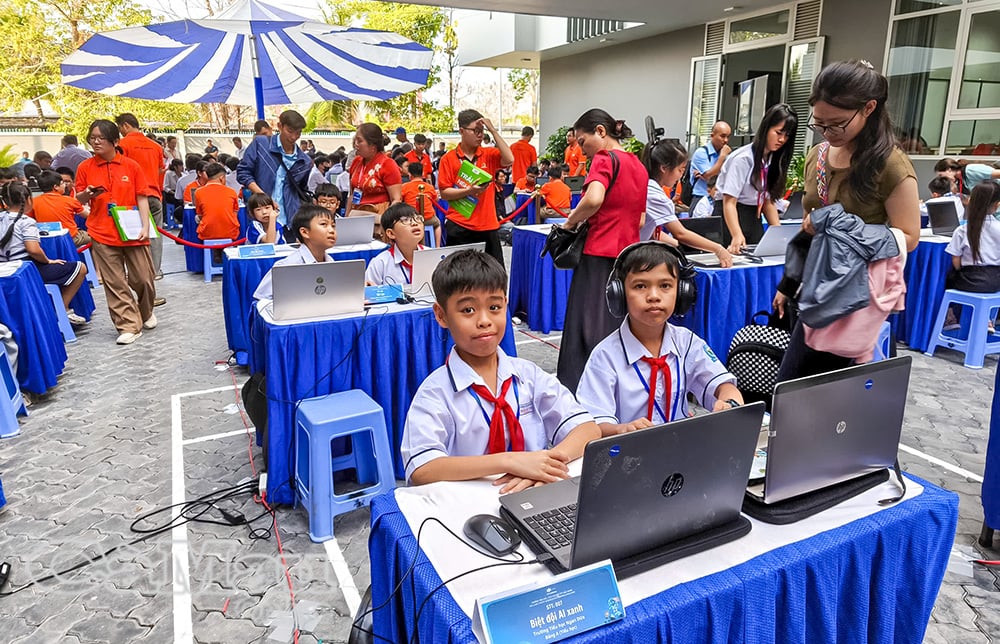 Students from Ngan Dua Primary School won the Encouragement Prize in the AI Innovation Competition in Can Tho.
According to some, the issue is not whether to use AI, but how to use it. If implemented correctly, AI will support personalized learning, reduce the workload for teachers, and improve the quality of education; conversely, if not properly controlled, it could negatively impact students' self-learning abilities.
Mr. Nguyen Van Nguyen, Director of the Department of Education and Training, stated that the education sector needs to develop a roadmap for investing in synchronized infrastructure; strengthen training and professional development for teachers; and mobilize social resources and cooperate with technology companies to support schools. Implementation must be flexible, practical, and not put undue pressure on teachers and students.
The digital education project in Ca Mau is a necessary step to keep up with the trend. However, to achieve effectiveness, it requires synchronization from teacher training and parent support to building a learning environment where technology plays a supporting role, not replacing human beings. Because the core of education remains the formation of thinking, character, and self-learning abilities in students.
Lam Khanh
Source: https://baocamau.vn/ai-vao-lop-hoc-ky-vong-va-thach-thuc-a128306.html
![[Image] Hanoi's urban life under the challenge of a "scorching hot" environment](https://vphoto.vietnam.vn/thumb/1200x675/vietnam/resource/IMAGE/2026/05/25/1779706979265_nang-nong-t5-2026-minh-duy-7-4636-jpg.webp)

![[Image] Close-up view of the interchange connecting the two expressways and Long Thanh Airport.](https://vphoto.vietnam.vn/thumb/1200x675/vietnam/resource/IMAGE/2026/05/25/1779703378210_ndo_br_z7863716673926-224453a31600126cce10622af6290afd-4549-jpg.webp)




















































































Comment (0)