

(To Quoc) - Applying accreditation procedures to training programs at all levels of higher education and teacher training college programs. Adjusting the evaluation criteria from 1-7 points to a pass/fail rating system.
On February 17, 2025, the Ministry of Education and Training (MOET) issued Circular No. 04/2025/TT-BGDĐT regulating the accreditation of undergraduate training programs (Circular 04), replacing the current related circulars on accreditation of undergraduate training programs.
Circular 04 consists of 5 chapters and 46 articles, built on the basis of updating the 4.0 version of the program evaluation standards of the ASEAN University Network Quality Assurance Organization (AUN-QA) and in accordance with the practical conditions of higher education in Vietnam.
The new circular ensures a focus on international and regional integration in quality assurance and accreditation, especially in the context of the Ministry of Education and Training developing a reference report on the Vietnamese National Qualifications Framework with the ASEAN Qualifications Reference Framework and amending and supplementing the Vietnamese National Qualifications Framework, implementing Decision No. 78/QD-TTg of the Prime Minister on quality assurance and accreditation of higher education.
Circular 04 has repealed the regulations on quality assessment standards for training programs in certain specialized fields and distance learning programs in previous circulars because those regulations are no longer appropriate and incompatible with the current methods of evaluating criteria, standards, and training programs.
The new circular applies the accreditation process to training programs at all levels of higher education and teacher training college programs. It adjusts the evaluation criteria from a 1-7 point scale to a pass/fail scale, includes mandatory conditions for achieving a pass level, and adjusts the number of standards and criteria accordingly.
The self-assessment, external assessment, evaluation, and accreditation process outlined in the Circular is more specific and detailed, step by step, to ensure greater rigor and scientific rigor, incorporating content from current guidance documents into the Circular. Furthermore, the Circular eliminates the permanent member role, adjusts the number of members in the external assessment team, and clarifies regulations regarding supervisors and interns of the external assessment team to facilitate their participation at higher education institutions.
The new circular removes the requirement to seek opinions from the Department of Quality Management (Ministry of Education and Training) on the self-assessment report of training programs; it adds content on periodically reviewing, evaluating, supplementing, and adjusting the quality improvement plan for training programs in the regulations on activities to be implemented after completing the self-assessment report.
Further details are provided on the types of documents that need to be archived according to the steps of the self-assessment and external assessment process. The responsibilities of the external assessment team leader and the working principles of the external assessment team are specified in detail.
Compared to previous regulations, Circular 04 provides more detailed regulations on the activities of educational quality accreditation organizations and educational quality accreditation councils in the assessment and recognition of evaluation results.
The regulations clarify the responsibilities of training institutions regarding external evaluation activities; they also add a deadline for training institutions to respond to educational quality accreditation organizations when requesting consideration for accreditation of educational quality standards. Furthermore, they specify the reporting regime and the updating of information into the educational quality assurance and accreditation system management software.
The new circular has integrated the guidance into an appendix issued with the circular, thereby facilitating the work of relevant parties, avoiding the need for additional guidance documents, and ensuring consistency in implementation at higher education institutions and accreditation centers.
The forms for the regulations on accreditation of university training programs have also been streamlined and improved to suit practical requirements, facilitate implementation, and still ensure compliance with current regulations and serve management purposes.
In Circular 04, the Ministry of Education and Training only stipulates core issues such as: standards, minimum requirements, and general evaluation methods for criteria, standards, and training programs. It expands the authority of accreditation organizations in professional evaluation and provides recommendations to each higher education institution for continuous quality improvement. Specifically, educational quality accreditation organizations are given more detailed regulations on meeting and not meeting criteria, and detailed evaluation guidelines are developed to help training institutions understand their current situation and improve the quality of their training programs.
Source: https://toquoc.vn/ban-hanh-quy-dinh-moi-ve-kiem-dinh-chuong-trinh-dao-tao-trinh-do-dai-hoc-20250218185354848.htm
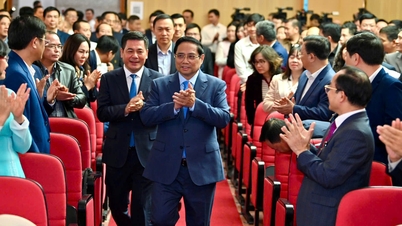
![[Photo] Prime Minister Pham Minh Chinh attends the Conference on the Implementation of Tasks for 2026 of the Industry and Trade Sector](/_next/image?url=https%3A%2F%2Fvphoto.vietnam.vn%2Fthumb%2F1200x675%2Fvietnam%2Fresource%2FIMAGE%2F2025%2F12%2F19%2F1766159500458_ndo_br_shared31-jpg.webp&w=3840&q=75)

















































































Comment (0)