

Staying close to market prices is essential.
According to the Land Law 2024, effective from August 1, 2024, localities are allowed to apply the old land price list until December 31, 2025, and apply the new land price list from January 1, 2026. The new price list will not be constrained by the land price framework and must be developed to closely approximate market prices.
Ho Chi Minh City was the first locality to solicit opinions on the draft revised land price list. Prices in the revised land price list are significantly higher than the old ones, with increases of 10-15 times in Thu Duc City; 10-20 times in Nha Be, Binh Chanh, Can Gio, and Cu Chi districts. In Hoc Mon district, land prices are projected to increase by 15-30 times on many roads.
Regarding this issue, Savills experts believe that Ho Chi Minh City's land price list has not kept pace and is often significantly lower than the actual market value. This prolonged price discrepancy has created a "dual pricing" system, leading to many serious consequences.
According to Ms. Do Thi Thu Giang, Director of Consulting Services at Savills Ho Chi Minh City, this issue makes land management difficult and complicated for the state. "For example, the difference between the declared price in the notarized contract and the actual transaction price is often used to reduce land transfer tax. Or, in another case, paying annual land rent based on a land price list lower than the market price has led to losses for the state budget," Ms. Giang cited as an example.

Ms. Do Thi Thu Giang, Director of Consulting Services, Savills Ho Chi Minh City
Savills experts also stated that the development of real estate projects faces many difficulties, especially during the land acquisition and site clearance phase. Compensation based on land price lists that do not reflect market prices has caused delays, dissatisfaction, and financial losses for those affected, leading to prolonged land disputes and lawsuits.
Because of these persistent problems, Ms. Giang believes that applying market-based land price regulations is inevitable and necessary. This progressive change will help overcome previous limitations, ensuring transparency and fairness in the system. In particular, land prices that closely reflect market values will facilitate the compensation and land clearance process, especially in important infrastructure development projects, by promoting consensus among the people regarding compensation and support levels.
Commenting on the proposed land price list, Savills experts also noted that there is still a significant discrepancy between the proposed land prices and actual transaction prices. For example, on Cao Thang Street (District 3), the market transaction price is approximately 525 million VND/m2, while the proposed land price is only 330 million VND/m2. Similarly, on Tan Thang Street (Tan Phu District), the transaction price is around 150 million VND/m2, while the proposed price is 90 million VND/m2. Overall, the proposed land price list only reaches about 60%, or 70% in some areas, of the market price, indicating a significant difference remains.
Things to consider before implementation
Ms. Do Thi Thu Giang stated that, according to Article 159 of the 2024 Land Law, the land price table is used for 11 cases. In addition, Articles 109 and 111 of the 2024 Land Law, which regulate support and resettlement arrangements, also use land prices from the land price table. Therefore, the proposed land price table for Ho Chi Minh City will directly affect two different groups of people, both favorably and adversely.
The beneficiary group includes those who receive support from the State when land is reclaimed and resettlement is arranged (according to Articles 109 and 111 of the 2024 Land Law).
The affected group includes households and individuals whose land use has been recognized and converted. According to the previous Land Law of 2014, financial obligations were estimated differently for land within and outside the allocated limit: land within the limit was calculated based on the land price table, while land outside the limit was calculated based on specific land prices.
However, the current Land Law 2024 no longer makes this distinction; the entire area will be subject to the land price list. Therefore, the proposed land price list, which is many times higher than the current land price list, will increase financial obligations for the area within the permitted limit. The proposed land price list, which is many times higher than the current land price list, will increase the cost of financial obligations for this area.
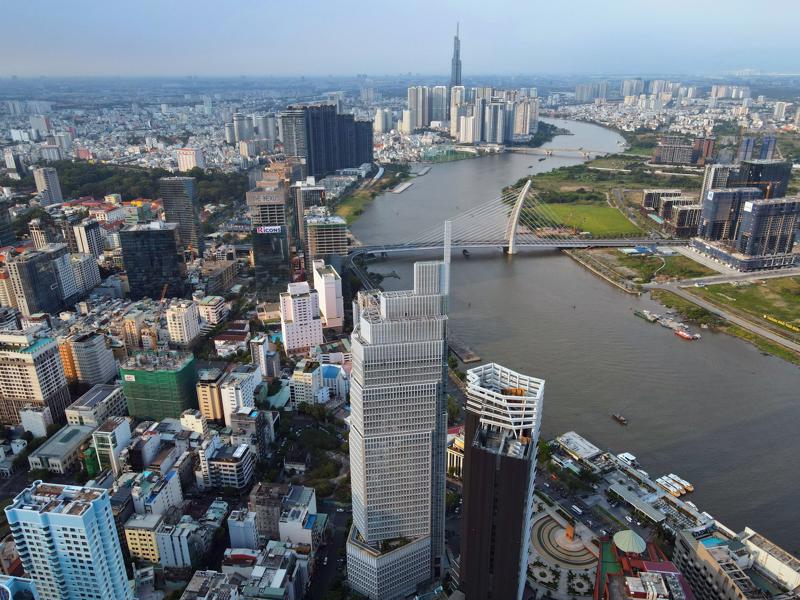
The immediate implementation of the new land price list in Ho Chi Minh City will affect many groups of people.
Ho Chi Minh City's proposed land price list, scheduled to take effect on August 1, 2024, has been postponed for further consideration. Savills experts believe this postponement is reasonable, as the proposed price list represents a significant increase compared to the previous one, and is proposed for a short period. This creates substantial financial pressure on affected groups. Therefore, the development and application of land price lists require careful consideration to balance the interests of all parties, with particular emphasis on ensuring the rights of citizens.
Furthermore, the methods applied to determine land prices are still inconsistent and simplistic. In some high-value areas, the method for constructing land price tables seems to simply involve applying a fixed coefficient to all roads.
For example, in District 1, a multiplier of 5.0 is applied uniformly to all locations and streets. As a result, Dong Khoi Street is proposed at 810 million VND/m2 (compared to the current 162 million VND/m2), and Hai Ba Trung Street (the section from Ben Bach Dang to Nguyen Thi Minh Khai) at 484 million VND/m2 (compared to the current 96.8 million VND/m2). Similarly, District 4 has a multiplier of 11.3 and District 5 has 5.58.
"This approach is essentially no different from applying the old price list and multiplying it by a coefficient K, therefore it does not truly reflect the market value of each road as intended by the Land Law," Ms. Giang said.
In summary, Ms. Do Thi Thu Giang believes that while updating land price tables to reflect market values is an important step forward, the current proposal needs further refinement. The methodology needs to be more specific and tailored to each area, rather than simply applying general coefficients. A gradual, transparent transition that ensures the interests of all stakeholders is essential to guaranteeing the long-term success of this new system.
Source: https://www.congluan.vn/bang-gia-dat-moi-tai-tp-hcm-va-nhung-van-de-can-can-nhac-post309016.html
![[Photo] Ba Lang An Lighthouse - the "eye of the sea" amidst the "rock museum" of Quang Ngai province.](https://vphoto.vietnam.vn/thumb/1200x675/vietnam/resource/IMAGE/2026/05/29/1780038698840_anh-man-hinh-2026-05-29-luc-14-10-42.png)



![[Image] Pleasant weather helps students enter the 10th grade entrance exam with confidence.](https://vphoto.vietnam.vn/thumb/1200x675/vietnam/resource/IMAGE/2026/05/29/1780034401612_ngay-1-thi-lop-10-minh-duy-8-5009-jpg.webp)































































































Comment (0)