

(CLO) In the digital age, traditional journalism is struggling against an information crisis. Influencers and AI are creating a fierce battle, raising the question: will journalism maintain its role as the "gatekeeper" of truth, or will it be overwhelmed by chaotic information?
Are 'influencers' changing the landscape of media?
Recently, the uproar surrounding Steven Bartlett, a popular UK entrepreneur and podcaster, allowing guests to make outlandish claims on sensitive health topics has sparked a heated debate. Many argue that, given his significant influence, Bartlett should be held accountable for what he disseminates. His shift in content from business to health has doubled his audience, but has also raised concerns about the accuracy of the information.
This issue reflects a broader trend: the rise of 'news influencers' replacing traditional news organizations. In this new media environment, attention and engagement are often prioritized over authenticity, leading to the risk of spreading misinformation.
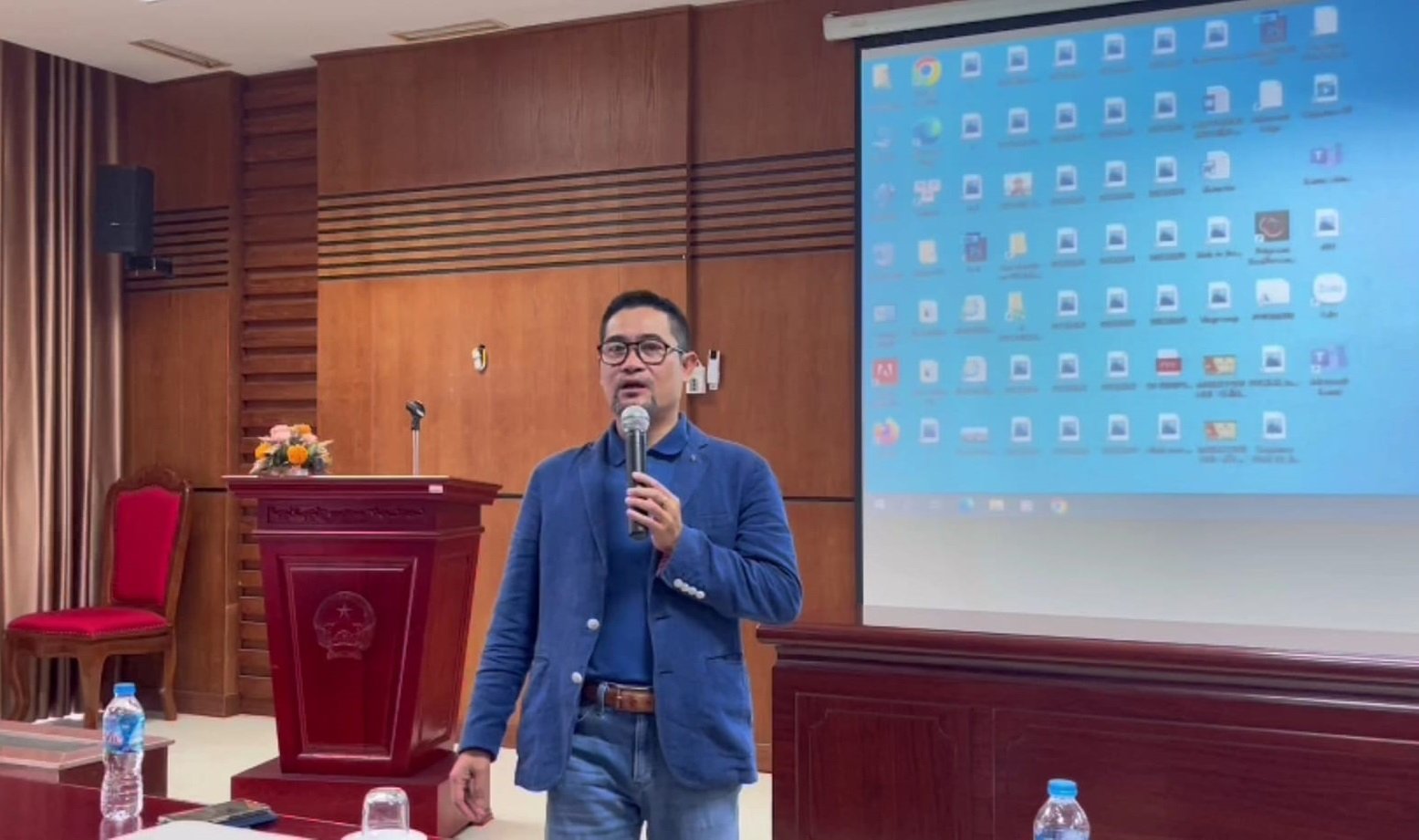
Mr. Nguyen Cao Cuong, a media and journalism expert and lecturer at the Professional Training Center of the Vietnam Journalists Association .
Mr. Nguyen Cao Cuong, a communications expert and lecturer at the Professional Training Center of the Vietnam Journalists Association, commented: "We are living in a world where information spreads at breakneck speed. 'News influencers,' with their powerful reach on social media, are gradually becoming the main source of information for many people, especially young people. This poses a major challenge: how to distinguish truth from rumor in such a 'sea' of information?"
"In reality, the press is gradually losing ground to these influential figures," Mr. Cuong added. "They are not journalists, but they have the ability to attract public attention quickly and effectively. The worrying thing is that many of them are taking information from the press but not adhering to professional ethics, potentially leading to the spread of misinformation."
Mr. Cuong pointed out that this change not only affects the accuracy of information but also impacts the role and credibility of traditional journalism. "As the public increasingly trusts 'influencers' rather than news organizations, we are witnessing a decline in trust in traditional journalism," he said.
According to a recent study, nearly 40% of young people in the US under 30 regularly receive news from social media influencers. Meanwhile, traditional newsrooms are gradually disappearing, giving way to a new ecosystem where interaction and provocative content are prioritized over accuracy. According to Mr. Cuong, this number is even higher in Vietnam, where social media is becoming an indispensable part of young people's lives.
Mr. Cuong expressed concern about the consequences of this trend. "When misinformation spreads easily and quickly, we are facing the risk of information 'distortion'," he said. "This raises urgent questions about the accuracy of information, the accountability of information providers, and the existence of responsible reporting in the digital age."
The 'black box' of algorithms and the responsibility of information gatekeepers.
Beyond just 'influencers,' the development of AI also poses significant challenges for journalism. Large technology corporations are using AI to generate news summaries, but their algorithms act like a 'black box,' making it difficult to verify the accuracy and objectivity of the information.

The 'black box' of algorithms controls information, putting the news industry at risk of manipulation.
According to Lexie Kirkconnell-Kawana, Chief Executive of IMPRESS, the UK's independent press regulator: "If people are relying on information generated through AI-powered platforms and that information is inaccurate, incomplete, or violates people's rights, then we need to act now." She emphasized the urgent need to control information in the context of the increasing application of AI.
However, managing these technology platforms is a major challenge. How can editorial standards and accountability be maintained when so many sources create and share content? Part of the problem stems from a lack of connection between AI developers and the industries in which their tools are deployed.
Sharing the same view, Mr. Nguyen Cao Cuong argued that if information generated by AI is inaccurate or incomplete, we need to act immediately. He emphasized, "Clear regulations and strict penalties are needed to ensure transparency and accountability in the information space."
In this context, the role of the press has become more important than ever. "The press needs to become a 'lighthouse' amidst the 'storm' of information, providing the public with accurate, objective, and reliable information," Mr. Cuong said. "This requires the press to invest in verifying information, improving content quality, and building trust with readers."
Mr. Cuong also argued that the press needs to proactively adapt to the changes of the times. "We need to understand the market, monitor emerging tools, and adjust integrations when the harm becomes clear. But most importantly, we need leadership and vision to protect the core values of journalism in the digital age."
He emphasized that media outlets and related organizations often tend to be conservative, wanting to maintain the status quo and saying, "Things are best the way they are; let's try to keep things that way for as long as possible." This shows that conservatism and a reluctance to change are hindering the development of the media.
The biggest challenge today is that those in the media industry must recognize that change is happening, but lack the leadership to guide that change, as well as the ability to safeguard the core values we want to preserve, ensuring they remain strong amidst these upheavals.
"This requires the joint efforts of all stakeholders, from journalists and technology platforms to regulatory bodies and users," he concluded. "Only then can we protect the public's right to access accurate information and maintain the role of journalism in society."
Phan Anh
Source: https://www.congluan.vn/nhieu-tin-tuc-tu-nguoi-co-suc-anh-huong-va-thuat-toan-dinh-hinh-thong-tin-bao-chi-can-hanh-dong-post336726.html


![[Photo] General Secretary To Lam receives the Special Envoy of General Secretary and President of China Xi Jinping](/_next/image?url=https%3A%2F%2Fvphoto.vietnam.vn%2Fthumb%2F1200x675%2Fvietnam%2Fresource%2FIMAGE%2F2026%2F01%2F30%2F1769759383835_a1-bnd-5347-7855-jpg.webp&w=3840&q=75)


![OCOP during Tet season: [Part 3] Ultra-thin rice paper takes off.](/_next/image?url=https%3A%2F%2Fvphoto.vietnam.vn%2Fthumb%2F402x226%2Fvietnam%2Fresource%2FIMAGE%2F2026%2F01%2F28%2F1769562783429_004-194121_651-081010.jpeg&w=3840&q=75)

![OCOP during Tet season: [Part 2] Hoa Thanh incense village glows red.](/_next/image?url=https%3A%2F%2Fvphoto.vietnam.vn%2Fthumb%2F402x226%2Fvietnam%2Fresource%2FIMAGE%2F2026%2F01%2F27%2F1769480573807_505139049_683408031333867_2820052735775418136_n-180643_808-092229.jpeg&w=3840&q=75)





Comment (0)