


Needle-eye storms are rare and dangerous phenomena (Illustrative image).
Typhoon No. 5, internationally named Kajiki, is making landfall in central Vietnam.
Dr. Nguyen Ngoc Huy, commonly known online as "Huy the Weatherman" – who has over half a million followers on his personal page – recently made some noteworthy comments regarding this storm, including mentioning the "needle-eye storm".
This concept is rarely mentioned in everyday life, but it is one of the most dangerous types of storms according to meteorologists. So what is a needle-eye storm, and why is it considered a warning sign of superstorms?
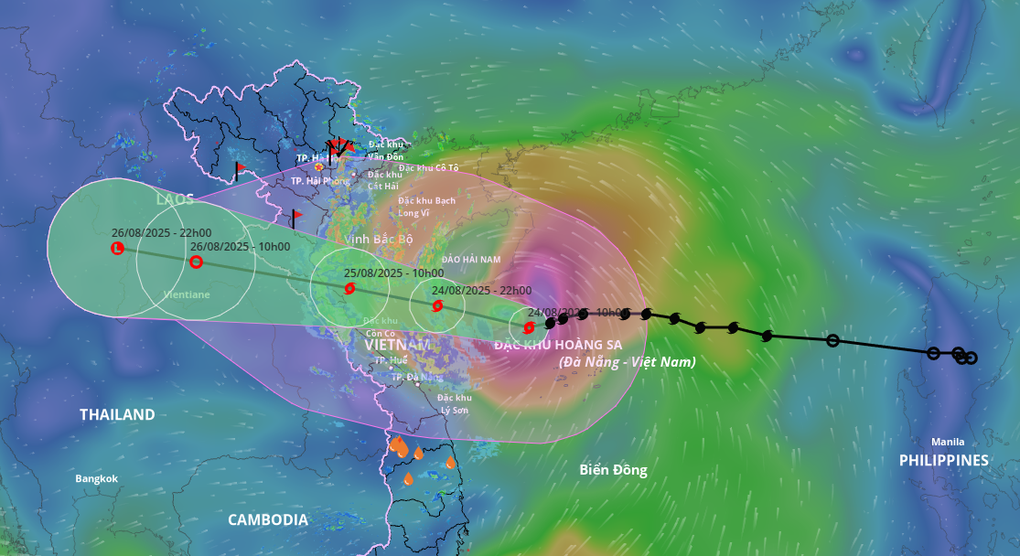
Predicted path of Typhoon Kajiki (Image: Vietnam Disaster Monitoring System).
What is a needle-eye storm?
Among extreme weather phenomena, tropical storms are always a nightmare due to their fierce winds, heavy rain, and giant waves. However, among the various types of storms, meteorologists are particularly interested in a less common structure that is often associated with unpredictable destructive power: the pinhole eye hurricane.
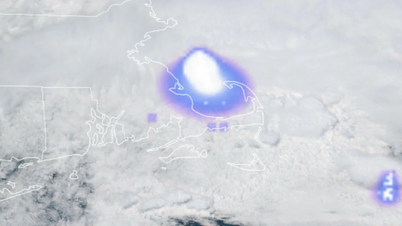
This is a phenomenon where the eye of a hurricane (the calm central area surrounded by the eyewall) shrinks to an extremely small size, appearing like a "pinhole" when observed from satellite.
Typically, the diameter of a hurricane's eye ranges from 32–64 km. However, with needle-eye hurricanes, this size drops to less than 16 km. On satellite imagery, the eye of the hurricane appears as a tiny dot amidst dense, swirling clouds.
This contraction is not merely a formality; it also signals a specific physical mechanism: the storm is rotating faster and generally tends to intensify.
Why is it that the smaller the eye of a storm, the stronger the storm?
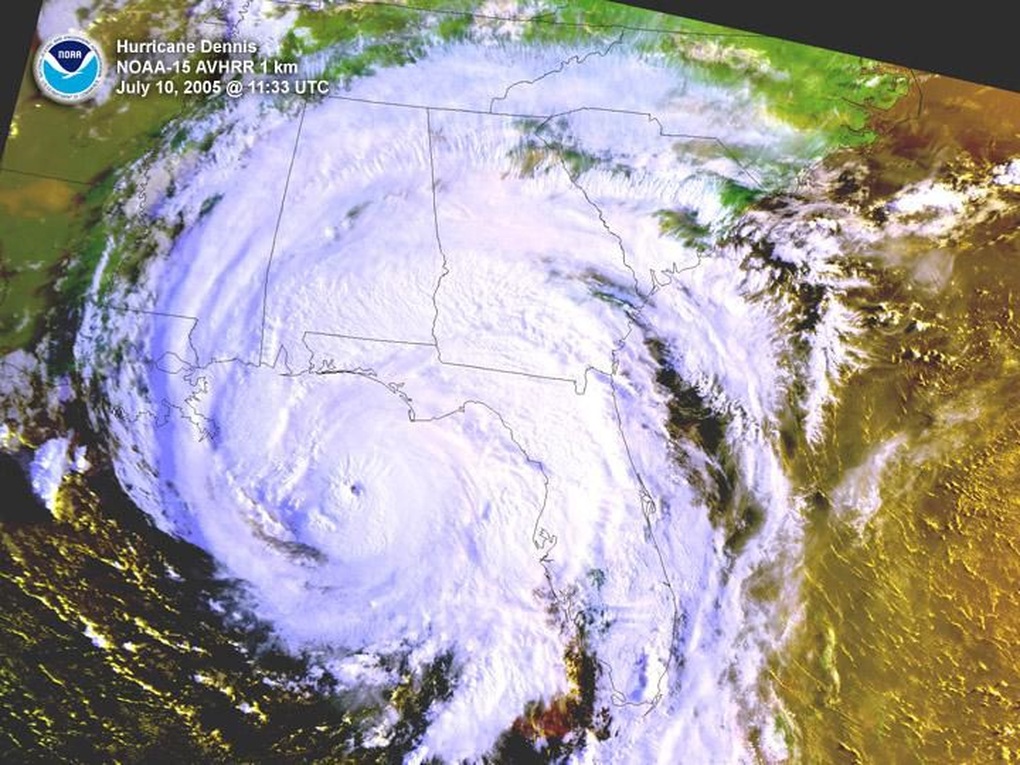
The eye of Hurricane Dennis was only about 8 km wide (Image: NOAA).
Meteorologists often liken this phenomenon to a dancer spinning: when the arms are brought together, the speed of rotation immediately increases. With storms, the same principle applies, known as the conservation of angular momentum.
As the eye diameter narrows, the air swirling around the storm's center must move faster, causing wind speeds at the eyewall to surge. This explains why needle-eye storms often quickly reach super typhoon status.
A worrying characteristic of needle-eye storms is their ability to intensify or weaken abruptly. Their small size makes them more sensitive to environmental changes, from sea surface temperatures to surrounding atmospheric currents.
Therefore, forecasting faces many challenges, especially in providing early warnings for coastal areas. Many storms that seemed stable suddenly intensified within hours of the appearance of the sun's eye.
Meteorological history records several instances of needle-eye storms that caused significant disruption. Among them, Superstorm Wilma (2005) in the Atlantic had an eye only 5 km wide – the smallest ever observed in the region, and also reached a record low pressure of 882 hPa.
In the Pacific, Super Typhoon Haiyan (2013), which swept through the Philippines with winds exceeding 300 km/h, also demonstrated how the eye of the storm narrowed to an extremely small size before landfall, leaving behind horrific damage to lives and property.
Warning from the scientific community.
Thanks to advances in satellite technology, particularly next-generation geostationary observation systems like GOES-19, scientists can monitor the structure of hurricane eyes in detail in real time.
This helps in the early identification of the eye of the storm, and, combined with numerical models, predicts the trend of storm intensification. However, experts still acknowledge that there are many gaps in understanding, especially regarding the internal mechanisms that cause the eye of the storm to suddenly shrink.
Research from the University of Colorado and the U.S. National Center for Atmospheric Administration (NCAR) indicates that nearly 60% of storms that initially appear as pinheads subsequently develop into hurricanes of category 3 or higher.
This shows that the needle-like pattern is not only a distinctive morphological sign, but also an early indicator of extreme danger. In the context of climate change increasing the risk of extreme weather events, understanding and closely monitoring this phenomenon becomes even more crucial.
Source: https://dantri.com.vn/khoa-hoc/bao-mat-kim-nguy-hiem-nhu-the-nao-20250824125144159.htm
































































































![[Photo] Hanoi residents on the first day after the official cessation of E5 RON 95 gasoline sales.](https://vphoto.vietnam.vn/thumb/402x226/vietnam/resource/IMAGE/2026/06/02/1780370815909_666523_thumb_1780357660_06474202.jpeg)



![[Infographic] Market starts June 2026 with negative sentiment, VN-Index drops nearly 19 points.](https://vphoto.vietnam.vn/thumb/402x226/vietnam/resource/IMAGE/2026/06/02/1780370839687_666534_thumb_1780357795_06495602.jpeg)








Comment (0)