

The U.S. National Oceanic and Atmospheric Administration (NOAA) issued a rare and severe geomagnetic storm warning after a solar flare reached Earth on the afternoon of May 10th local time, hours earlier than predicted, potentially causing effects that could last into next week.
NOAA warned operators of power plants and orbiting spacecraft to take precautionary measures, as did the Federal Emergency Management Agency. But "for everyone on Earth, nothing needs to be done," said scientist Rob Steenburgh of NOAA's Space Weather Prediction Center.
According to NOAA, the storm could produce auroras in northern U.S. areas like Alabama and Northern California, but this remains difficult to predict.
"The aurora borealis is truly a gift from space weather," Steenburgh said. He and his colleagues said that even phone cameras can capture the most beautiful views of the aurora.
The most intense solar storm in recorded history occurred in 1859, producing the aurora borealis in Central America and possibly Hawaii.
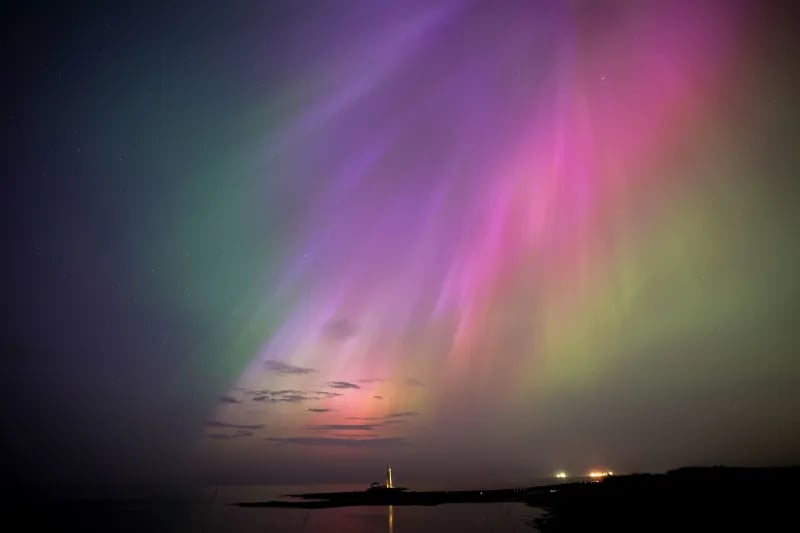
The aurora borealis illuminates Whitley Bay on the North East coast of England, on May 10. Photo: AP
NOAA space weather forecaster Shawn Dahl said the solar storm poses a danger to high-voltage power transmission lines supplying the grid, not the regular power lines people use.
Satellites can also be affected, which can disrupt navigation and communication services on Earth. For example, a powerful geomagnetic storm in 2003 caused power outages in Sweden and damaged transformers in South Africa.
According to NOAA, even after the storm ends, signals between GPS satellites and ground receivers may be disrupted or lost. But there are so many navigation satellites that the outage won't last long, Steenburgh noted.
Since May 8th, the Sun has produced intense bursts of light, leading to at least seven coronal mass ejections. Each eruption can contain billions of tons of plasma and magnetic fields from the Sun's outer atmosphere, also known as the corona.
NASA said the storm posed no serious threat to the seven astronauts on the International Space Station. According to Steenburgh, the biggest concern was the increased radiation levels, and the crew could move to a better-sheltered area if necessary.
Increased radiation could also threaten some of NASA's scientific satellites. Antti Pulkkinen, director of NASA's astrophysics division, said that highly sensitive equipment would be shut down if necessary to avoid damage.
Hoai Phuong (according to AP)
Source: https://www.congluan.vn/bao-mat-troi-manh-bat-thuong-sap-tan-cong-trai-dat-post295059.html

























![[Photo] Prime Minister Pham Minh Chinh holds a phone call with the CEO of Russia's Rosatom Corporation.](/_next/image?url=https%3A%2F%2Fvphoto.vietnam.vn%2Fthumb%2F1200x675%2Fvietnam%2Fresource%2FIMAGE%2F2025%2F12%2F11%2F1765464552365_dsc-5295-jpg.webp&w=3840&q=75)


















































Comment (0)